
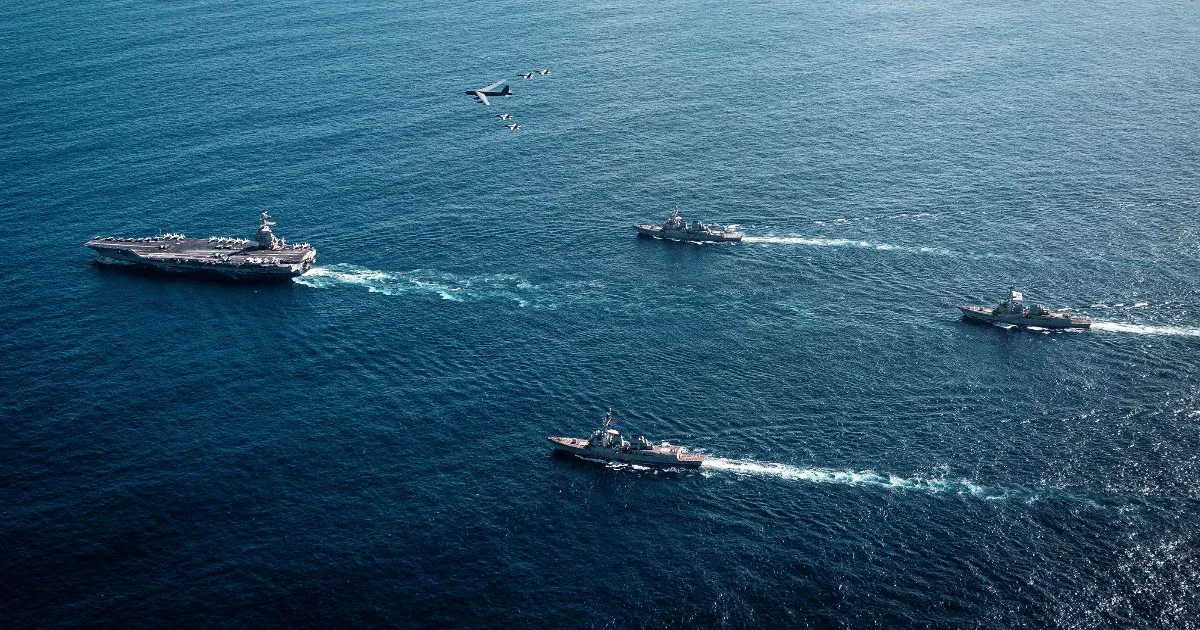
Washington is increasing pressure on venezuela as president trump weighs options for responding to the ongoing political and economic crisis, sending the USS Gerald R.Ford carrier strike group to the Caribbean Sea. While the administration publicly frames the moves as a drug enforcement operation, reports indicate a broader consideration of regime change and access to the country’s vast oil reserves. The situation is intricate by a lack of detailed post-Maduro planning and ongoing dialogue attempts from Venezuelan officials, raising concerns about potential instability in the region.
The world’s largest and most advanced aircraft carrier, the USS Gerald R. Ford, is now sailing in the Caribbean Sea, positioning U.S. forces near Venezuela as the possibility of military action looms. The deployment comes as President Donald Trump weighs options for responding to the ongoing political and economic crisis in the South American nation, a situation that has raised concerns about regional stability.
While the U.S. military appears prepared for potential strikes, awaiting only a presidential order, Venezuelan officials have indicated a willingness to engage in dialogue. Meanwhile, the Trump administration is reportedly considering designating a drug cartel, allegedly led by Venezuelan President Nicolás Maduro, as a foreign terrorist organization. The precise nature of Trump’s plans remains unclear, despite official statements framing the situation as a drug enforcement operation.
Experts fear that the removal of Maduro, who has maintained a firm grip on the economically struggling country, could plunge Venezuela into chaos and civil war. However, according to reports, the White House has yet to formulate a detailed plan for the aftermath of any potential regime change, and Trump’s advisors remain divided on the best course of action.
Trump, known for his unconventional approach, has deliberately maintained an air of uncertainty. “I’ve pretty much made a decision, yes. I can’t tell you what it is, but I’ve pretty much made a decision,” he told reporters on Friday as he traveled to his Florida estate. Prior to his departure, the White House had received briefings for three consecutive days on potential strikes against targets in Venezuela.
Trump Signals Potential Actions
Reportedly, potential targets include military and government facilities, as well as drug trafficking routes. More aggressive options, such as a direct attack on Maduro and the deployment of U.S. special forces, have also been discussed. Pilots aboard the USS Gerald R. Ford are studying Venezuelan air defenses, according to the Washington Post, though they have not yet received orders to attack. Further details on the escalating tensions were previously reported.
On Wednesday, Defense Minister Pete Hegseth and the Chairman of the Joint Chiefs of Staff briefed Trump on the latest plans, which included potential ground strikes, according to CBS News and CNN. The following day, a larger national security team provided Trump with an update on possible courses of action, CNN reported. On Friday, another meeting took place with the participation of the Defense Minister, the Chairman of the Joint Chiefs, Foreign Minister Marco Rubio, and Vice President J.D. Vance.
During a return trip to Washington from Florida on Sunday, Trump indicated a willingness to negotiate with Maduro. “We may talk to Maduro, we’ll see how it goes, they’d like to talk,” he said, offering no further specifics. Simultaneously, the U.S. Navy announced the arrival of the Gerald R. Ford carrier strike group in waters near Venezuela, bringing the total number of American troops stationed in the region to 15,000.
The State Department announced plans to designate the Cartel de los Soles, a criminal organization allegedly led by Maduro, as a foreign terrorist organization. The cartel is reportedly controlled by high-ranking members of the Venezuelan military and controls the country’s ports, using them for cocaine trafficking.
When asked if this designation would provide a legal justification for military strikes against Maduro, Trump stated it offered an opportunity, but “we haven’t said we’re going to do that.” According to anonymous government officials quoted in the American press, Trump has yet to make a final decision. The Wall Street Journal reported Sunday that an immediate military attack is not expected.
The U.S. government also announced on Sunday that another “drug boat” had been destroyed near Venezuela. Trump’s administration launched what it calls a “war on drugs” in the region in September. With the latest destruction, a total of 22 boats have been destroyed, with the government claiming they were involved in drug smuggling. At least 83 people have died in these operations, which officials justify by claiming the individuals were “narco-terrorists” associated with cartels responsible for drug-related deaths in the United States.
The Trump administration officially characterizes military actions near Venezuela as part of a drug enforcement effort. However, Western analysts suggest the deployment of an aircraft carrier indicates the U.S. may be preparing for more than just a drug war, potentially aiming to remove Maduro from power. They argue the Ford is unnecessary for simply interdicting small vessels and its presence is a clear signal of pressure on Maduro.
Nicolás Maduro venezuelai elnök Trump elleni tüntetésen Caracasban 2019. augusztus 10-én – Fotó: Carolina Cabral / Getty Images
The U.S. has also imposed a $50 million bounty on Maduro and authorized covert operations by the CIA. Deterrence efforts included the deployment of B52 and B1 bombers for training exercises near Venezuela in recent weeks. American officials stated that further bombing runs and demonstrations of force by special operations forces are expected.
U.S. officials claim the deployment of the Ford is intended to increase pressure and gauge Maduro’s reaction, hoping he will either flee or be arrested and face charges in a U.S. court for drug trafficking, according to a high-ranking European official speaking to the New York Times. They admitted, however, that they had not conducted a thorough risk assessment before taking this step.
No Post-Maduro Plan
While several military action plans have been developed, there is no clear strategy for what would happen if Maduro were to leave power, the New York Times reported. A similar conclusion was reached by a leading foreign policy reporter at Politico, who investigated the question.
Trump’s team is not known for long-term planning, according to Politico. The publication noted that even considering the various possibilities is noteworthy. According to their sources, only a small number of people within the departments and the White House are working on the issue, and they are seeking assistance from outside analysts and former government officials. There are no comprehensive, president-approved plans for the post-Maduro period, and coordinated discussions are lacking.
Former government officials and Venezuela experts who spoke to Politico expressed concern that different government agencies are not communicating with each other and that the White House has not consulted with experienced officials on the matter. “We have a concept of a plan,” one government official told the publication. Sources indicate that discussions within the U.S. government are focused on potential options, such as providing economic assistance to a new leadership, arresting Maduro, or allowing him to leave for a friendly country.
And, of course, the fate of Venezuela’s vast oil reserves, the largest in the world. The New York Times reported that while Trump publicly frames the actions against Venezuela as a drug enforcement operation, private conversations reveal a greater focus on the president’s legacy and the country’s oil wealth. Discussions are underway to secure U.S. access to Venezuelan oil fields, and the deployment of the aircraft carrier was reportedly necessary for these negotiations, a high-ranking American government official told the newspaper on Friday.
