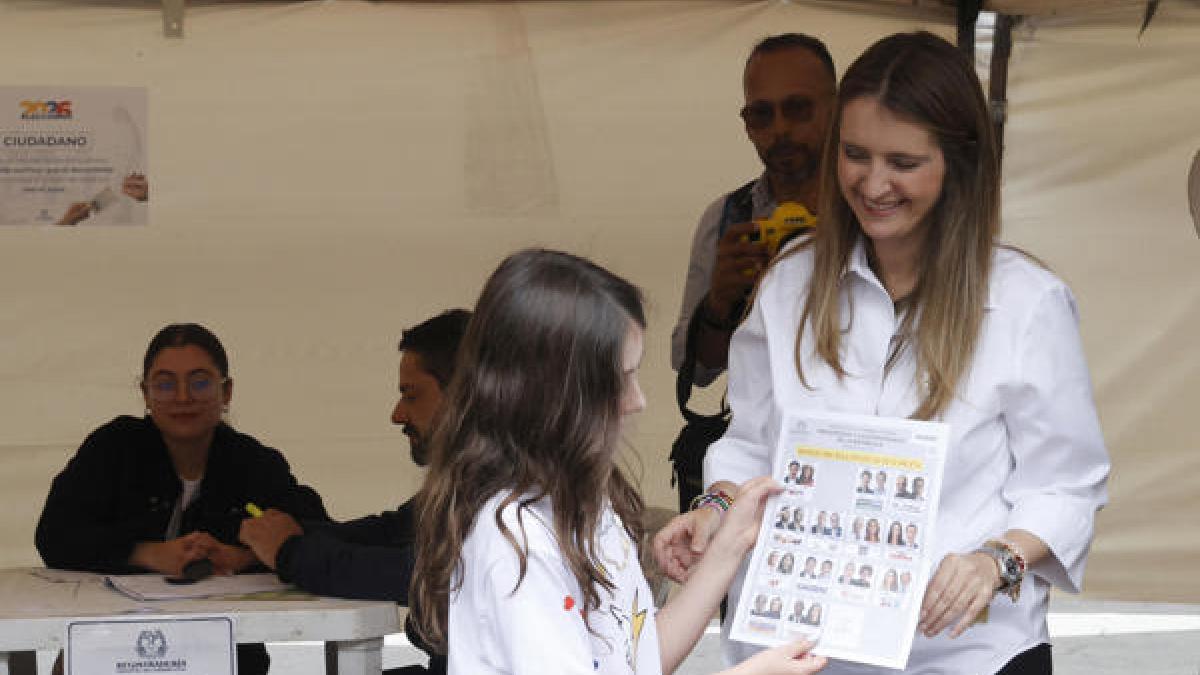
Colombia’s presidential election on May 31, 2026, unfolded under the shadow of a political storm: President Gustavo Petro’s public display of his vote for leftist candidate Iván Cepeda, a move that sparked accusations of electoral interference and reignited debates over the sanctity of the secret ballot. With 41 million voters choosing between 11 candidates—including Paloma Valencia, the first woman to reach a runoff in Colombian history—the election’s legitimacy hinged on Petro’s controversial act, the integrity of the voting system, and the country’s fragile democratic institutions.
Petro’s Vote Leak: A Presidential Breach of Democratic Norms
Petro’s decision to show his marked ballot—supporting Cepeda, his handpicked successor—triggered immediate backlash. The president argued that his vote was a “mandate” from the population, but critics, including the opposition’s Centro Democrático, seized on the moment as evidence of government pressure. “El voto debe ser libre y sin presión,” Petro insisted after voting, yet his public endorsement of Cepeda contradicted his own words. The move violated Colombia’s long-standing tradition of vote secrecy, a cornerstone of democratic elections designed to protect voters from retaliation.
cluster (priority): Portafolio.co
According to La Silla Vacía, Petro’s claims about the electoral system’s opacity were factually flawed. The preconteo (quick count) and escrutinio (official tally) are not handled by private companies but by state officials, judges, and citizens of recognized honorability—including jurados de votación (elected jurors) and delegates from the Consejo Nacional Electoral (CNE). Yet Petro’s rhetoric echoed earlier controversies, such as the 2014 Mira scandal, where a private software provider was accused of manipulating results in 1.4% of voting tables. A 2018 Consejo de Estado ruling explicitly required that all electoral software be state-owned and developed internally—a mandate Petro’s administration has yet to fully implement.
The president’s actions also raised questions about the Thomas Greg & Sons consortium, the sole private firm contracted for election logistics in 2026. While the Misión de Observación Electoral (MOE) noted that this year’s tender process was more transparent, critics argue that allowing any private entity to handle vote consolidation undermines public trust. Petro’s insistence that “el preconteo y el escrutinio pertenezca a una empresa privada que no se deja auditar” was incorrect: the process involves multiple layers of oversight, including testigos electorales (party witnesses) and CNE auditors. Yet his public correction did little to quell skepticism, especially after he linked his vote to a broader call for vigilance over the results.
“No estoy de acuerdo con que el preconteo y el escrutinio pertenezca a una empresa privada que no se deja auditar.”
— Gustavo Petro, President of Colombia, May 31, 2026
The fallout extended beyond Petro’s personal conduct. His public endorsement of Cepeda—who trails in polls behind right-wing candidates like Abelardo de la Espriella and Valencia—fueled accusations of clientelismo, or political patronage. The opposition’s Centro Democrático accused Petro of using state resources to sway the election, a charge the president denied. Meanwhile, Valencia, who voted in Bogotá’s northern district, framed the election as a historic moment for Colombian women: “Este es nuestro tiempo. La mujer colombiana nunca ha pasado a una segunda vuelta y tengo la impresión de que esta vez lo vamos a lograr porque las mujeres tenemos que tener un lugar distinto en el país y en la política.” Her optimism contrasted with Petro’s divisive tactics, as the race tightened between leftist and right-wing factions.
The Secret Ballot Under Siege: Legal and Democratic Implications
The secret ballot is not just a legal requirement in Colombia—it’s a constitutional guarantee. Article 40 of the Colombian Constitution states that voting must be “personal, equal, secret, free, and direct.” Yet Petro’s actions exposed a tension between democratic norms and political theater. The Procuraduría General de la Nación, led by Gregorio Eljach, clarified that while voters can reveal their choices, doing so publicly—especially for a sitting president—risks undermining the principle itself.
cluster (priority): Revista Semana
“El secreto del voto es una garantía democrática para que a la persona no la vayan a perseguir, para que el patrono no lo bote del cargo, para que no le hagan ningún daño. Es una obligación, es una garantía. Cada quien es dueño de su secreto. Si yo quiero revelar mi secreto, estoy en libertad de hacerlo.”
— Gregorio Eljach, Procurador General de la Nación, May 31, 2026
Petro brazenly shows his vote for Cepeda #politics #news #Uribe #elections
Eljach’s statement reflected a legal nuance: the secret ballot is a right of the voter, not an absolute rule. But Petro’s high-profile disclosure—captured by media and shared across social platforms—amplified the perception of coercion. The Defensoría del Pueblo and Personerías Municipales deployed over 10,000 officials to monitor the election, including 3,505 escrutinio commissions nationwide. Yet the damage was done: by revealing his vote, Petro effectively turned his endorsement into a campaign ad, a move that could influence undecided voters or intimidate opponents.
Legal experts warn that Petro’s actions set a dangerous precedent. While the Consejo de Estado has ruled that vote secrecy is not mandatory, public figures—especially those with state power—have a duty to avoid even the appearance of interference. The Comisión de Investigación y Acusaciones de la Cámara could theoretically investigate whether Petro’s conduct violated electoral laws, but such proceedings would likely drag on until after the runoff. For now, the focus remains on the June 16 runoff, where Cepeda, Valencia, or de la Espriella will face off in a battle that could reshape Colombia’s political future.
Three Candidates, One Race: Who Stands to Gain?
Iván Cepeda (Pacto Histórico): Petro’s protégé, leading the leftist coalition. His campaign has struggled with low approval ratings, but Petro’s endorsement—however controversial—could boost his base. Cepeda’s victory would extend the current government’s progressive reforms, including peace talks with armed groups and economic shifts toward social programs.
Paloma Valencia (Centro Democrático): The right-wing favorite, backed by former president Álvaro Uribe. As the first woman to reach a runoff, her campaign has energized conservative voters wary of Petro’s policies. A Valencia win would likely reverse course on drug policy, security strategies, and relations with the U.S.
Abelardo de la Espriella (Independent): A billionaire businessman with centrist appeal, positioning himself as a pragmatic alternative. His lack of party affiliation could attract disillusioned voters from both sides.
Valencia’s campaign has framed the election as a gender milestone, but her rise also reflects Colombia’s deep political polarization. The country’s 2026 vote marks the first time since 2018 that the left and right are evenly matched, with neither side holding a clear advantage. Petro’s gamble on Cepeda could backfire if voters perceive it as heavy-handed. Meanwhile, Valencia’s message of female solidarity resonates in a country where women make up 51% of the electorate but have never held the presidency.
De la Espriella, meanwhile, has avoided the ideological battles, focusing on economic stability—a critical issue in a country where inflation remains near 12%. His campaign has benefited from voter fatigue with both Petro’s social experiments and Uribe’s hardline policies. If he advances to the runoff, he could position himself as the compromise candidate, though his lack of party infrastructure makes his path uncertain.
The Road Ahead: What’s Next for Colombia’s Democracy?
The immediate challenge is the June 16 runoff, but the deeper question is whether Colombia’s democratic institutions can withstand Petro’s final push. The president’s actions have exposed vulnerabilities in the electoral system, from the role of private contractors to the enforcement of vote secrecy. While the CNE and Registraduría Nacional have vowed to ensure transparency, the damage to public trust is already done.
cluster (priority): La Silla Vacía
One silver lining is the unprecedented civic engagement. Over 860,000 jurados de votación were selected for this election, alongside nearly a million testigos electorales—record numbers that suggest Colombians are taking the process seriously. The MOE and CEET (Centro de Estudios de Derecho Electoral) have deployed observers to monitor for irregularities, including potential indebida manipulación de los sistemas de información, as seen in past elections. Yet without full state control over electoral software—a requirement ignored by Petro’s administration—the risk of technical failures or manipulation remains.
“Se rompe una sentencia del Consejo de Estado (…) que ordenó taxativamente que los software de tipo electoral fuesen propiedad del Estado y desarrollados en sus algoritmos desde y dentro del Estado.
The next 15 days will be critical. If Cepeda wins the runoff, his administration will inherit a polarized Congress and a public skeptical of Petro’s legacy. Valencia’s victory would likely trigger protests from leftist groups, while de la Espriella’s win could lead to a centrist realignment. Regardless of the outcome, Colombia’s 2026 election will be remembered as a turning point—not just for its candidates, but for the health of its democracy.
The bigger question is whether Petro’s actions will have lasting consequences. His public vote revelation may have violated the spirit of electoral law, but it also laid bare the fragility of Colombia’s democratic norms. As the runoff approaches, the focus must shift from personal vendettas to the future: Can Colombia’s institutions recover from this crisis, or is the secret ballot now just another casualty of political warfare?
The answer will determine whether this election marks the beginning of a new era—or the unraveling of one.
Bio:
John Smith is the World Editor at Headlinez.News, leading the global news desk and overseeing international correspondents. With 15 years of field experience across Europe, the Middle East, and Asia, John has reported from conflict zones, summits, and humanitarian missions. His deep understanding of geopolitical trends and cross-cultural reporting ensures that readers receive accurate, balanced perspectives on world events that shape the global narrative.
Expertise: International reporting, geopolitics, diplomacy, conflict journalism, foreign policy analysis.
Location: London, United Kingdom