

The Lowy Institute reported on June 14, 2026, that China has developed the military capability to strike the Australian mainland with ballistic missiles. The report identifies the DF-27 intermediate-range ballistic missile as a primary threat, noting that Beijing’s expanding hypersonic arsenal and increased naval reach have fundamentally altered Australia’s security outlook.
The Shift in Strategic Threat Assessment
The assessment from the Lowy Institute marks a significant departure from previous security discourse in Canberra. While the report acknowledges that Australia’s most immediate risks—such as cyberattacks, the severance of undersea communication cables, and the disruption of maritime trade—remain critical, it emphasizes that the threat of direct kinetic strikes is no longer theoretical.

According to reporting by Central News Agency (CNA), the risk is compounded by China’s construction of artificial islands in the South China Sea. If Beijing chooses to deploy DF-26 anti-ship ballistic missiles to these outposts, the range would effectively cover northern Australia. The report further notes that China’s naval capacity, including the world’s largest fleet by ship count, provides the People’s Liberation Army (PLA) with the ability to project force far beyond its traditional coastal waters. This transition represents a shift from a focus on regional defense to a posture that must account for long-range, precision-strike capabilities capable of bypassing traditional maritime buffers.
Technical Capabilities of the PLA Rocket Force
Central to the institute’s warning is the deployment of the DF-27, a system that U.S. military assessments from late 2025 indicated has a range between 5,000 and 8,000 kilometers. As on.cc detailed, this capability allows China to strike Australian territory directly from the Chinese mainland.
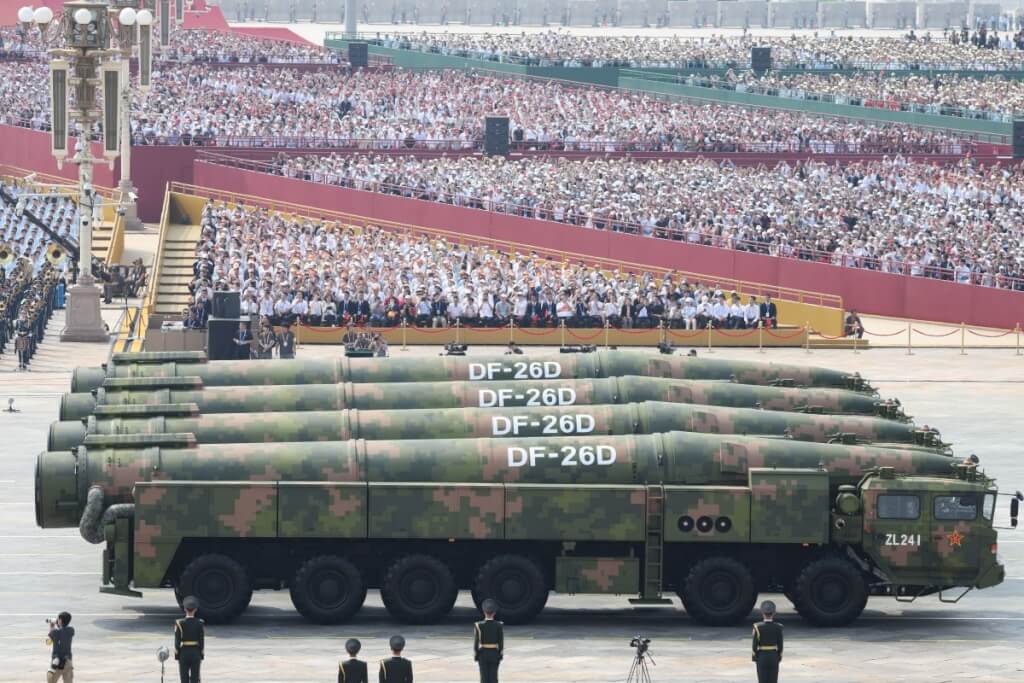
The report outlines several key developments in China’s military modernization that contribute to this heightened risk:
- Missile Evolution: The DF-27 could potentially function as an intercontinental ballistic missile equipped with conventional warheads.
- Aviation Reach: While current H-6 bombers rely on South China Sea bases or aerial refueling to reach Australia, the future development of new long-range bombers would significantly lower the threshold for such strikes.
- Naval Expansion: China’s shipbuilding capacity, reportedly over 200 times that of the United States, ensures a sustained growth in both surface combatants and submarine fleets capable of long-range operations.
These developments occur within the framework of the PLA’s “Anti-Access/Area Denial” (A2/AD) strategy, which aims to deter external powers, particularly the United States and its allies, from intervening in conflicts near China’s periphery. By extending the reach of its missile forces, the PLA is effectively signaling that the “tyranny of distance”—long considered Australia’s primary geographic defense—is being eroded by technological advancements in propulsion and guidance systems.
Diplomatic Rebuttal and Strategic Misinterpretation
Beijing has dismissed the report’s findings as a strategic misjudgment. During a regular press conference on June 15, Chinese Foreign Ministry spokesperson Lin Jian stated that China’s military growth is intended solely for national sovereignty and security, not to target any specific nation.
As reported by Wen Wei Po, the ministry characterized the report as an attempt to mirror China through the logic that a strong nation is inherently expansionist. “We advise relevant institutions to stop exaggerating the so-called ‘China threat’ and to view China’s development objectively, fairly, and rationally,” Lin said. This diplomatic friction reflects a broader trend in the Indo-Pacific, where China consistently frames its military expansion as a necessary modernization to protect its expanding global economic interests and sovereign claims, while regional neighbors and the United States view these same assets as destabilizing, offensive capabilities.
The Domestic Debate in Australia
The Lowy Institute’s findings have ignited a debate regarding how transparent the Australian government should be with the public about potential conflicts. UDN reported that the administration of Prime Minister Anthony Albanese has remained cautious about publicly discussing the possibility of direct strikes on the mainland, despite having spent the last three years restructuring national defense strategy to deter adversaries approaching from the north. This restructuring has included the acquisition of long-range strike capabilities through the AUKUS partnership, an trilateral security pact between Australia, the United Kingdom, and the United States, designed to enhance interoperability and provide Australia with nuclear-powered submarines.

“I think the growth of the PLA is the most significant event for Australian security since the collapse of the Soviet Union, and there is an urgent need for a more informed public discussion on this.” — Sam Roggeveen, Director of the International Security Program at the Lowy Institute
The report suggests that as these weapon systems reach operational capacity over the next decade, the strategic environment for Australia will become increasingly complex. With 99% of Australia’s international trade reliant on sea routes and 95% of data transmission dependent on undersea cables, the vulnerability of these infrastructure points remains the primary concern for defense planners, even as the risk of direct ballistic threats continues to climb. The challenge for Canberra lies in balancing the maintenance of its critical economic relationship with Beijing against the increasingly tangible requirements of national survival in a contested maritime theater.
Find more reporting in our World section.
