
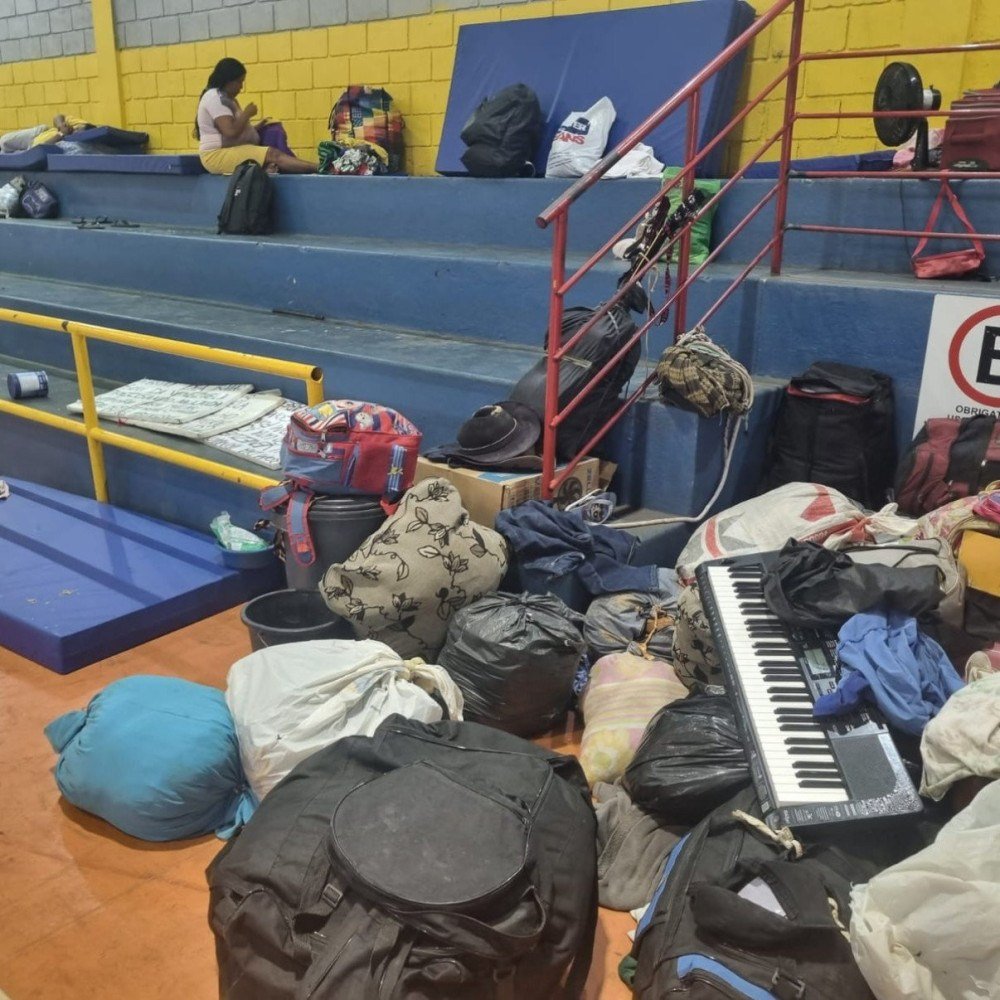
A group of 41 Indigenous Venezuelan refugees, including pregnant women and children, are currently receiving temporary assistance in Montes Claros, brazil, after being abandoned at a bus station following a lengthy journey. While the municipality is providing immediate support, Mayor Guilherme Guimarães has stated the city lacks the capacity and resources to offer long-term housing, highlighting the growing challenge for Brazilian cities grappling with migration from Venezuela and broader regional instability. The situation underscores the need for coordinated federal and international support for displaced populations seeking refuge in Brazil.
The mayor of Montes Claros, Guilherme Guimarães (União Brasil), stated Tuesday, November 18, that while his administration is providing assistance to 41 Venezuelan nationals – seven families of the Indigenous Warao people, including men, women, and children – who arrived in the city on Saturday, November 14, the municipality does not plan to provide long-term housing. He also indicated the city will not rent any properties to accommodate the group permanently.
Guimarães announced he is attempting to contact representatives of the United Nations (UN) to find a solution for the Indigenous Venezuelans, noting their status as “refugees.” He also argued that addressing the situation of the immigrants falls under the responsibility of the federal government – specifically the Ministry of Foreign Affairs, which he intends to urge to take action.
According to the mayor, the city, a regional hub in northern Minas Gerais, “does not have the capacity” to provide permanent housing for the immigrants, citing “cultural issues” related to the Indigenous group as a contributing factor.
The Indigenous Venezuelan group – comprised of seven men, seven women, four of whom are pregnant, and 27 children – was left at the Montes Claros bus station early Saturday morning. They traveled from Itabuna, Bahia, a distance of 681 kilometers, on a bus funded by the Itabuna municipal government. Prior to arriving in Itabuna, the Venezuelans had spent five years in João Pessoa, Paraíba, according to reports.
On Saturday, the families were taken to a temporary shelter at the Ana Lopes Polysport Gymnasium, where they received support from the local government, including mattresses, hygiene kits, and food. They remain at the gymnasium, where they are also receiving social assistance and healthcare services provided by the municipality.
In an interview with Estado de Minas, Mayor Guimarães described the situation as “extraordinary” and criticized the manner in which the Itabuna government transported the Venezuelans to Montes Claros. “A municipal government in the interior of Bahia sent 41 people to Montes Claros in a rather undignified way, abandoning their belongings at the bus station and putting these people at risk,” he said.
“So, out of humanitarian concern, the city government provided immediate assistance and took them to a gymnasium, and the entire city team – several departments including Health, Education, Social Development, Civil Defense, and Security – worked to provide this temporary reception.”
Guimarães identified the primary obstacle to the Warao people’s long-term stay in Montes Claros as the group’s Indigenous identity and cultural background, stating they are “not adapted – as I see it – to our conditions.”
“We understand that they are seeking asylum in Brazil, fleeing a dictatorial regime and a host of economic and moral problems. They arrived on Saturday and are currently sheltered in a gymnasium, but this is only a temporary solution. We are already in contact with oversight agencies, such as the Public Prosecutor’s Office and the Federal Police, to resolve the situation,” the mayor of Montes Claros explained.
“Now we are seeking contact with representatives of the UN, given their status as refugees, to find a solution for these people,” Guimarães said. He further argued, “This is a national issue, not a local one. It has to do with the entire aspect of the Ministry of Foreign Affairs, especially regarding asylum seekers.”
“Montes Claros has no capacity to receive them. We understand their culture, but we will not allow children here in Montes Claros to be begging… or anyone, for that matter. Therefore, we do not have the appropriate conditions to accommodate them. The city government of Montes Claros will not rent any houses for them to stay permanently,” Guimarães assured.
“So, the search now is to find a place that will receive refugees with these characteristics. They are an Indigenous people, and we understand their culture, but we do not have the conditions to receive them permanently here,” he stated.
He added, “Our shelters, while not extensive, seek to serve the local community. Those who come from outside, who are in a situation of homelessness, we try to convince them to return to their cities, and we will continue this work of persuasion and, above all, of identifying a municipality that has the capacity to receive them.”
Belo Horizonte as a possible destination for Venezuelans
The mayor of Montes Claros suggested that the state capital, Belo Horizonte, could be a potential destination for the Indigenous Venezuelans. “It appears that Belo Horizonte has the necessary infrastructure in this regard. Therefore, the city government is contacting them to facilitate a dignified transfer to this appropriate location, which will not be Montes Claros. It is important to say that,” he emphasized.
A welcoming city
Guilherme Guimarães affirmed that the city government welcomed the Venezuelans and placed them, temporarily, in a makeshift shelter, offering full support in terms of food and healthcare, because Montes Claros is “a welcoming city.” “It is important to emphasize that Montes Claros has always been a welcoming city, but we understand that this situation is unusual,” he said.
Siga o nosso canal no WhatsApp e receba notícias relevantes para o seu dia
He stressed that finding a solution for the Venezuelans’ destination is the responsibility of the federal government. “This is an issue that is not at the municipal level, but at the federal level. We will urge the federal government to take action to ensure that these people are sent to a place with dignity, because this is not the place for them,” the municipal executive declared. The situation underscores the challenges faced by Brazilian municipalities in responding to migration crises.
