

Wall Street Investors Shift Funds from Palantir to Nvidia Amid AI Boom
Several prominent Wall Street firms are reallocating capital away from data analytics company Palantir Technologies and toward semiconductor manufacturer Nvidia, according to recent filings with the Securities and Exchange Commission (SEC).
SEC Form 13F data reveals that Citadel, founded by Ken Griffin, reduced its Palantir holdings by 48%, offloading 639,935 shares during the second quarter. Stanley Druckenmiller’s Duquesne Family Office completely exited its Palantir position, which at the start of 2024 held 769,965 shares. Ray Dalio’s Bridgewater Associates followed a similar pattern, dumping its remaining Palantir stake by the first quarter of 2025. This shift in investment comes as investors assess valuations in the rapidly evolving artificial intelligence landscape.
Conversely, these firms are increasing their investments in Nvidia, which has seen its stock surge alongside the growth of AI. Coatue Management, led by Philippe Laffont, increased its Nvidia position by 34%, adding 2,942,694 shares in the second quarter. Citadel took an even more aggressive approach, purchasing 6,513,348 shares – a 414% increase. Nvidia’s stock has climbed 55% since its stock split on June 10, 2024, and is now considered a key indicator of the AI market’s health, as detailed in analysis by investment analysts.
Analysts suggest the moves are driven by valuation concerns, with Nvidia’s price-to-sales ratio currently at 28 and forward price-to-earnings multiple at 42 – multiples that, while high, have moderated from earlier peaks. Palantir’s valuation multiples, however, continue to expand. The increasing demand for AI infrastructure, particularly in areas like robotics and autonomous systems, is fueling continued confidence in Nvidia’s potential, according to experts at the SEC. This trend highlights the growing scrutiny investors are applying to AI-related stocks as the market matures.
Officials at the firms involved have not yet commented on future investment strategies, but further 13F filings in the coming months will provide additional insight into these trends.
Some of Wall Street’s largest money managers are locking in gains in Palantir and doubling down on an AI chip stock.
Following the end of each calendar quarter, institutional investors managing over $100 million in stocks have 45 days to file a form 13F with the Securities and Exchange Commission (SEC). This disclosure provides a detailed snapshot of the “smart money” on Wall Street — revealing which stocks major investors bought and sold during the most recent quarter.
According to recent 13F data, several billionaires have been trimming their stakes in data analytics platform Palantir Technologies (PLTR 0.11%) while reallocating capital toward semiconductor powerhouse Nvidia (NVDA 0.86%).
Let’s take a closer look at who’s making these moves in artificial intelligence (AI) stocks, what might be motivating them, and which company could be the better long-term buy.
Which billionaires are selling Palantir stock?
Below is a look at some of the prominent investors who pared back their exposure to Palantir in recent quarters.
- Citadel is a multi-strategy hedge fund that was founded by billionaire Ken Griffin. During the second quarter, the company offloaded 639,935 shares of Palantir, reducing its position by 48%. Interestingly, Citadel also holds both put and call options on the stock — suggesting that its Palantir strategy is less a simple exit and more a tactically hedged position within a broader, sophisticated trading framework.
- Stanley Druckenmiller is a legend on Wall Street, perhaps best known for his tenure managing money for George Soros before turning his focus to his own capital through the Duquesne Family Office. At the start of 2024, Duquesne held 769,965 shares of Palantir. But nearly a year later, the company had fully exited its position. This move wasn’t entirely unexpected. Duquesne has a history of trading Palantir opportunistically, adding or trimming exposure in step with the stock’s sharp volatility.
- Ray Dalio, the billionaire founder of Bridgewater Associates, has taken a similar approach to that of Duquesne. Throughout 2024, Bridgewater’s trading activity in Palantir followed a pattern of cautious trimming and rebalancing. By the first quarter of 2025, however, it had dumped its remaining position — and, as of now, has not reinitiated a stake in the stock.
Image source: Getty Images.
Which billionaires are buying Nvidia stock after its generational rally?
Between the public debut of OpenAI on Nov. 30, 2022, and Nvidia’s most recent stock split on June 10, 2024, shares of the chipmaker soared by 620%. Nvidia isn’t merely a beneficiary of the AI revolution — it has become the yardstick by which the entire megatrend is measured.
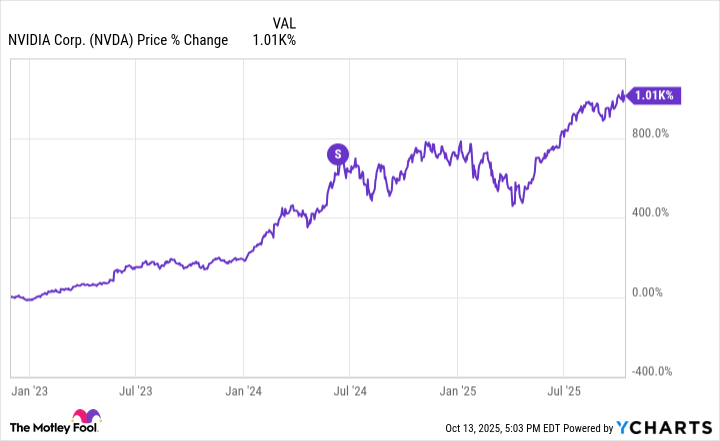
The rally hasn’t stopped there. Since the split, Nvidia’s stock has climbed another 55% as of this writing (Oct. 13). While it might be tempting to assume that such momentum can’t last much longer, several notable billionaires appear to see things differently:
- During the second quarter, Coatue Management — the hedge fund founded by Philippe Laffont — boosted its position in Nvidia by 34%, adding 2,942,694 shares to its holdings.
- Griffin’s Citadel took an even more aggressive stance, purchasing 6,513,348 shares and increasing its stake by an impressive 414%.
Palantir vs. Nvidia: Which AI stock is the better buy?
When considering why some billionaires may be rotating out of Palantir and doubling down on Nvidia, one explanation stands out: Valuation.
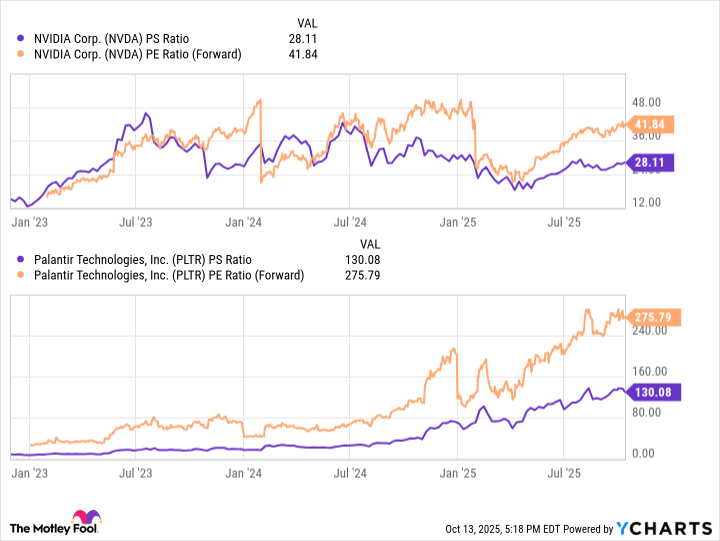
NVDA PS Ratio data by YCharts.
As shown in the chart above, Nvidia currently trades at a price-to-sales (P/S) ratio of 28 and a forward price-to-earnings (P/E) multiple of 42.
While the company’s market capitalization has surged to record highs — making it the most valuable company in the world — its valuation multiples have actually moderated. In other words, both its current P/S and forward earnings ratios sit below the peaks reached earlier during the AI revolution.
These same dynamics do not apply to Palantir. As the figures above illustrate, Palantir’s valuation multiples have continued to expand, suggesting that investors are now pricing the stock to perfection amid increasingly bullish growth expectations.
For sophisticated investors like Laffont and Griffin, these trends likely represent an opportunity. They appear to be betting that continued investment in AI infrastructure, along with new trillion-dollar opportunities in fields like robotics, autonomous systems, and even crypto, have yet to be fully reflected in Nvidia’s share price — leaving meaningful upside potential from current levels. In my eyes, savvy investors are choosing to lock in profits and rotate their capital into more reasonably valued assets.
While I think Palantir stands to benefit from broader AI-driven tailwinds, its current valuation profile looks frothy at best and unsustainable at worst. For this reason, I see Nvidia as the better buy over Palantir right now.
Adam Spatacco has positions in Nvidia and Palantir Technologies. The Motley Fool has positions in and recommends Nvidia and Palantir Technologies. The Motley Fool has a disclosure policy.
