
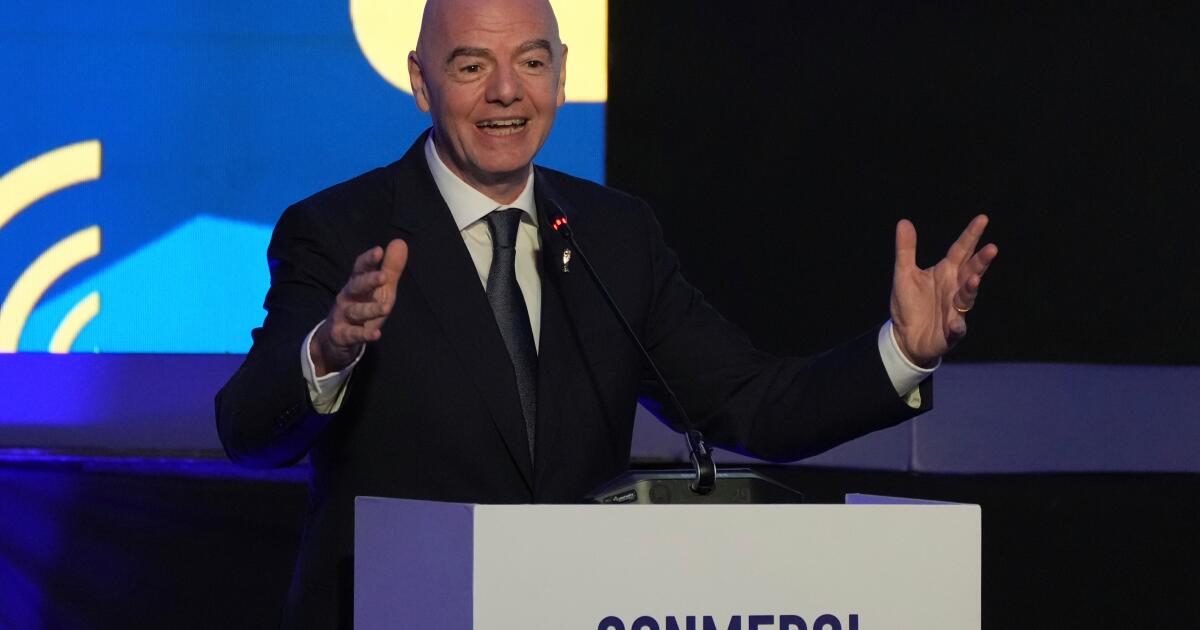
FIFA will distribute over $100 million in additional cash to national teams competing in the 2026 World Cup to offset higher-than-expected costs. The governing body, which anticipates at least $11 billion in tournament revenue, increased basic federation payments to a minimum of $12.5 million for the upcoming June 11 kickoff.
Financial Adjustments for the 2026 World Cup
:format(jpg):quality(99):watermark(f.elconfidencial.com/file/bae/eea/fde/baeeeafde1b3229287b0c008f7602058.png,0,275,1)/f.elconfidencial.com/original/846/1b2/120/8461b21202d34637f1e7c078798bc568.jpg "cluster (priority): El Confidencial")
The FIFA Council, meeting in Vancouver, finalized an agreement on Tuesday to bolster financial support for the 48 participating federations. The move follows concerns from several member associations, particularly those from Europe, that the tournament’s existing prize structure and preparation payments would lead to net financial losses unless teams advanced deep into the knockout stages.
Under the new agreement, support for pre-tournament training and related expenses will rise from $1.5 million to $2.5 million per team. Additionally, the basic prize payment for each federation will increase by $1 million, bringing that specific allocation to $10 million. These adjustments are part of a broader, total prize fund of $655 million announced last December.
Beyond direct cash injections, FIFA has committed $16 million in additional subsidies to assist with delegation costs. The organization is also increasing the number of tickets allocated to each federation. These measures arrive as teams navigate the logistical complexities of hosting the tournament across the United States, Canada, and Mexico, where varying tax obligations and travel requirements have created significant financial pressure on participating nations.
Logistically, the updated financial package addresses the extended duration of team stays. Per the recent council decision, the covered hotel costs for participating squads are set to begin five nights prior to a team’s opening match and will continue until one night following the team’s elimination from the competition. This expansion in coverage is intended to provide greater stability for federations managing the high costs of base camps across the three host nations.
Legal and Commercial Impacts of the Global Tournament
The economic ripple effects of the 2026 tournament extend far beyond the pitch, driving a surge in activity for legal firms specializing in sports law. According to El Confidencial, nearly 70% of large law firms expect their sports law revenue to increase in the coming season, fueled by the complex fiscal and intellectual property structures required by teams and star players.
Legal experts observe that the primary driver of this activity remains men’s professional football, with high-value mandates in mergers and acquisitions, litigation, and arbitration. Roberto Álvarez, a partner at Cuatrecasas, notes that the focus for these firms is highly specific: “Patrocinios, ‘ambush marketing’ y temas fiscales,” he explained.
These legal challenges are corroborated by data from the FIFA World Cup 2026 Socioeconomic Impact Analysis, which projects total event-related expenditures around $13.9 billion. As teams and businesses prepare, they are navigating a landscape where intellectual property protections are strictly enforced. Non-official sponsors face significant risks if they attempt to associate their brands with the event, with potential fines reaching 250,000 UMAs—roughly 29.3 million pesos—for engaging in unauthorized ambush marketing.
The regulatory environment surrounding the tournament has forced law firms to expand their specialized departments. Beyond standard contract law, attorneys are increasingly tasked with managing the interplay between host-country tax regulations and the internal revenue distribution policies of the federations. This is particularly relevant for the 48 teams, each of which must reconcile their domestic financial commitments with the tax requirements of the United States, Canada, and Mexico.
Sponsorship Dynamics and Long-Term Strategy

For official partners, the World Cup remains a cornerstone of global marketing strategy. The financial stakes are immense, with marketing revenue for the 2027–2030 cycle projected to reach $4.6 billion, a 61% increase over the previous period. Experts suggest that the exclusivity granted to these partners justifies the high entry cost, which averages between $100 million and $150 million per four-year cycle.
Michel Desbordes, a professor at the University of Lausanne, describes the commitment required for successful sponsorship as enduring:
“El patrocinio es como un matrimonio. Cuanto más tiempo se lleva, más difícil es salir de él.” Michel Desbordes, Universidad de Lausana
This sentiment is shared by industry leaders who emphasize that brand effectiveness in such a high-profile environment requires multi-year consistency. Ricardo Forte, a former global sponsorship executive at Visa and Coca-Cola, noted to France 24 that while prestige is a factor, collaborations must ultimately satisfy concrete business objectives.
The competition for sponsorship slots remains high, as the tournament serves as a primary vehicle for global brand visibility. As the countdown to the June 11 opening match at Estadio Azteca continues, the financial architecture of the tournament—from the $100 million in team subsidies to the rigorous enforcement of intellectual property—reflects an event attempting to balance massive commercial scale with the practical needs of its 48 national participants. This balance is critical, as the success of the tournament relies on both the participation of top-tier federations and the sustained investment of the corporate partners who fund the infrastructure of the global game.
