
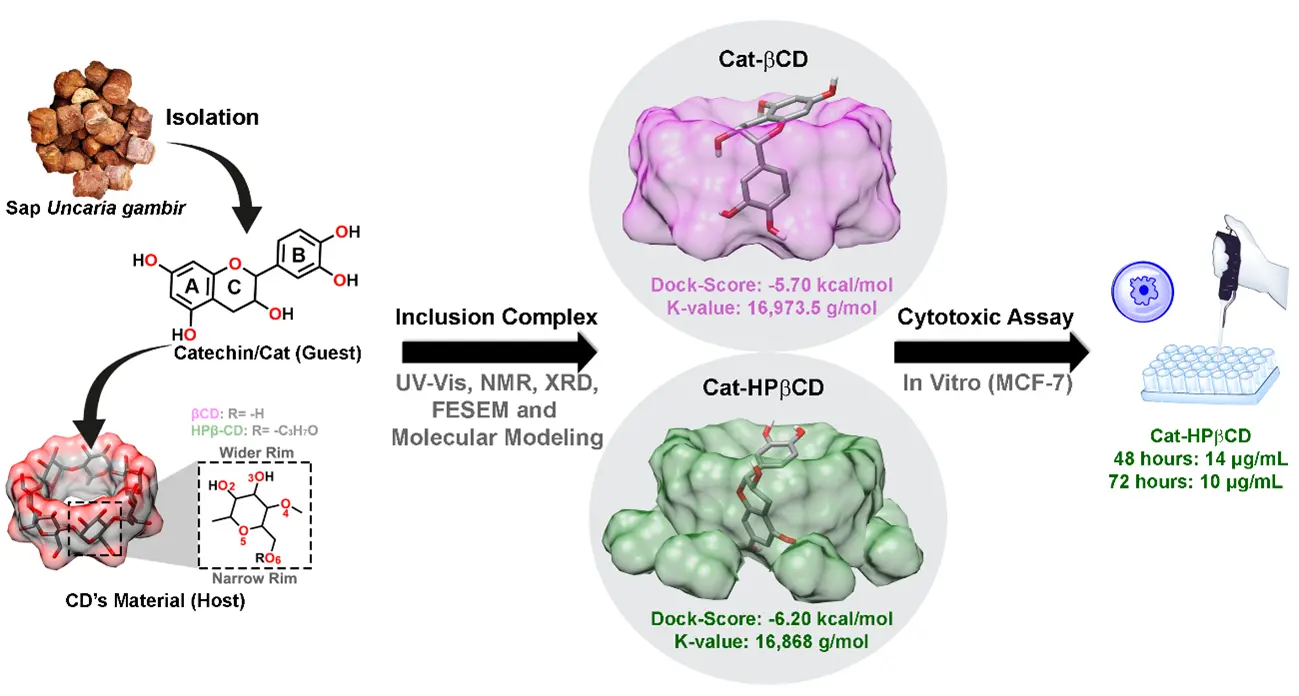
A naturally occurring compound found in teh Indonesian plant Uncaria gambir is showing promise in early research as a potential new weapon in the fight against breast cancer.The study, published this month, focuses on enhancing the delivery of catechins-powerful anti-cancer agents-from the plant, which has a long history of use in customary Indonesian medicine and accounts for roughly 80% of the global gambir export market.Researchers are now exploring how improved bioavailability of these compounds could lead to innovative therapeutic strategies.
A compound found in a plant widely used in traditional Indonesian medicine shows promising potential in fighting breast cancer, according to new research. The study, focused on the plant Uncaria gambir, suggests a way to improve the delivery of its potent anti-cancer agents, potentially paving the way for new therapeutic approaches.
Indonesia is the world’s leading exporter of gambir, supplying approximately 80% of the international market. Most of the production, estimated at 2,491 tons in 2018, comes from small-scale farms in West Sumatra. Traditionally, gambir is extracted with hot water from the leaves and stems of the Uncaria gambir plant and has been chewed as a herbal remedy for conditions like diarrhea and as an antioxidant.
For centuries, traditional healers have used Uncaria gambir to treat a range of ailments, including wounds, stomach ulcers, fever, asthma, rheumatism, high blood pressure, headaches, gastrointestinal issues, and bacterial or fungal infections. Many of these conditions are linked to chronic inflammation and oxidative stress – processes also implicated in cancer development. This historical use sparked interest in the plant’s potential anti-cancer properties, particularly due to its high concentration of polyphenols.
Chemically, gambir consists of 7.63–23.16% water, 12.24–24.16% tannins, 14.76–86.71% catechins, 1.43–25.24% ash, and 5.58–46.28% water-insoluble compounds. Catechins are the most abundant component in gambir, and researchers believe isolating and refining them could significantly increase the product’s value and export potential.
However, catechins have limited solubility in water and low bioavailability, hindering their effectiveness. To overcome this, researchers investigated encapsulating the catechins with β-cyclodextrin (βCD) and hydroxypropyl-β-cyclodextrin (HPβCD) using both experimental and computational methods. Their work, detailed in this research paper, aimed to improve how well the body can absorb and utilize the beneficial compounds.
Structural characterization using field emission scanning electron microscopy (FESEM), X-ray diffraction (XRD), and nuclear magnetic resonance (NMR) spectroscopy confirmed the successful formation of inclusion complexes. HPβCD demonstrated superior amorphization and molecular dispersion, suggesting improved solubility. Further computational studies, including molecular docking and dynamics simulations, showed no significant changes in the catechin’s structure within the cavities of either material.
Notably, the Cat-HPβCD complex exhibited a stronger binding free energy (∆Gbind) through several endpoint free energy approaches. Importantly, the Cat-HPβCD complex demonstrated significant, time-dependent cytotoxic effects against MCF-7 human breast cancer cells, achieving an IC50 value of 14 μg/mL and 10 μg/mL at 48 and 72 hours, respectively. These findings suggest that HPβCD is an optimal carrier for catechins, enhancing their solubility, stability, and anti-cancer efficacy. The research highlights a potential pathway for developing new pharmaceutical applications based on this natural compound.
