
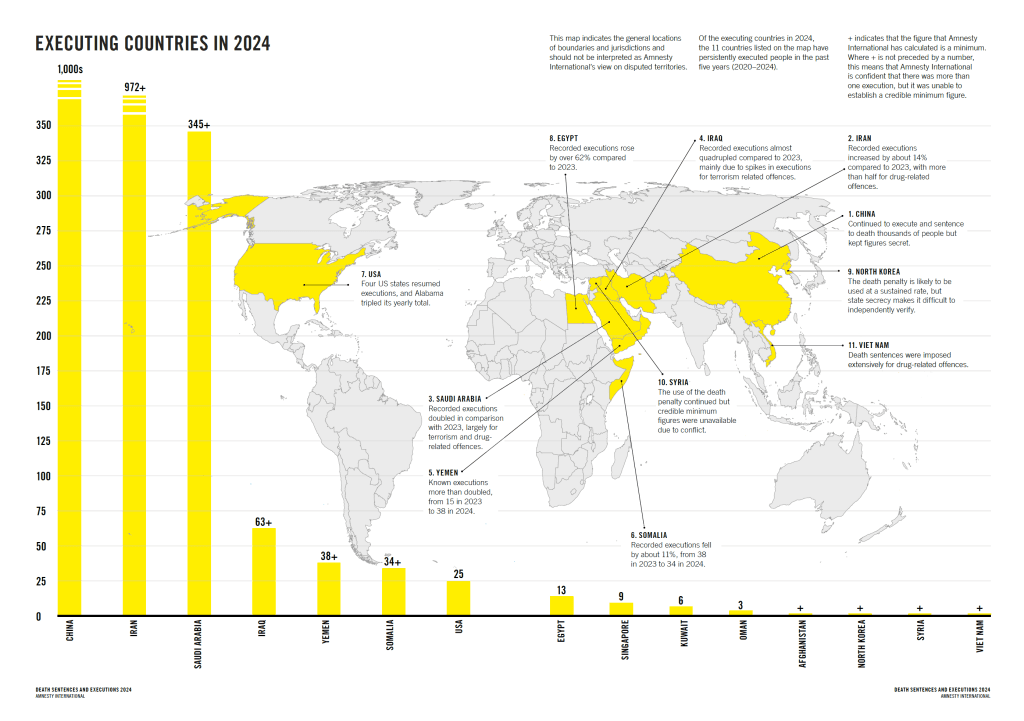
Amnesty International reported on May 18, 2026, that global executions in 2025 reached 2,707, the highest figure recorded by the organization since 1981. This 78% increase from the previous year is attributed by the group to a small number of governments utilizing the death penalty to suppress dissent and exert control.
The latest annual report from Amnesty International, titled Death Sentences and Executions 2025,
highlights a significant reversal in the global trend toward the abolition of capital punishment. According to the organization, at least 2,707 individuals were executed across 17 countries in 2025, a sharp rise from the 1,518 executions documented in 2024. The findings indicate that while the long-term historical trajectory has leaned toward abolition, the 2025 data marks a definitive interruption of that progress, driven by specific state actors prioritizing the use of lethal force.
Regional Drivers of the 2025 Increase
The surge in state-sanctioned killings was concentrated in a small group of nations. Amnesty International identified Iranian authorities as the primary driver of this global trend, reporting that Iran executed at least 2,159 people in 2025—more than double the number recorded in the country the previous year. The intensity of these executions in Iran, according to the report, reflects a systemic escalation in the state’s judicial posture.
Saudi Arabia also saw a marked increase, with at least 356 executions recorded. The report notes that Saudi authorities frequently applied the death penalty in cases involving drug-related offenses, a practice that Amnesty International highlights as a primary contributor to the country’s rising annual tally.
Other nations experienced similarly steep trajectories. Executions in Kuwait nearly tripled, rising from 6 in 2024 to 17 in 2025. Significant increases were also observed in Egypt, where the count rose from 13 to 23, and in Singapore, where executions climbed from 9 to 17. In the United States, the number of executions nearly doubled, rising from 25 in 2024 to 47 in 2025, a shift that the report contextualizes within the broader, albeit localized, resurgence of the practice among a specific subset of nations.
Institutional Perspectives on Capital Punishment
Anna Johansson, Secretary General of Amnesty International Sweden, emphasized that the data reflects a strategic use of the death penalty by a minority of states. In her assessment of the findings, she argued that these governments are operating in isolation from the broader international movement against the practice, deliberately choosing to utilize capital punishment as a political instrument despite international scrutiny.
The total figure for 2025 includes not the thousands of executions that Amnesty believes continued to be carried out in China, which remains the world’s leading executioner.
Amnesty International, Death Sentences and Executions 2025 report
This alarming increase in the use of the death penalty is due to a small, isolated group of states that are willing to carry out executions at any cost, despite the continued global trend toward abolition. Around the world, this minority of states uses the death penalty as a weapon to, among other things, instill fear, crush dissent, and show the power that state institutions have over vulnerable people and marginalized groups.
Anna Johansson, Secretary General of Amnesty International Sweden
Data Limitations and Scope
While the 2025 report provides a granular look at the 17 countries where executions were verified, Amnesty International noted that its global total remains incomplete. The organization continues to believe that thousands of additional executions are carried out annually in China, which remains excluded from the verified count due to the lack of transparent state reporting. Because the Chinese government classifies data regarding the death penalty as a state secret, Amnesty International’s verified count is restricted to countries where judicial proceedings and administrative records are accessible to human rights monitors.
The report underscores that despite the statistical spike in 2025, the majority of the world’s nations continue to move toward the restriction or total abolition of the death penalty. The current figures, however, serve as a stark reminder of the resolve of specific regimes to maintain the practice as a tool of domestic policy and state authority. The findings suggest a hardening of policy in the identified 17 nations, where the death penalty is increasingly utilized to signal state strength to domestic populations.
Amnesty International’s methodology for the 2025 report involved cross-referencing official government announcements, court documents, and reports from local human rights organizations. The organization emphasizes that for many of these countries, the official numbers are likely an undercount, as clandestine executions or those not publicly acknowledged by judicial authorities remain difficult to track. This discrepancy between official state acknowledgment and documented human rights data remains a central challenge in assessing the true scale of capital punishment on a global level.
The report also highlights the specific legal justifications used by these nations, noting that drug-related offenses, acts perceived as threats to national security, and political dissent are frequently cited as grounds for capital sentencing. By documenting these categories, Amnesty International aims to demonstrate that the 2025 increase is not merely a consequence of higher crime rates, but rather a deliberate choice by institutional actors to expand the reach of the death penalty into the social and political spheres of their respective countries.
