
A new statistical tool called HERMES is reshaping how scientists will analyze the atmospheres of 1,000 exoplanets through ESA’s upcoming Ariel Space Mission, with a focus on uncovering population-level trends in planetary composition. Released on June 1, 2026, the framework—developed by researchers Wasi M. F. Naqvi and Nicolas B. Cowan—uses Bayesian modeling to detect correlations between stellar metallicity, planetary mass, and atmospheric chemistry, even when data is noisy or incomplete.
Why HERMES Matters: The Problem It Solves
Exoplanet science has long struggled with a fundamental challenge: how to extract meaningful patterns from limited, noisy data. Most surveys of planetary atmospheres—like those planned for Ariel—collect observations with inherent scatter due to astrophysical variability and measurement errors. Traditional methods often fail when faced with this “intrinsic scatter,” leading to false conclusions or missed correlations. HERMES changes that by treating the problem as a multidimensional Bayesian inference task, where trends are modeled across multiple axes (e.g., stellar metallicity vs. planetary mass vs. atmospheric composition) simultaneously.
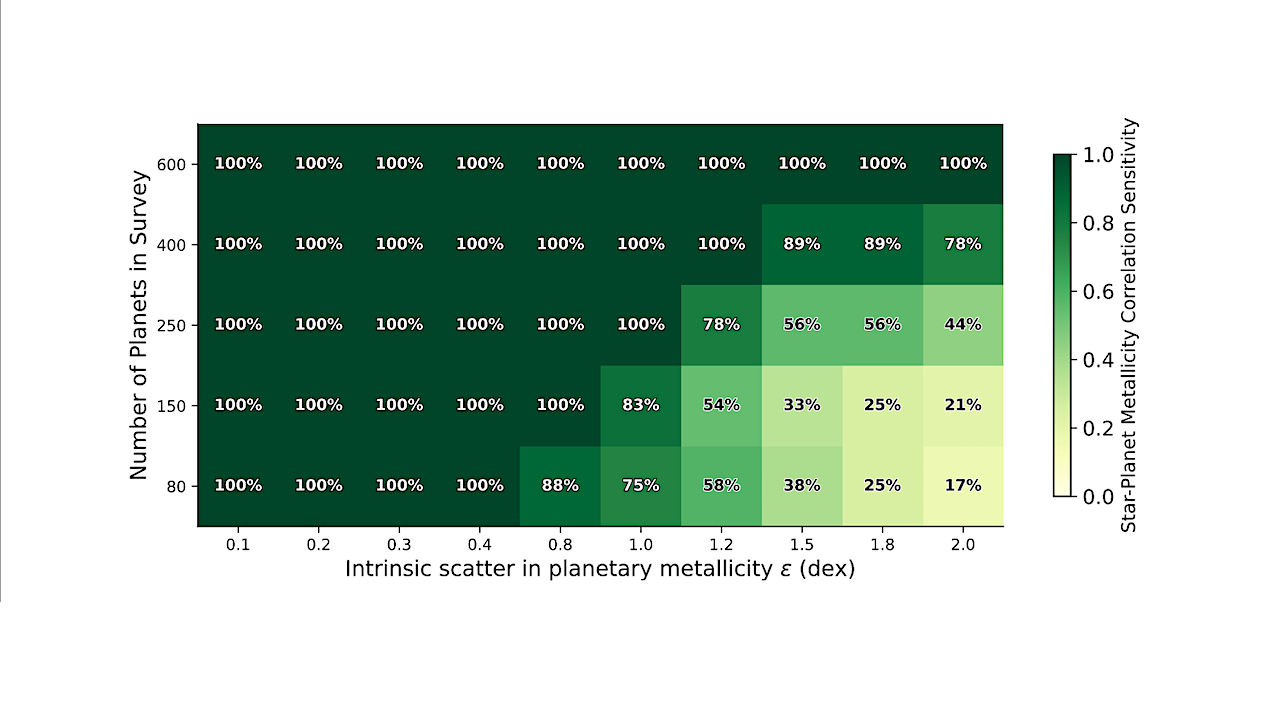
According to the preprint published on arXiv, the framework was tested using simulated surveys mimicking Ariel’s Tier 2 transit sample—at least 400 planets. Even with intrinsic scatter as high as 1.2 dex in planetary abundances, HERMES successfully recovered the correlation between stellar and planetary metallicity. This robustness is critical: smaller or moderate surveys lose sensitivity when scatter exceeds a certain threshold, but HERMES maintains high recovery rates regardless.
The Ariel Connection: A Mission-Ready Tool
ESA’s Ariel Space Mission, set to launch in the coming years, aims to characterize the atmospheres of approximately 1,000 exoplanets to quantify population-level trends—a goal that demands sophisticated analytical tools. HERMES directly addresses this need by providing a way to forecast science yield and optimize survey design. The researchers behind the framework started with the Ariel Mission Candidate Sample (Edwards & Tinetti 2022), selecting confirmed planets with available masses and stellar metallicity, then injected plausible multidimensional trends to test recovery accuracy.
The results are promising: survey leverage—essentially the statistical power derived from sample size and observational depth—remains a reliable predictor of trend precision even in complex, multidimensional datasets. This means mission planners can now estimate how many planets they need to observe to detect specific correlations, accounting for both measurement noise and astrophysical variability. For Ariel, this could translate into more efficient use of telescope time and higher-confidence scientific outputs.
Beyond Ariel: The Broader Impact
While HERMES was developed with Ariel in mind, its applications extend far beyond that single mission. Any survey probing population-level trends in exoplanet science—whether focused on transmission spectra, emission spectra, or other atmospheric signatures—could benefit from this framework. The ability to handle intrinsic scatter and measurement noise makes it particularly valuable for missions with limited observational windows or those targeting diverse planetary systems.
As Astrobiology Magazine notes, the tool also serves as a “practical guide for survey design,” helping researchers balance the trade-offs between sample size, observational depth, and scientific return. This is especially relevant as new exoplanet missions—such as those planned by NASA or private space initiatives—begin to take shape. HERMES could become a standard in the field, much like how Bayesian methods revolutionized fields from genomics to economics.
What’s Next: Validation and Adoption
The next critical step for HERMES is validation against real-world data. While the current study relies on simulated surveys, its success in recovering known trends suggests it could be applied to early Ariel observations or even existing datasets from missions like Hubble or JWST. Researchers will need to test its performance under real-world conditions, where systematic errors and unmodeled variables might introduce new challenges.
Adoption will also depend on how accessible the framework becomes. The preprint on arXiv signals that the code and methods are already available for other researchers to use, but broader uptake may require additional documentation, tutorials, or integration with existing exoplanet analysis pipelines. If successful, HERMES could become a cornerstone of exoplanet science, much like how machine learning tools have transformed fields from medical imaging to climate modeling.
For now, the tool represents a significant leap forward in our ability to make sense of exoplanet data. As Ariel prepares to launch and other missions follow, frameworks like HERMES will be essential in turning raw observations into discoveries about the diversity—and potential habitability—of worlds beyond our solar system.
One thing is clear: the days of treating exoplanet data as isolated points are over. With HERMES, we’re entering an era where population-level trends can be extracted from the noise, revealing the hidden patterns that define entire classes of planets.
