
Here’s a short introductory paragraph to prepend to the provided text:
Honda is re-entering the hotly contested retro-roadster motorcycle market with the new CB1000F,a machine aiming to blend classic styling with modern performance. During a recent discussion with Honda representatives, the focus was on building a bike with a distinct identity-one rooted in the brand’s rich history yet firmly positioned for the future. This excerpt details insights into the CB1000F’s advancement, Honda’s response to increasing competition, and exciting hints about potential future models within the lineup.
Honda’s roadster project lead reveals the company’s strategy and design choices in an exclusive interview. And confirms: it’s already a success in Japan, and poised to be in Europe.
EICMA, the annual motorcycle show, isn’t just a showcase for next year’s models; it’s a crucial meeting point for industry professionals and journalists to delve into the reasoning behind design decisions. This year, headlinez.news secured exclusive interviews with key Honda managers, including Takayuki Haramoto, Large Project Leader (LPL) – the head of the Honda CB1000F project. Given the significant interest in this model, we pressed Haramoto for details, resulting in a lively discussion between enthusiasts that we hope will be of interest to those captivated by this new roadster.
Replacing a Legacy: The CB1300’s Departure and the Arrival of the CB1000F
Table of Contents
- Replacing a Legacy: The CB1300’s Departure and the Arrival of the CB1000F
- Designing for Three Generations of Riders
- Engine Tuning: A Different Character from the CB1000 Hornet
- The Sound of the Four-Cylinder: Engineering Emotion
- Modern Instrumentation: A Necessary Choice
- Enthusiastic Reception in Japan, Europe Still to Discover
- Chinese Competition and Copying: Honda Remains Unconcerned
- Future Plans: Will Additional Variants Arrive?
The conversation began with Honda’s roadster lineup, specifically the impending discontinuation of the CB1300 in Japan with the Final Edition. As Honda considered a replacement for its flagship standard model in its home market, it faced a challenge: adapting to increasingly stringent environmental regulations. This also applied to another iconic Honda model, the CB1100, known for its romantic design and enduring appeal. “The CB1300 and CB1100 struggled to meet current environmental standards,” explained Haramoto. “And even for more mature riders, they had become a bit too heavy.” He shared an anecdote: a friend who had owned every CB model since the original CB750 Four, at age 70, found the CB1100 too cumbersome and switched to a more agile NX500. This experience highlighted the need for a different kind of motorcycle – one that evoked the past but also felt modern. That’s where the CB1000F comes in.
Designing for Three Generations of Riders
The development goal, as outlined by Haramoto, was ambitious: to create a motorcycle that would appeal to younger riders, mid-life enthusiasts, and more experienced riders alike. “We didn’t want to disappoint anyone,” Haramoto stated. This complex challenge was addressed through a balance of heritage aesthetics and modern technology. The motorcycle industry is increasingly focused on appealing to a wider demographic, and Honda’s approach reflects this trend.
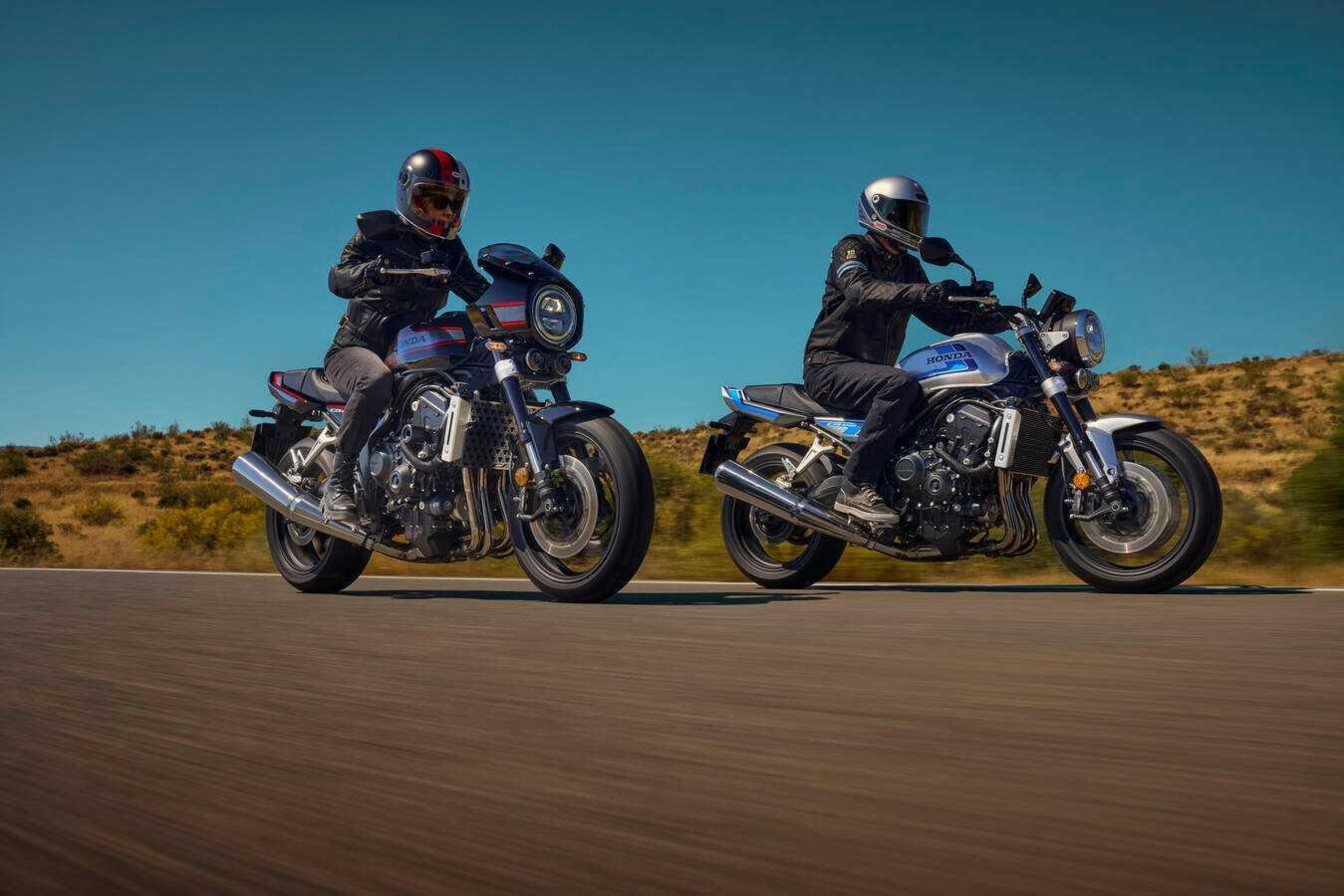
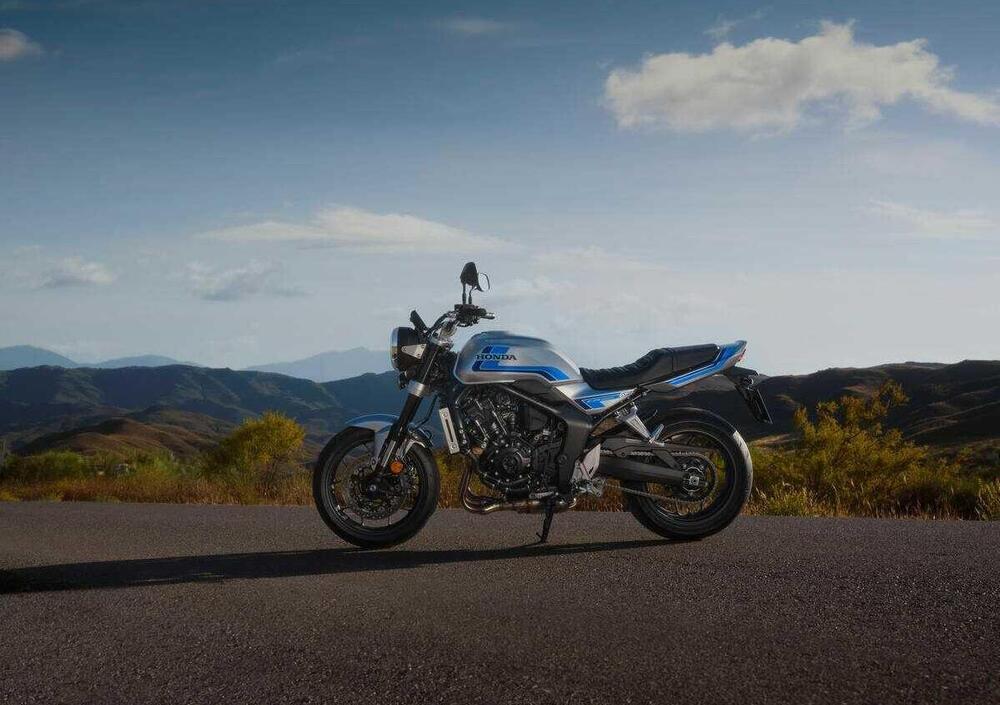
The question arose: wasn’t the design leaning too heavily towards sportiness for a classic roadster? “We wanted to maintain the essence of the 750F design, but not be solely classic,” Haramoto responded. “We’re also targeting younger riders, so we created a standard that’s also a bit traditional, to satisfy a broader range.”
Engine Tuning: A Different Character from the CB1000 Hornet
The most interesting aspect of the interview centered on the engine. The CB1000F shares the technical base with the CB1000 Hornet, but the engine character has been completely transformed.
“With an inline four-cylinder engine, the sound it emits is very important,” Haramoto emphasized, “but so is the power delivery. It’s not as sharp as the Hornet; it’s smoother. We built it this way so that everyone can enjoy the ride.”
The modifications were extensive and systematic: modified valve timing, redesigned intake systems, a new exhaust design, and optimized gear ratios. “Even the bolts were changed,” he said with a smile, confirming meticulous work on every functional component. “We incorporated all the new technologies, and even the actuation has been modernized.”
The result? 124 horsepower at 9,000 rpm compared to the Hornet’s 152 hp might seem like a compromise, but it’s a deliberate choice, offering a different character with power delivery that arrives in the mid-range, far from the redline. This is a character designed for everyday riding, not the aggression of a naked sportbike.
The Sound of the Four-Cylinder: Engineering Emotion
A particular emphasis emerged during the interview: the meticulous attention to the engine sound. Haramoto, visibly pleased, responded without hesitation when asked what he liked most about the CB1000F: “the sound.”
This wasn’t a casual detail. Honda worked asymmetrically on the intake trumpets: 40 mm in diameter for the right pair of cylinders (3 and 4) and 50 mm for the left pair (1 and 2). This irregularity creates a “pulsation” in the sound when the throttle opens, giving the four-cylinder a raw and evocative timbre. We look forward to hearing it to confirm our interviewer’s enthusiasm.
Modern Instrumentation: A Necessary Choice
One aspect drew some skepticism from more traditional enthusiasts: the fully digital instrumentation. When asked why they didn’t opt for instrumentation with a more heritage look, the response was clear and pragmatic: “We didn’t want to do what other brands do with classic models; we want young people to be interested in this motorcycle. A motorcycle that, beyond the lines and taste, also has a lot of Honda technology.” The solution was a compromise: a 5-inch TFT display with optical bonding technology and Honda RoadSync connectivity – a discreet yet functional element of modernity.
Enthusiastic Reception in Japan, Europe Still to Discover
In Japan, the CB1000F has been very well received. For Europe, our interviewee was cautious, commenting only “We hope the response is good,” with typical Japanese reserve but also a hint of Western irony. “We can’t know how it will be received in Europe,” he added, but it’s clear expectations are high. Sales have already begun in the domestic market, with a starting price of 1,397,000 Yen, a figure that isn’t directly comparable to our market. A price closer to that in Germany, where a leaked price of 12,329 euros has surfaced, is more likely.
The Honda CB1000F will be at EICMA! The roadster arrives in Italy in 2026, here are all the details
Chinese Competition and Copying: Honda Remains Unconcerned
The conversation then turned to authenticity and how the design of the CB1000F is a deliberate nod to Honda’s history and originality. A company’s history, Haramoto argued, is a value, not a burden. The question of Asian competition, with some brands drawing inspiration from Honda’s designs, inevitably arose. “Competition is increasing, as you know,” Haramoto responded diplomatically. “Chinese motorcycles are improving in quality, that’s true, but we’re certainly not going to lose any battles. We can count on our authenticity, our history, and our innovation, as well as a global network built on 65 years of reliability.”
Future Plans: Will Additional Variants Arrive?
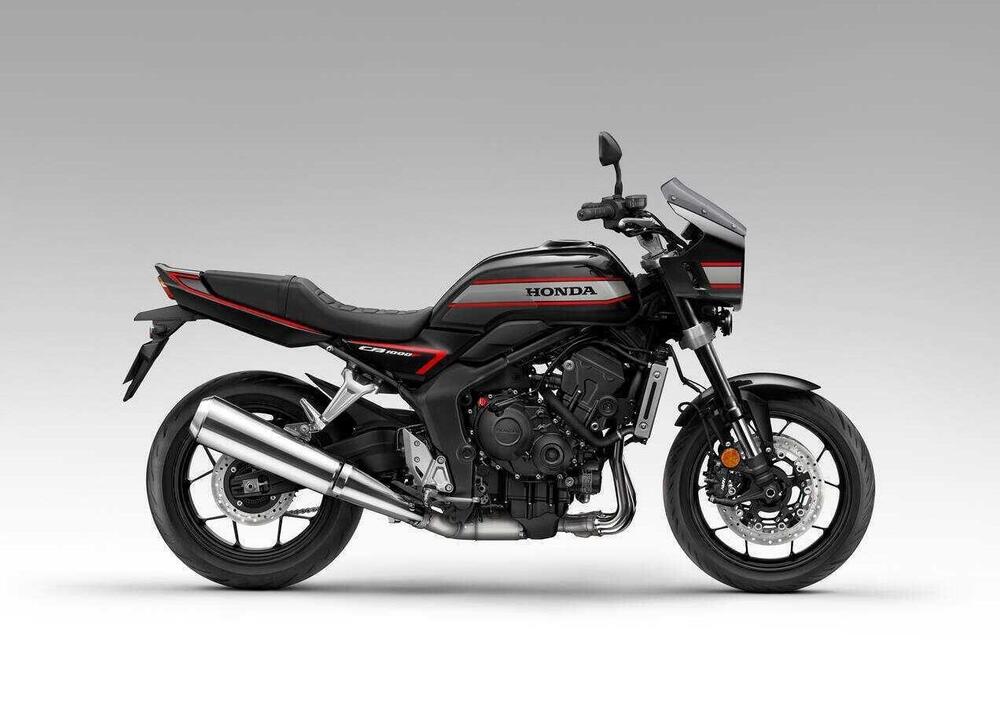
At launch, two trim levels are available: a base model and an SE version distinguished by a windscreen. When asked if the CB1000F would remain the sole model or be joined by others with a similar heritage spirit, Haramoto smiled and declined to comment. But when suggested that a Bol d’Or model would be a welcome addition, his expression changed, and he laughed, admitting it would be nice. He then cautioned that the SE version is already somewhat reminiscent of a Bol d’Or. However, we take this as a hint that interesting scenarios could unfold for the CB lineup in the future, as we’re always hoping for more.
We conclude our conversation, thanking our host for the insightful discussion and for confirming a thoughtful design process that focused on creating a motorcycle with its own personality, rather than simply a vintage-styled Hornet. The success in Japan suggests the goal has been achieved. Will Europe, with its passion for models like the Z900RS, GSX-8TT, and XSR900, appreciate this Honda? The segment is now complete with options for those seeking authentic heritage without sacrificing modern performance – but is it an expanding segment, or will it fragment? We’ll likely find out in 2026, when the CB1000F finally arrives in Italian dealerships.
