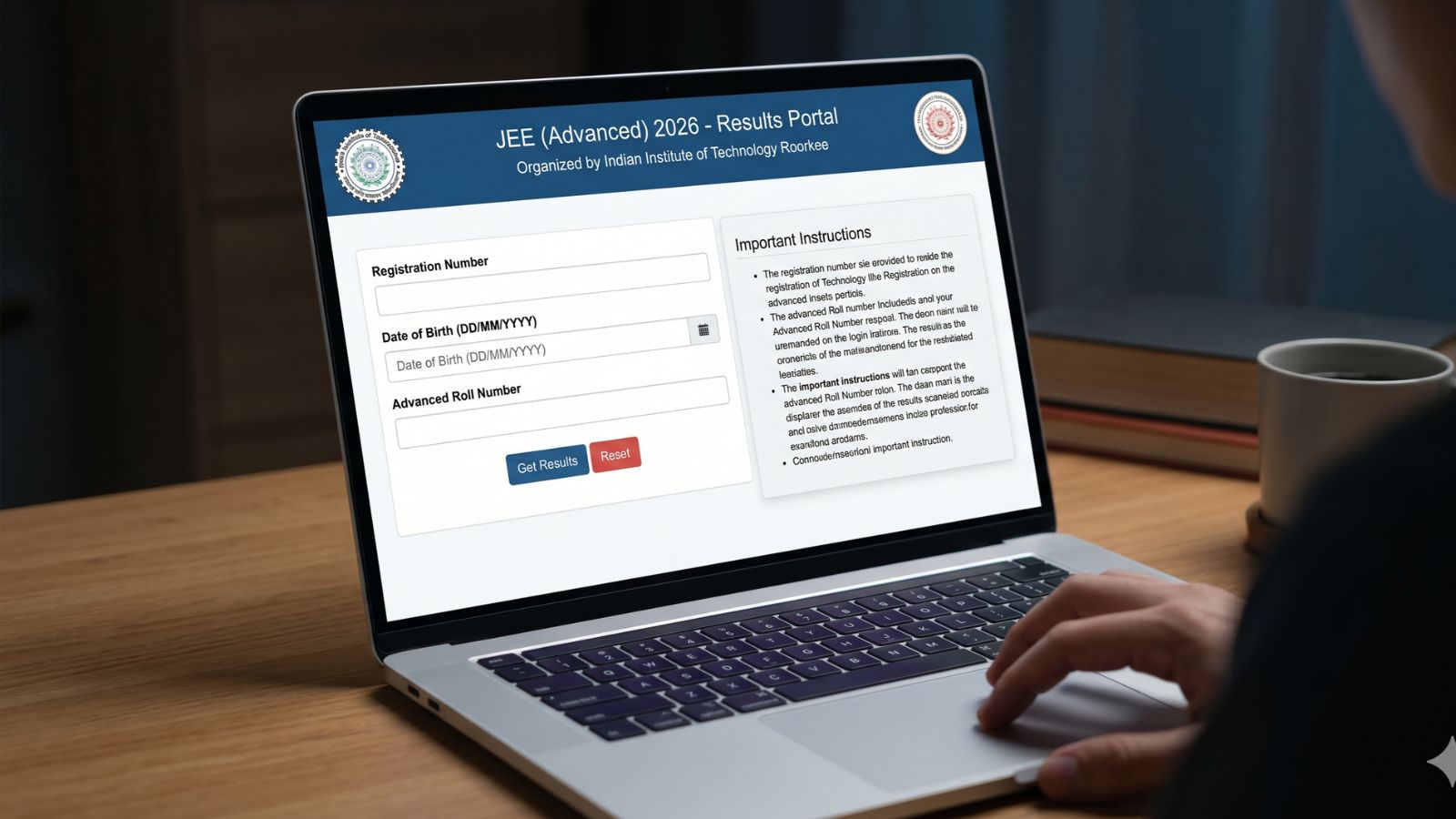
The Indian Institute of Technology (IIT) Roorkee declared the results of the Joint Entrance Examination (JEE) Advanced 2026 on May 31, 2026. From a pool of 1,79,694 candidates who appeared for both papers, 56,880 qualified for admission to undergraduate engineering, science, and architecture programs across India’s premier technical institutions.
A Sweep for the IIT Delhi Zone
cluster (priority): The Indian Express
The merit list for this year’s examination is defined by a singular geographic trend: the absolute dominance of the IIT Delhi zone. Among the top-ranked candidates, the top three spots are held entirely by students from this region. Shubham Kumar secured the All India Rank (AIR) 1, recording an impressive 330 out of 360 marks. He was closely followed by Kabeer Chhillar, who earned 329 marks, and Jatin Chahar, who completed the podium with a score of 319.
The success of the Delhi zone extended to female candidates as well. Arohi Deshpande, also representing the IIT Delhi zone, emerged as the top-ranked female candidate, achieving an overall Common Rank List (CRL) of 77 with a score of 280 out of 360. According to The Indian Express, these results serve as the primary gateway for the upcoming seat allocation process, though officials emphasize that qualifying does not guarantee admission, which remains strictly merit-dependent and subject to seat availability.
Understanding the Qualifying Thresholds
cluster (priority): NDTV
Qualification for the JEE Advanced 2026 was determined by specific subject-wise and aggregate marks, which varied significantly across different categories. To be included in the rank lists, candidates were required to meet the minimum threshold set by the conducting authority.
As reported by Careers360, the qualifying structure for the Common Rank List (CRL) required a minimum of 8 marks in each subject and a total aggregate of 92 marks. For candidates under the OBC-NCL and GEN-EWS categories, the requirement was 7 marks per subject and an aggregate of 82. Those in the SC, ST, and various PwD categories faced a threshold of 4 marks per subject with an aggregate of 46.
Of the 1,87,389 registered candidates, 1,79,694 appeared for both Paper 1 and Paper 2. Among the 56,880 successful candidates, 10,107 are female. While these numbers reflect a steady participation rate, they also underscore the high level of competition for seats in the 23 IITs and other participating government-funded technical institutions.
Navigating the JoSAA Counselling Process
My JEE ADVANCED Storytime to IIT DELHI 🔥
With the results now public, the focus shifts to the Joint Seat Allocation Authority (JoSAA) 2026, which manages the centralized admission process. Registration for counselling is slated to begin on June 2, 2026, according to The Economic Times.
The counselling process is a multi-stage procedure designed to match candidates with their preferred institutions and programs:
Registration: Candidates must log in using their JEE credentials on the official portal.
Choice Filling & Locking: Applicants select their preferred colleges and courses, a critical step that dictates seat allocation.
Mock Seat Allotment: Provides candidates with a preview of potential outcomes based on their current choices.
Final Seat Allocation: Seats are assigned based on rank, category, and the preferences submitted by the candidate.
Reporting & Verification: Once a seat is accepted and the fee is paid, candidates must undergo document verification and report to their allotted institute.
Candidates are required to have a variety of documents ready for this phase, including Class 10 and 12 mark sheets, category certificates, and proof of date of birth. Shiksha notes that students cannot challenge the final answer key, meaning the current results and ranks are definitive.
Institutional Standing and Next Steps
cluster (priority): Shiksha
As students prepare to finalize their academic futures, the hierarchy of engineering institutions remains a central consideration. According to NDTV, the rankings—often influenced by the National Institutional Ranking Framework—continue to place IIT Madras, IIT Delhi, and IIT Bombay at the top of the national list.
For those who have qualified, the next 30 days will be dominated by the intricacies of the JoSAA portal. With thousands of candidates vying for limited spots across 23 IITs and various NITs and IIITs, the choice-filling phase will be the most critical window for students to secure their desired placements. Candidates are advised to monitor the official website regularly for updates on the specific timelines for each of the six rounds of counselling.
ail: emily.johnson@headlinez.news
Bio:
Emily Johnson serves as News Editor at Headlinez.News, overseeing the publication’s coverage of national and breaking stories. She has worked in journalism for more than 12 years, building a reputation for precision, credibility, and rapid-response reporting. Emily’s editorial philosophy focuses on clear, fact-based writing that helps readers understand the full context behind the day’s most important events. Her expertise bridges traditional reporting and modern digital news strategies.
Expertise: Breaking news, political reporting, fact-checking, newsroom coordination, public affairs.
Location: Washington, D.C., USA