
LinkedIn to Use User Data for AI Training in Major Expansion
LinkedIn will begin utilizing profile details, posts, and activity data from users in the UK, EU, Switzerland, Canada, and Hong Kong to train its artificial intelligence models and personalize advertising across Microsoft products, starting November 3, 2025.
The change marks a significant expansion of LinkedIn’s AI training data pool, previously excluding users in these regions. Data included in the program encompasses profile information, public posts, and user activity within the platform, but will not include private messages. This move raises concerns about data privacy and potential misuse of professional information as AI technology rapidly evolves.
Users will have the option to opt-out of having their data used for AI training, but the default setting will be to allow data collection. To disable this feature, users can navigate to Settings & Privacy > Data Privacy > “Data for Generative AI Improvement” and toggle the setting to “Off.” Additionally, users can limit Microsoft-wide ad targeting by adjusting settings under Settings > Advertising Data, toggling off “Ads off LinkedIn,” “Data from others for ads,” “Measure ad success,” and “Share data with affiliates and partners.” For more information on data privacy, see the Federal Trade Commission’s guidance on data privacy.
Microsoft officials stated the data will be used to improve AI features and deliver more relevant advertising experiences. However, security experts warn that increased data availability for AI models could potentially increase the risk of sophisticated, automated phishing attacks. LinkedIn has already been identified as a platform frequently targeted by malicious actors seeking professional information, as reported by Wired.
LinkedIn encourages users and organizations to review their privacy settings and update social media policies accordingly, while Microsoft plans to continue evaluating and refining its AI data practices.
If you thought your postings on LinkedIn were safe from the AI-training arms race, think again.
The Microsoft-owned professional networking site has quietly announced that from Monday, 3 November 2025, it will be using profile details, public posts, feed activity data, and more from users in the UK, EU, Switzerland, Canada, and Hong Kong to train its artificial intelligence models – as well as to support personalised ads across the broader family of Microsoft companies.
I can’t be certain, but my hunch is that many users will agree with me that having my résumé, “thought leadership” posts, and career brags served up as fodder for Microsoft’s generative AI features and ad empire doesn’t sit terribly comfortably.
In short, here is what is happening:
- Until now, LinkedIn has excluded EU/UK/Swiss/Canadian/Hong Kong users from being herded into certain automated AI-training pens. That changes on Monday, November 3, 2025.
- The data feeding into LinkedIn’s models includes profile details, posts, and your public activity. Any private messages are excluded, according to the company.
- Additional data from LinkedIn will also be shared with other Microsoft-related business entities, for the purposes of serving up “more personalised and relevant ads.”
The good news is that it is possible to opt-out, but by default LinkedIn has decided you would prefer to optin. In short, if you do nothing, Microsoft’s AI and ad machine will be feeding itself on your data.
If LinkedIn’s one billion members worldwide really did think that training the tech giant’s AI was to their benefit, and they appreciated having more personalised advertising, wouldn’t it be easy to encourage users to choose to opt-in?
The only reason that the firm is requiring users to go to the effort of opting-out is that they know most people will not bother, or won’t be aware of how to do it.
The truth is that LinkedIn is already a treasure trove for scammers, fraudsters and other cybercriminals, keen to learn about potential new victims. Malicious hackers and social engineers thrive on the information shared on LinkedIn, which helps them build ever larger datasets that can be exploited to produce yet more convincing attacks.
Allowing richer data to be fed directly into AI models could, it is argued, increase the risk that automated spear-phishing attacks become more credible – because the models have more real profile data and context to work from.
If you, or your company, value controlling the spread of your profile data you should take steps now.
Visit LinkedIn > Settings & Privacy > Data Privacy > “Data for Generative AI Improvement”. Toggle it to “Off” if you don’t want your data feeding LinkedIn’s AI-training models.
Ok, that’s that done. But now you may want to stop your profile being used for Microsoft-wide ad targeting.
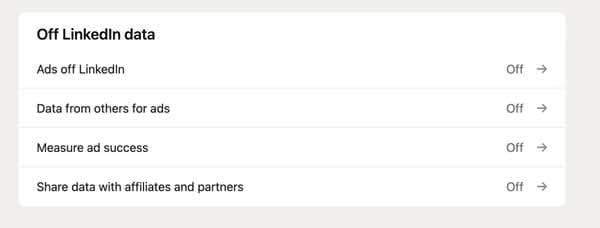
So, now go to Settings > Advertising Data
If you scroll down you will see a number of options that can be toggled on or off: “Ads off LinkedIn”, “Data from others for ads”, “Measure ad success”, and “Share data with affiliates and partners”.
Make sure that all of these are also toggled to “Off” to minimise the chances that your profile will be used for Microsoft-wide ad targeting.
Things unfortunately are not as easy if you are in a corporate environment, as you have no direct control over your staff’s LinkedIn profiles. But what you can do is update your social media policies and remind staff that their profiles will now be part of an AI-training pool unless they opt out. It may also be a good time to remind employees of the dangers of sharing too much information on any social network.
Oh, and US-based LinkedIn users? I’m afraid that you have already been subject to AI training data collection for some time.
More and more tech companies are showing an “anything goes” attitude when it comes to training their AI systems. This isn’t just a LinkedIn problem, it’s a societal problem.
Do what you can to reduce the risks to yourself, and your organisation, if you don’t like the way things are heading.
