
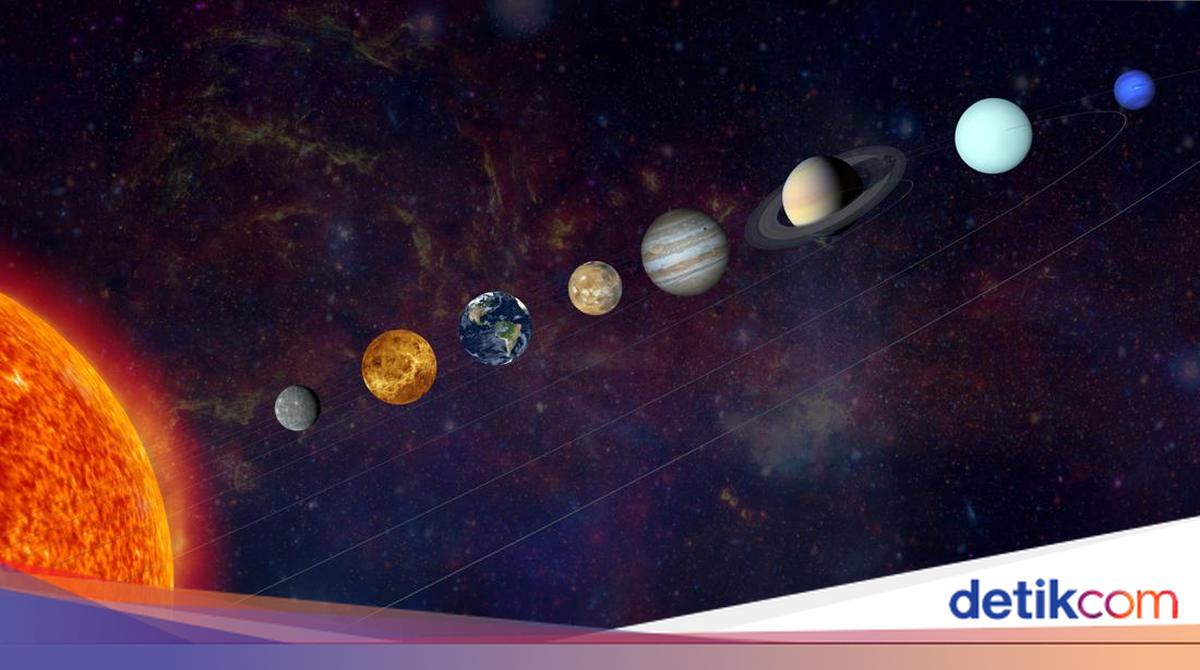
NASA has clarified that Jupiter, along with Earth, doesn’t technically orbit the Sun in the traditional sense. This revelation, stemming from calculations of barycenters, highlights the complex gravitational dynamics within our solar system and offers a nuanced understanding of planetary motion.
According to NASA, 99.86% of the solar system’s mass is comprised of the Sun, with the remaining 0.14% consisting of planets, dwarf planets, moons, comets and asteroids. This distribution means planets and stars don’t orbit each other directly, but rather a common center of mass known as the ‘barycenter.’
“Jupiter is much more massive than Earth – 318 times more massive, in fact,” NASA explained. “the barycenter of Jupiter and the Sun doesn’t lie at the center of the Sun. It actually sits just outside the Sun’s surface!”
The entire solar system as well has a barycenter, around which the Sun, Earth, and all other planets orbit. This barycenter represents the combined center of mass of every object in the solar system.
Jupiter accounts for approximately 70% of the solar system’s mass (excluding the Sun), which is enough to position the Jupiter-Sun barycenter outside of the Sun itself. This principle applies to smaller objects as well, such as planets, dwarf planets, and their moons.
Notably, Pluto’s five moons technically orbit the barycenter of the Pluto-moon system, rather than Pluto itself. Similarly, Earth and its moon orbit a barycenter located roughly 5,000 kilometers from Earth’s center.
Due to the substantial mass of Jupiter and the gas giant Saturn, the solar system’s barycenter rarely coincides with the Sun’s center, frequently residing outside of it. Astronomer James O’Donoghue provides a visual explanation of this phenomenon in a video.
NASA’s ongoing exploration of Jupiter, including the Juno spacecraft, continues to refine our understanding of the planet and its role in the solar system. The Europa Clipper mission, launched on October 14, 2024, will further investigate Jupiter’s icy moon, Europa.
Early observations of Jupiter were first documented by Galileo Galilei in 1610 using a homemade telescope. Since then, numerous missions, including Pioneer 10 (launched in March 1972 and making its closest approach on December 4, 1973) and Voyager 1, have contributed to our knowledge of the planet.
