
Un pétrolier au large de Dubai, le 1er mars 2026 ( AFP / Fadel SENNA )
Oil and gas prices surged Monday, March 2, 2026, as escalating tensions in the Middle East raised concerns about disruptions to crucial energy supplies. The price increases followed attacks on energy infrastructure in the Gulf region, threatening production and exports worldwide.
European gas futures jumped more than 39%, briefly exceeding a 50% increase during the trading day, though remaining well below peaks seen at the onset of the war in Ukraine.
Brent crude, the international benchmark, opened sharply higher, climbing over 13% to surpass $82 per barrel. It ultimately closed the session up 7.26% at $77.74, approximately $15 higher than at the start of the year.
West Texas Intermediate (WTI), the U.S. Benchmark, finished at $71.23 per barrel, a gain of 6.28%.
– Risks to Infrastructure –
The volatility in oil and gas markets stemmed from Iranian attacks targeting energy infrastructure in Gulf countries. These events underscore the region’s vulnerability and the potential for wider supply disruptions.

Carte montrant les raffineries et le réseau de pipelines en Iran, en juin 2023 d’après le département américain de l’énergie ( AFP / Pauline PAILLASSA )
QatarEnergy, the state-owned Qatari energy company, announced Monday it had halted production of liquefied natural gas (LNG) following Iranian attacks on facilities at two of its major gas processing sites.
Earlier, one of Saudi Arabia’s largest refineries, Ras Tanura, operated by Saudi Aramco, suspended some operations after an attack caused a fire.
A petroleum terminal in Abu Dhabi was also reportedly attacked by a drone.
– Ormuz Effectively Closed –
Alongside the attacks, “we are witnessing a de facto” closure of the Strait of Hormuz, a critical chokepoint for roughly 20% of global oil and LNG shipments, according to Andy Lipow of Lipow Oil Associates.
While not technically blocked, major shipping companies have announced suspensions of transits due to soaring insurance premiums.
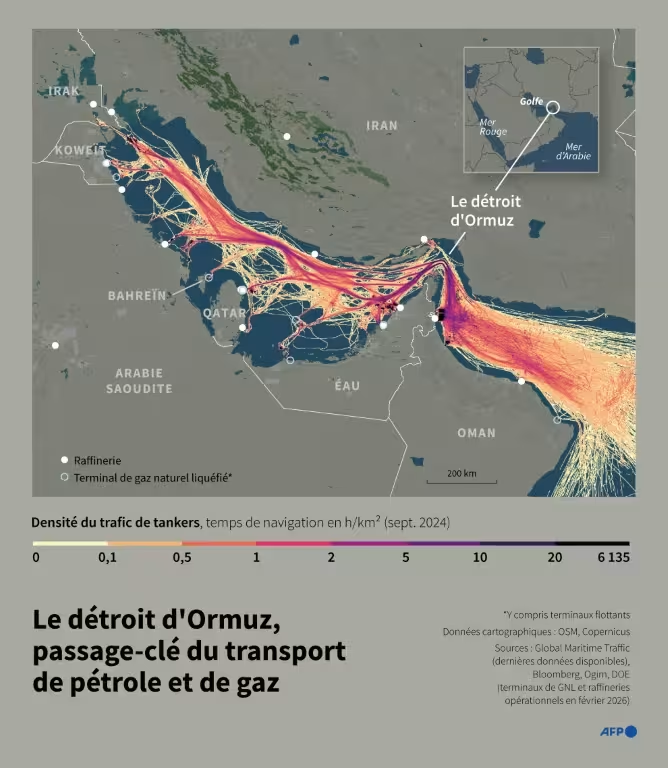
Carte du Golfe montrant les raffineries et terminaux de gaz naturel liquéfié opérationnels en février 2026, ainsi que le trafic maritime de tankers dans la région du Golfe, et en particulier au niveau du détroit d’Ormuz ( AFP / Nalini LEPETIT-CHELLA )
Maritime security agencies reported several ship attacks over the weekend in the area, which is approximately 50 kilometers wide. On Monday, Iran’s Islamic Revolutionary Guard Corps claimed responsibility for attacking a tanker, alleging it was linked to the United States.
This disruption significantly limits exports of oil from major producers like Saudi Arabia, the United Arab Emirates, and Iraq, as well as LNG from Qatar, the region’s leading exporter.
“Every day of paralysis means 20 million barrels of oil that don’t reach their market,” Lipow warned.
– Asia Particularly Affected –
Asian countries are expected to be the hardest hit, as more than 80% of the oil and gas transiting Hormuz is destined for the region, according to the International Energy Agency.
However, concerns extend beyond Asia. Eurasia Group noted that halting gas exports “could have serious repercussions for Europe’s energy security.”

Carte du Golfe montrant terminaux de gaz naturel liquéfié opérationnels et raffineries opérationnelles ou en situation d’arrêt programmé, maintenance ou opération d’amélioration, au 2 mars 2026 ( AFP / Nalini LEPETIT-CHELLA )
The consulting firm specifically highlighted Germany’s low gas reserves, “by far the largest European consumer of gas” at the end of winter.
Lipow suggested that even a reopening of Hormuz may not signal a return to normalcy. “It’s possible that, given that Iranian leadership is no longer intact, the oil industry simply doesn’t know who to negotiate with” to purchase oil from the key producer.
– $100 a Barrel? –
Importing countries theoretically hold substantial oil reserves, with OECD members, largely advanced economies, committing to maintain at least 90 days of stock.

Un cargo au large de la ville côtière de Fujairah, dans le détroit d’Ormuz, le 25 février 2026 ( AFP / Giuseppe CACACE )
But “in the event of a prolonged interruption of deliveries via Hormuz, crude oil could quickly climb to $100 a barrel,” Eurasia Group cautioned.
The last time crude prices exceeded that symbolic threshold was at the start of the war in Ukraine.
“A prolonged period of high prices would put upward pressure on inflation expectations,” warned Kristian Kerr of LPL Financial.
“The Achilles’ heel of (U.S. President Donald) Trump is high oil prices,” noted Michelle Brouhard, an analyst at Kpler, who believes Tehran may seek to maintain high prices to pressure Washington ahead of the midterm elections in November.
Such price levels would also affect global trade due to high transportation costs and threats to the operation of Chinese factories, which are heavily dependent on oil.
However, the scenario depends on the duration of the conflict.
“A serious and sustained disruption is unlikely” as long as the conflict does not last too long, experts at Oxford Economics judge.
Trump estimated that U.S. Operations could last “four to five weeks” while assuring he has “the capabilities” to go further.
