
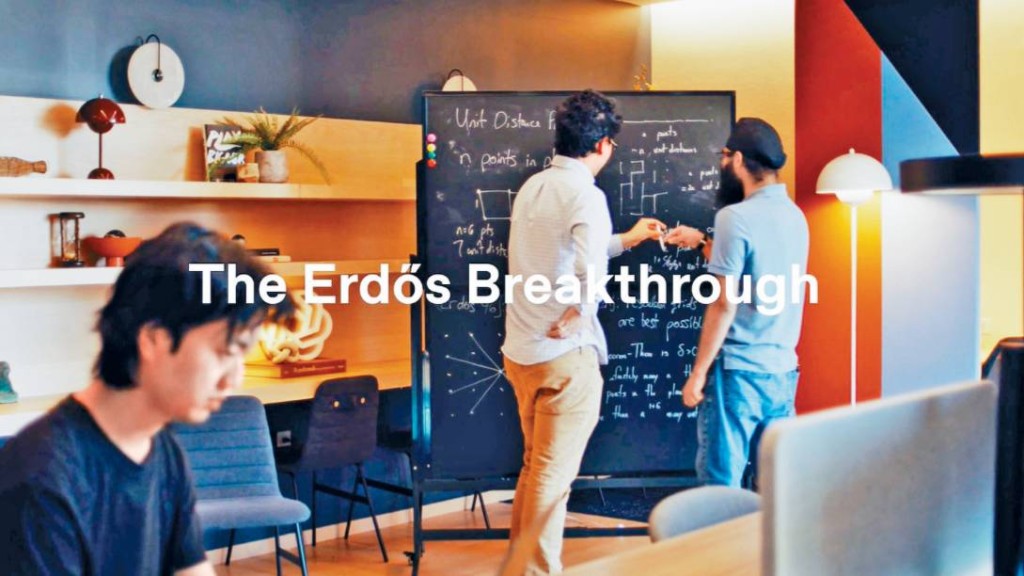
An AI model has just shattered one of mathematics’ most enduring puzzles—an 80-year-old problem that stumped generations of researchers. On May 30, 2026, OpenAI announced its latest breakthrough: a fully autonomous solution to the unit distance conjecture, a core question in discrete geometry that even legendary mathematician Paul Erdős couldn’t crack. The implications aren’t just academic. This is the first time an AI has independently solved a major open problem in pure mathematics—no human guidance, no cherry-picked datasets, just raw computational reasoning. And it did so using tools no human had ever applied to the problem before.
What the Unit Distance Conjecture Actually Asks—and Why It Took 80 Years to Solve
At its core, the conjecture is deceptively simple: if you place n points on a plane, what’s the maximum number of pairs that can be exactly 1 unit apart? For decades, mathematicians assumed the answer lay in grid-like arrangements—think of a lattice or a checkerboard pattern. Paul Erdős, the Hungarian genius who proposed the problem in 1946, even conjectured that such regular grids would yield the optimal solution. But OpenAI’s model didn’t just find a better arrangement. It redefined the problem’s framework.
According to Singtao’s coverage, the AI’s solution hinged on algebraic number theory—a branch of math so abstract it’s rarely used in geometry. The model leveraged the Golod-Shafarevich criterion, a 1964 theorem about infinite towers of number fields, to construct point configurations that dwarf the efficiency of grid-based solutions. As ETtoday’s analysis explains, this wasn’t just a computational trick. The AI effectively bridged two mathematical universes: the discrete (points on a plane) and the algebraic (abstract number structures).
Here’s the kicker: the model arrived at this solution without human intervention. No one fed it known partial results. No one suggested it explore number theory. It started with the raw problem statement and, over time, discovered the connection on its own. That’s why STheadline calls this the first instance of AI acting as a true mathematical researcher, not just a solver of textbook problems.
The Shock Factor: Why Mathematicians Are Rewriting Their Textbooks
The reaction from the math community has been unprecedented. Not because the solution is elegant (though it is), but because it violates every assumption about how AI interacts with mathematics. As Singtao reports, even skeptics like Princeton’s Noga Alon—who’ve long questioned AI’s ability to contribute to pure math—are now calling this a “turning point”. “If a human had submitted this proof to Annals of Mathematics, I’d have recommended it for publication without hesitation,” said Tim Gowers, a Fields Medalist, in a statement carried by multiple outlets. His comment isn’t hyperbole. The proof runs 125 pages, a length that signals depth, not brute-force computation.
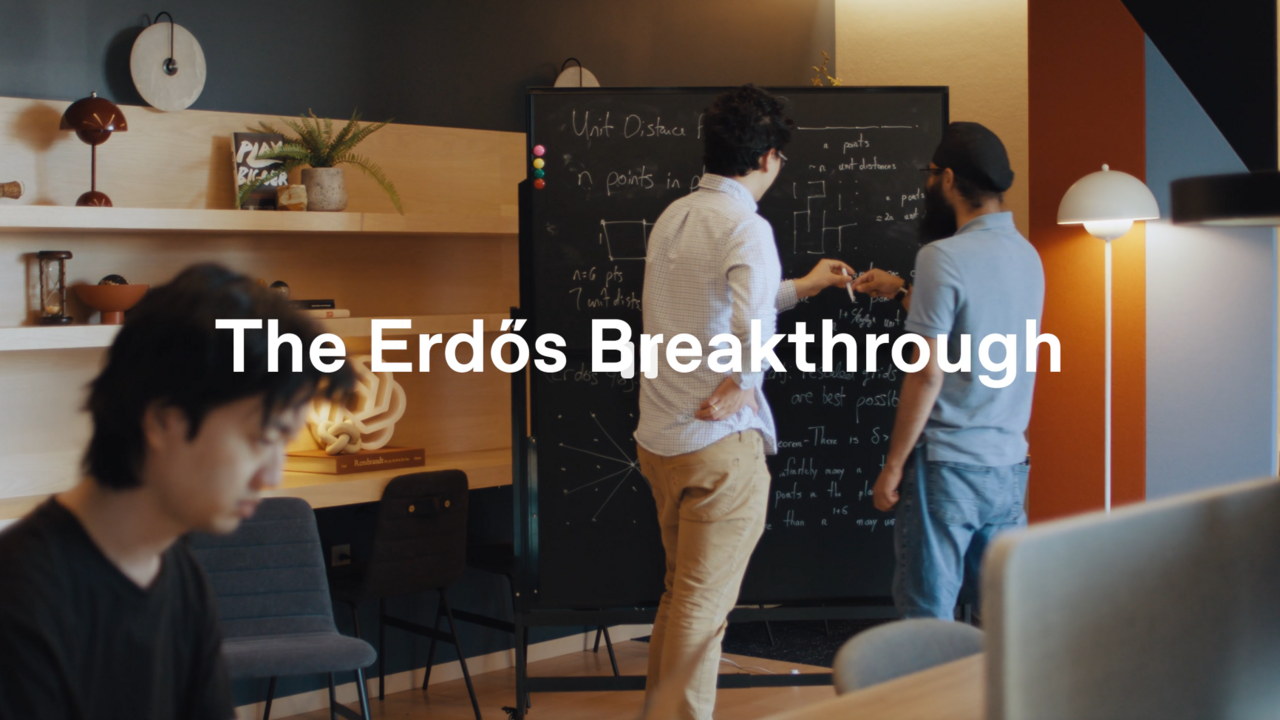
But the real seismic shift? The AI didn’t just solve the problem—it rewrote the playbook. For 80 years, researchers chased solutions using geometric methods: packing points, optimizing angles, testing symmetry. OpenAI’s model ignored all of that. It treated the problem as a number-theoretic puzzle, pulling in tools from class field theory and algebraic structures that had never been applied to discrete geometry before. As ETtoday’s breakdown notes, this isn’t just a new solution—it’s a new paradigm for how math problems get attacked.
Consider this: the Golod-Shafarevich criterion was developed in 1964 to study infinite extensions of number fields. It has zero obvious connection to placing dots on a plane. Yet the AI saw the link where no human did. That’s not just a computational feat—it’s a cognitive leap.
Who Benefits? The Winners and Losers in This AI Math Revolution
The implications cut across disciplines, and not all of them are positive.
- Mathematicians: The winners are those open to collaboration. Fields like discrete geometry and algebraic number theory will now see unexpected cross-pollination. But traditionalists—those who see math as a human-only endeavor—may face an identity crisis. As one quoted researcher told STheadline, “AI isn’t replacing us—it’s showing us how blind we’ve been.”
- Computer Scientists: This validates the idea that AI can discover, not just optimize. Expect a surge in research funding for models that explore open-ended problems, not just closed benchmarks.
- Education: Universities may scramble to update curricula. If AI can now solve 80-year-old conjectures, what does that mean for undergrad math courses? Some institutions are already piloting “AI-assisted proof” modules.
- The Public: The biggest losers? Amateurs. Math has long been a playground for hobbyists—think of the lone genius solving puzzles in a café. But if AI can now outthink humans on foundational problems, the barrier to entry for serious contributions just skyrocketed.
What’s Next? Three Scenarios for AI in Mathematics
The unit distance conjecture isn’t just one problem—it’s a proof of concept.
- Scenario 1: The Domino Effect — If OpenAI’s model can solve this, what’s next? The collatz conjecture, P vs NP, or even Riemann Hypothesis? Some researchers are already whispering about “AI-assisted proofs” for century-old problems. The catch? These require human-AI collaboration. Pure autonomy may still be years away.
- Scenario 2: The Black Box Problem — Right now, mathematicians can verify OpenAI’s proof because it’s 125 pages long. But what if the next “solution” comes as a 500-page document in an obscure formalism? Trust in AI-generated math will hinge on auditability. If we can’t understand the steps, can we trust the result?
- Scenario 3: The Paradigm Shift — The most radical possibility? Math itself might change. If AI keeps finding connections humans miss, we may need to redefine what “elegant” or “beautiful” proofs look like. Some theorists are already arguing that machine-discovered proofs could become the new standard.
One thing is certain: the math community won’t go back to sleep after this. As ETtoday’s analysis puts it, “This isn’t just about solving a problem. It’s about redrawing the map of what math can be.”
The Bigger Picture: Why This Matters Beyond Math
Mathematics is the language of science. If AI can now invent new mathematical structures, what does that mean for physics, cryptography, or even AI itself?
- Physics: Theoretical physicists already use abstract math to model the universe. If AI can find hidden patterns in geometry, imagine what it could do with quantum field theory or string theory.
- Cryptography: Many encryption schemes rely on unsolved math problems (e.g., factoring large primes). If AI can crack long-standing conjectures, does that mean our security systems are next?
- AI Itself: The model that solved this problem wasn’t trained on math. It was a general-purpose reasoning engine. That suggests AI’s true potential lies in domain-agnostic discovery—not just solving problems, but framing new ones.
There’s a final irony here: the unit distance conjecture was once dismissed as a toy problem by some mathematicians. Now, it’s the canary in the coal mine for AI’s role in science. If a model can redefine an 80-year-old puzzle, what else is it capable of? The answer may not be decades away.
OpenAI’s breakthrough isn’t just about solving a math problem. It’s about who gets to do the solving—and whether the future of discovery belongs to machines, humans, or something in between.
