
Sharp Japan to Crowdfund Lightweight Xrostella VR1 Headset in November
Sharp Japan announced today it will launch a Green Funding campaign in November for its Xrostella VR1 virtual reality glasses, offering a significantly lighter alternative to existing headsets.
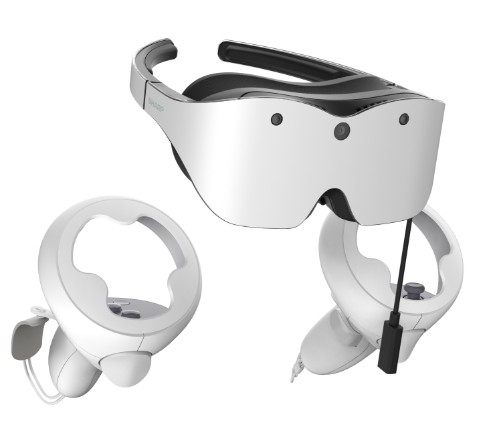
The Xrostella VR1 weighs just 198 grams (6.98 oz), less than half the weight of the Meta Quest 3, PlayStation VR2, and Apple Vision Pro, and measures 160.7 x 70.6 x 106 mm. The headset features a glasses-like design utilizing pancake lenses, intended to improve comfort and ease of use compared to bulkier, goggle-style VR devices. This lighter weight could be a key factor in increasing user comfort and adoption of VR technology.
Each eye receives a 2,160 x 2,160 resolution LCD display with a 90 Hz refresh rate and a 90° field-of-view. The VR1 also offers adjustable interpupillary distance (58-71 mm) and diopter correction (0D to -9.0D) for nearsighted users. Integrated six-degrees-of-freedom (DoF) cameras track head position and map the virtual space, while a color camera provides a view of the real world. Hand tracking and input are managed through included controllers, and a built-in speaker and microphone facilitate virtual communication. For more information on virtual reality technology, see How-To Geek’s guide to VR.
The Xrostella VR1 is compatible with both PCs and smartphones, expanding its potential applications beyond dedicated VR gaming. Sharp Japan plans to begin the Green Funding campaign on November 1st, 2025, seeking support for the final stages of development and production. You can find more details about Sharp’s product line on their official website.
Sharp officials stated the crowdfunding campaign will determine the final production timeline and availability of the Xrostella VR1.
Sharp Japan has announced it will launch a crowdfunding campaign for its Sharp Xrostella VR1 virtual reality glasses in November 2025 on Green Funding. The glasses are compatible with PCs and smartphones
The Xrostella VR1 weighs only 198 grams (6.98 oz.), which is less than half the weight of the Meta Quest 3s, PlayStation VR2, and Apple Vision Pro, and measures 160.7 x 70.6 x 106 mm (6.3 x 2.8 x 4.2 in.). The VR1 features a glasses-like design with pancake lenses, making it easier to wear and remove than competing goggle-like headsets.
The headset provides each eye with a 2,160 x 2,160, 90 Hz LCD display and a 90° field-of-view. The interpupillary distance (distance between two eye pupils) can be adjusted between 58 and 71 mm, and the diopter (lens correction) can be adjusted for nearsighted users from 0D to -9.0D.
Two six-degrees-of-freedom tracking (DoF) cameras and a color camera are included to sense the head position, properly map the virtual space, and provide a view of the real world. Two hand controllers track hand movements and inputs, while a speaker and microphone enable virtual conversations.

Having worked at Activision, UCLA, Anime Expo and more, I’ve seen technology being used to save lives, create games, and create fantastic 3D VR/AR worlds. There’s always something fun in emerging technology that I want to get my hands on and all my friends turn to me to find the best for their needs, so I’m glad to bring my experience to Notebookcheck.
