
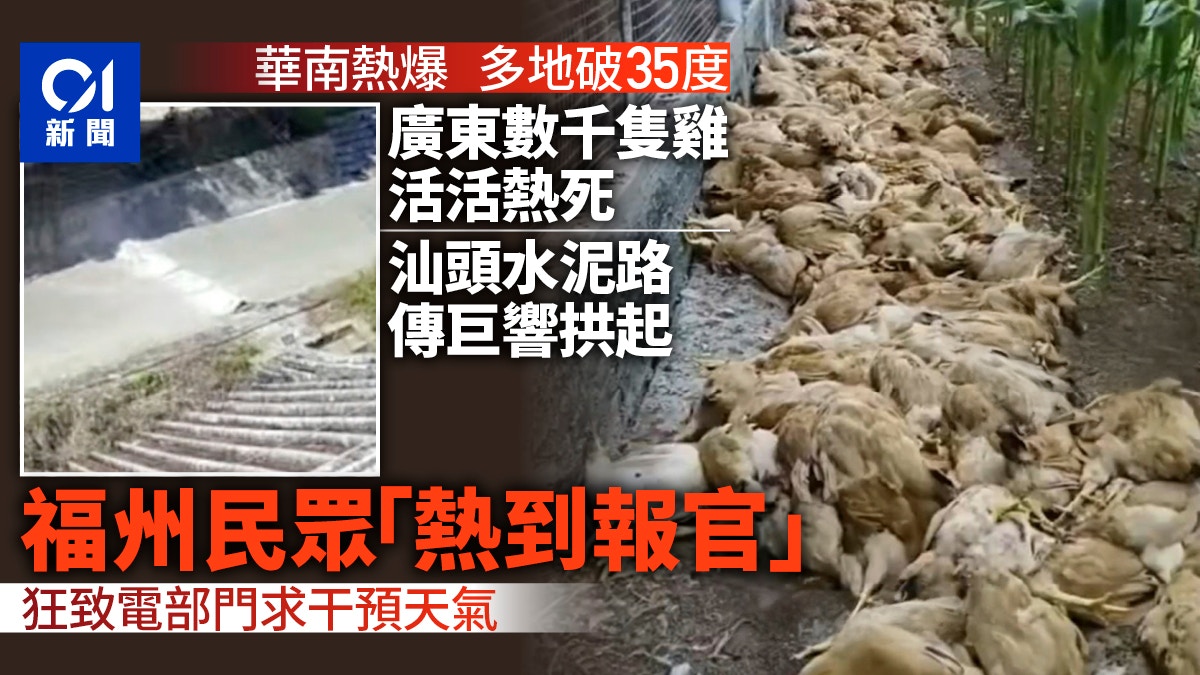
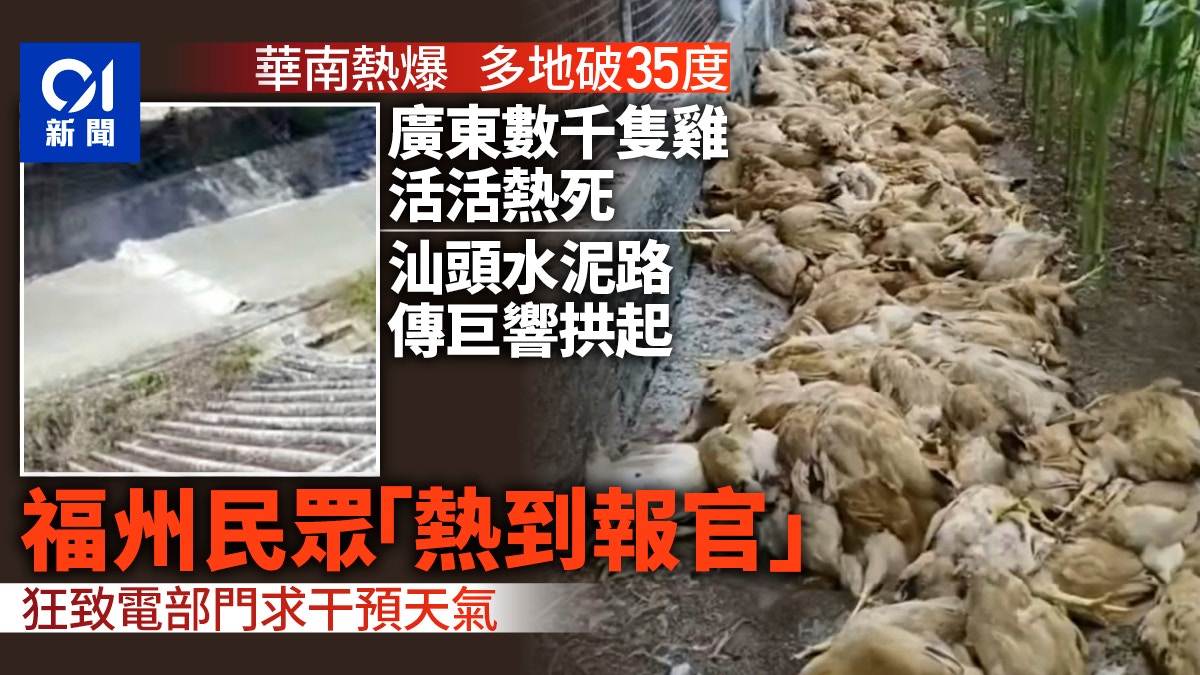
Southern China is baking under an unprecedented heat wave, where temperatures have surged past 38°C (100°F), turning streets into saunas, forcing farmers to bury thousands of dead livestock, and even causing roads to crack under the relentless sun. In Guangdong province alone, a single poultry farm lost thousands of chickens to heatstroke despite emergency cooling measures, while in Shantou, a rural road buckled and split apart under extreme heat—officials confirming the damage was not due to poor construction but the sheer force of the weather. Meanwhile, frustrated residents in Fuzhou have flooded government hotlines, demanding intervention to “change the weather,” only to be told by officials that such requests are beyond their authority. The crisis is exposing the limits of both infrastructure and human endurance in a region where climate records are being shattered.
The Poultry Farm Catastrophe: Thousands of Chickens Die Despite Emergency Measures
A poultry farm in Maoming, Guangdong, became ground zero for the heat wave’s devastation, where thousands of chickens succumbed to heatstroke despite desperate attempts to cool them down. The farm owner, speaking to reporters, described the scene as “heartbreaking”—water spraying systems were deployed, but the relentless heat proved too much. “Even at 36°C, the chickens couldn’t take it,” the owner said. “We tried everything, but there was nothing left to do but bury them.” The farm’s losses are part of a broader agricultural crisis, as high temperatures and humidity turn feedlots into death traps for livestock unable to regulate their body heat like humans can.
According to HK01, the deaths occurred despite the farm implementing standard emergency protocols, including continuous water spraying—a tactic that failed to lower the ambient temperature enough to prevent heatstroke. The problem isn’t just the high temperatures; it’s the humidity. In Guangdong, the combination of 38°C heat and humidity levels above 50% creates a “steam bath” effect, making it nearly impossible for animals (and humans) to cool down through evaporation. The farm’s losses are likely just the tip of the iceberg, as similar reports have emerged from other parts of southern China, where farmers are facing unprecedented challenges in keeping livestock alive.
Roads Crack Under the Sun: Infrastructure Fails as Temperatures Soar
In Shantou, Guangdong, the heat wave didn’t just test the limits of animal resilience—it also exposed the fragility of human-engineered structures. A rural road in Jinzhuo Township buckled and split apart under the extreme conditions, with witnesses reporting a loud cracking sound followed by the pavement rising and breaking into chunks. The damage was so severe that it created safety hazards for both vehicles and pedestrians. Officials confirmed that the road’s failure was not due to poor construction but rather the result of thermal expansion—as the asphalt and concrete absorbed the relentless sun, they expanded beyond their designed limits, causing the pavement to fracture.
The incident highlights a growing concern in southern China, where rising temperatures are pushing infrastructure to its limits. As LINE TODAY reported, the road’s design included standard expansion joints, but the extreme heat—combined with old, degraded joints—created enough stress to cause the pavement to fail. This is not an isolated incident; similar cases have been documented in other parts of the world where heat waves have led to road buckling, particularly in regions with poor-quality materials or older infrastructure. For Shantou, the damage serves as a warning: as temperatures continue to rise, even well-maintained roads may not be able to withstand the strain.
Local authorities have yet to release a full assessment of the damage or long-term repair plans, but the incident underscores a broader challenge: how to adapt infrastructure to a warming climate. In the short term, temporary fixes—such as resurfacing or reinforcing weak sections—may be necessary. But in the long term, engineers will need to reconsider materials and designs to account for higher temperatures and more frequent extreme weather events.
Citizens Take to Hotlines: The Limits of Government Intervention
Frustration over the heat wave has boiled over in Fuzhou, where residents have flooded government hotlines with complaints, demanding that authorities “intervene to change the weather.” One resident, whose call was featured in reports, expressed exasperation: “It’s like living in an oven. We can’t even go outside. Is there nothing the government can do?” The Fuzhou municipal hotline’s response was blunt: such requests are beyond the government’s authority. “Weather is a natural phenomenon,” officials stated. “We can monitor, forecast, and warn, but we cannot control the weather.” The response reflects a reality that many citizens are grappling with: in the face of extreme heat, there are few immediate solutions beyond personal precautions.
The situation in Fuzhou is emblematic of a broader trend across southern China, where heat waves are becoming more frequent and intense. According to meteorological data, Fuzhou’s first official heat wave of the year arrived 12 days early, beating the historical average by more than a week. The early onset, combined with the relentless humidity, has made the heat feel even more unbearable. While the government has issued warnings and advised residents to stay hydrated and avoid outdoor activities during peak hours, many are left feeling powerless—especially those without access to air conditioning or cooling centers.
The hotline’s refusal to entertain weather-modification requests—such as cloud seeding or artificial rain—is not without precedent. China has experimented with weather modification in the past, particularly in drought-prone regions, but such efforts are expensive, logistically complex, and often yield mixed results. More importantly, they are not a solution for heat waves, which require cooling rather than precipitation. The government’s stance is clear: while it can provide relief through infrastructure investments (like expanding cooling centers) and public health advisories, it cannot alter the fundamental laws of physics.
The Human and Economic Toll: Who Pays the Price?
The heat wave’s impact extends far beyond discomfort—it’s taking a tangible toll on public health, agriculture, and energy systems. In Guangdong, where temperatures have repeatedly exceeded 38°C, hospitals have seen an uptick in heatstroke cases, particularly among outdoor workers, the elderly, and children. The provincial meteorological bureau has warned that prolonged exposure to such conditions can lead to dehydration, heat exhaustion, and even fatal heatstroke, urging residents to limit outdoor activities and stay hydrated.
Agriculture is another sector feeling the brunt of the heat. Beyond the poultry farm in Maoming, other livestock operations—particularly those raising pigs, cattle, and other heat-sensitive animals—are reporting losses. The problem is compounded by the fact that many small-scale farmers lack the resources to invest in advanced cooling systems, leaving them vulnerable to sudden spikes in temperature. For these farmers, the current heat wave is not just an inconvenience; it’s a financial crisis that could push some out of business entirely.
Then there’s the strain on the electrical grid. As more residents turn to air conditioning to escape the heat, demand for electricity has surged, pushing the system to its limits. According to LINE TODAY, southern China’s power grid has implemented AI-driven systems to manage the load, including automated fault detection and rapid repair crews. The AI system, which can identify and respond to outages in under a minute, has reportedly saved millions in potential repair costs. However, even with these advancements, the grid remains under severe pressure, raising concerns about blackouts as temperatures continue to climb.
The economic ripple effects are already being felt. Businesses that rely on outdoor labor—construction, agriculture, and logistics—are seeing productivity plummet as workers take breaks to cool down. Retail sales of fans, ice packs, and bottled water have skyrocketed, while tourism in coastal cities has slowed as visitors seek refuge from the oppressive heat. The question now is whether this heat wave will serve as a wake-up call for policymakers to invest in long-term climate resilience—or if it will be treated as a temporary anomaly to be weathered until the next crisis arrives.
What Comes Next: Can China Adapt?
The current heat wave is a stark reminder of what’s to come if global temperatures continue to rise. For southern China, where humidity amplifies the effects of heat, the challenges are particularly acute. The question now is not just how to survive this week’s extreme conditions but how to prepare for a future where such heat waves become the norm. Short-term solutions—like expanding cooling centers, improving early warning systems, and investing in more resilient infrastructure—are critical. But long-term adaptation will require a shift in how cities are designed, how energy is managed, and how vulnerable populations are protected.
One potential area for innovation is in urban planning. Cities like Hong Kong and Shenzhen have already begun experimenting with “cool pavements” and green roofs to mitigate the urban heat island effect. Expanding these initiatives could help reduce temperatures in densely populated areas. Similarly, investments in renewable energy—particularly solar and wind—could reduce reliance on fossil fuels, which contribute to both air pollution and climate change. For agriculture, research into heat-resistant livestock breeds and better ventilation systems for farms could provide some relief.
Yet, even with these measures, the most vulnerable—those without access to cooling, reliable healthcare, or financial resources—will continue to bear the brunt of the heat. The government’s response so far has been reactive: warnings, advisories, and temporary fixes. But as the climate crisis deepens, a more proactive approach will be necessary. That means not just preparing for the next heat wave but fundamentally rethinking how society adapts to a warmer world.
For now, southern China’s residents are left with little choice but to endure. The heat will eventually break, and the roads will be repaired. But the underlying question remains: how long before the next extreme weather event strikes, and what will be the cost of inaction?
