
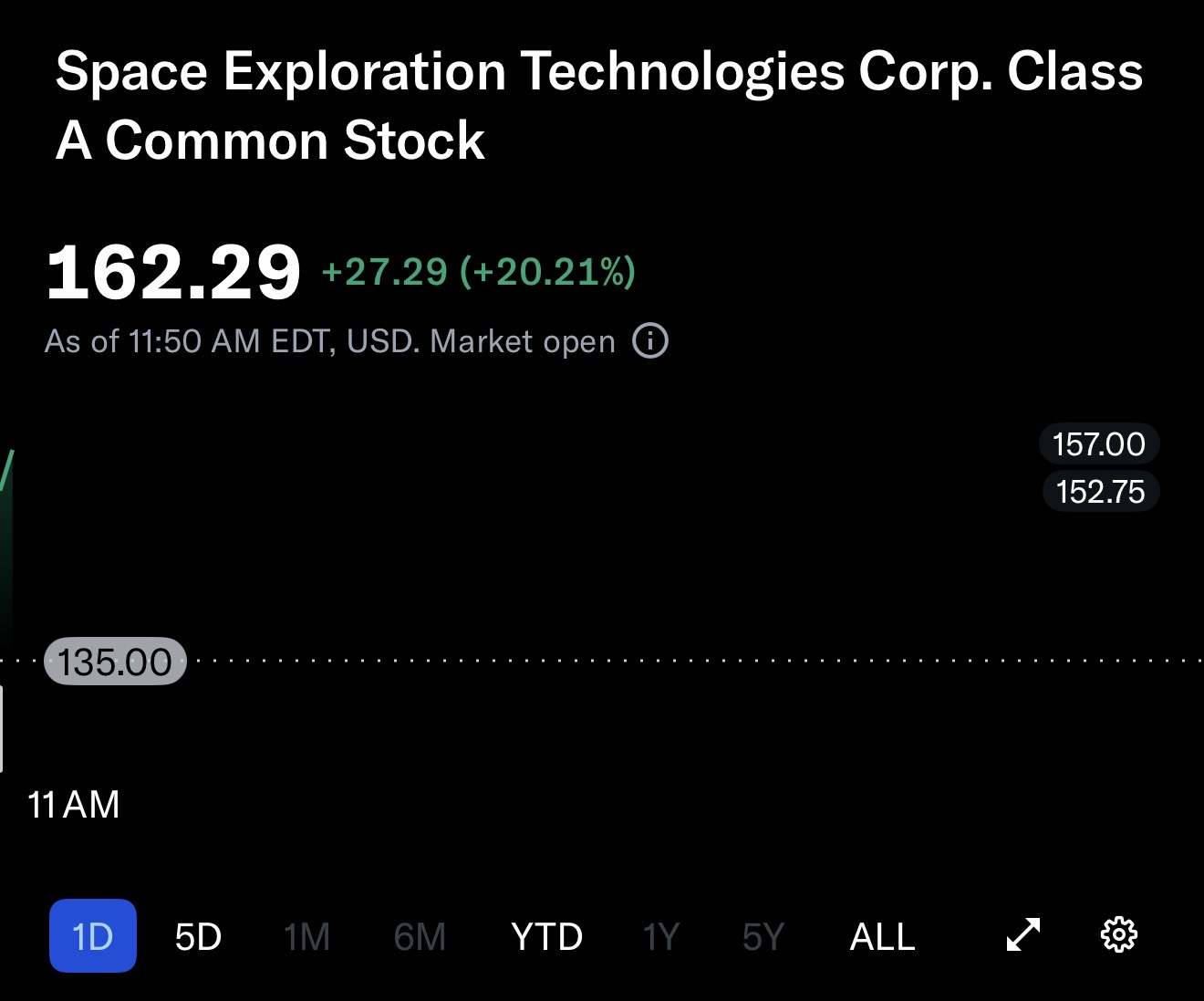
SpaceX began trading on the Nasdaq under the ticker symbol SPCX on June 12, 2026, with shares opening at $162 after an initial public offering price of $135. The debut values the space exploration company at approximately $2.1 trillion, making it the seventh-largest company globally and the largest IPO in United States history.
SpaceX Market Debut and Financial Performance
The listing of SpaceX on the Nasdaq represents a significant milestone for the aerospace industry, with the company raising $75 billion in its public offering, according to reporting by The Standard. This figure significantly exceeds previous records, surpassing the IPO of Alibaba and the 2019 listing of Saudi Aramco, which raised $26 billion.
Financial disclosures indicate that SpaceX is operating across three primary business segments. Connectivity via Starlink remains the company’s largest revenue driver, accounting for 61% of total income. As of the first quarter of 2026, Starlink reached 10.3 million users across 164 countries with a constellation of over 9,600 satellites. The space services division, which includes Falcon 9 launches and Starship development, accounts for 22% of revenue, while the AI segment—formed following the merger with xAI—contributes 17%, as detailed by Longtunman.

Despite the high valuation, the company reported a net loss of $4.9 billion in 2025 and an additional $4.28 billion in the first quarter of 2026 alone. Analysts attribute these losses primarily to massive capital expenditures required for ongoing infrastructure development. In the context of capital-intensive technology firms, such burn rates are historically common during periods of aggressive scaling. The company’s S-1 filing, submitted to the Securities and Exchange Commission (SEC) in early 2026, highlighted that long-term profitability remains contingent on the sustained frequency of Starship flights and the stabilization of satellite manufacturing costs.
Regulatory Scrutiny and Index Inclusion Concerns
The rapid entry of SpaceX into public markets has triggered pushback from state-level financial officials. On June 12, 2026, Today Line reported that pension fund managers from four major U.S. states sent a formal letter to Nasdaq and FTSE Russell. The officials, including the comptrollers of New York and Maryland, expressed concern that recent changes to index inclusion criteria were designed to fast-track companies like SpaceX, OpenAI, and Anthropic into major market indices.
The letter argues that the current valuation of SpaceX—combined with its centralized corporate governance structure—could expose passive funds and retail investors to significant volatility. The officials requested that the index providers delay the application of these new rules until a comprehensive assessment of the risks to investors can be completed. This request reflects broader concerns regarding the governance structures of “founder-led” technology companies, where voting power is often concentrated in a way that limits the influence of minority shareholders. Historically, index providers such as MSCI and FTSE Russell have navigated similar controversies, including when companies with dual-class share structures were initially restricted from certain benchmark indices before later being granted entry under specific conditions.
Investment Accessibility and Retail Participation
SpaceX took the unusual step of allocating 30% of its IPO shares to retail investors, a move that contrasts with the typical practice of reserving the bulk of high-profile offerings for institutional clients. Platforms such as Robinhood and SoFi facilitated these purchases without requiring minimum investment thresholds. This strategy aimed to democratize access to an asset class that has historically been limited to venture capital firms and private equity participants.
For investors outside the United States, direct participation in the IPO remains restricted due to regulatory hurdles and account verification requirements. However, as noted by PPTVHD36, there are alternative avenues for exposure to the broader “Space Economy,” which McKinsey estimates could reach a valuation of $1.8 trillion by 2035. These include:
- Tema Space Innovators ETF (NASA): Focuses on pure-play companies in the space supply chain, including launch providers and satellite infrastructure.
- Neuberger Berman Next Generation Space Economy Fund: A UCITS-compliant fund that targets technology developers and data application platforms.
- VanEck Space Innovators UCITS ETF (JEDI): Tracks the MVIS Global Space Industry ESG Index, concentrating on diversified space industry participants.
For those with access to international brokerage accounts, such as Interactive Brokers or local platforms offering U.S. stock trading, shares of SPCX became available for purchase in the secondary market immediately following the initial public offering. The transition from private ownership to public listing requires the company to adhere to quarterly reporting standards mandated by the SEC, including the filing of 10-Q and 10-K forms. This shift subjects SpaceX to heightened transparency requirements, necessitating the public disclosure of material risks, including geopolitical tensions affecting satellite operations and the regulatory hurdles associated with international launch permits.
Find more reporting in our Business section.
