
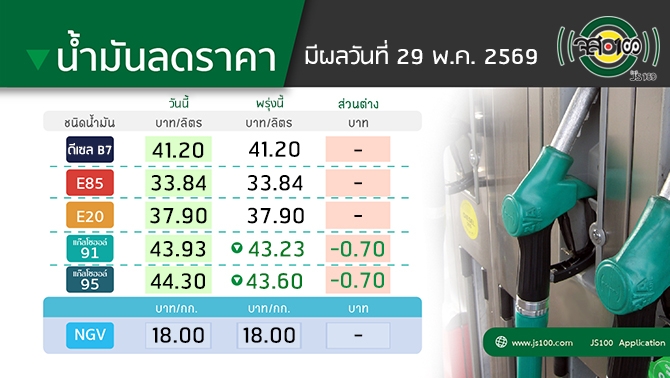
Thailand’s fuel prices drop tomorrow as PTT and Bangchak cut gasoline costs by 70 satang per liter—except for E20 and E85, which stay unchanged—while diesel remains flat except for premium grades. The adjustments take effect at 5:00 AM on May 29, 2026, offering relief at the pump ahead of the weekend.
Gasoline Prices Fall by 70 Satang/Liter—But Not Every Fuel Type
Thailand’s fuel market is set for a mixed but largely downward adjustment starting Friday, May 29, 2026, at 5:00 AM. Major oil retailers PTT Public Company Limited (PTT) and Bangchak Corporation have announced a 70-satang-per-liter reduction in gasoline prices across most grades, including GSH95 (95-octane gasoline) and GSH91 (91-octane gasoline), according to verified pricing updates from JS100 and LINE Today. However, two key exceptions stand out: E20 (20% ethanol blend) and E85 (85% ethanol blend) will not see price cuts, remaining at their current rates.
Diesel prices, meanwhile, remain largely unchanged—except for premium diesel grades, which will see a 1-baht-per-liter reduction. This selective adjustment reflects ongoing market dynamics, including global oil price volatility tied to geopolitical tensions in the Middle East, as noted in Sanook’s latest analysis.
The New Pricing Breakdown: Who Gets the Discount?

| Fuel Type | New Price (Baht/Liter) | Change from Previous | Source |
|---|---|---|---|
| GSH95 (95-octane gasoline) | 43.60 | ↓ 0.70 baht | Manager Online |
| GSH91 (91-octane gasoline) | 43.23 | ↓ 0.70 baht | JS100 |
| E20 (20% ethanol blend) | 37.90 | No change | NationTV |
| E85 (85% ethanol blend) | 33.84 | No change | LINE Today |
| Diesel B7 (standard diesel) | 41.20 | No change | Sanook |
| Premium Diesel (high-grade) | 59.25 | ↓ 1.00 baht | Manager Online |
The pricing discrepancies highlight Thailand’s push to balance affordability with ethanol mandates. While regular gasoline sees a uniform cut, E20 and E85—both higher-ethanol blends—remain unchanged, suggesting policymakers are prioritizing compliance with biofuel targets over immediate consumer relief. This aligns with broader trends in Southeast Asia, where ethanol subsidies often take precedence over price adjustments for conventional fuels.
Why Now? Global Oil Markets and Local Politics
The timing of this adjustment coincides with global oil price fluctuations, particularly the 5% drop in WTI crude and Brent crude futures following reports of progress in U.S.-Iran diplomacy, as cited in Sanook’s economic briefing. While Thai retailers typically adjust prices weekly, the selective cuts—excluding E20/E85—signal a deliberate strategy to avoid triggering backlash over ethanol policies, which have faced criticism for higher costs despite environmental benefits.
Locally, the move also comes as Thailand prepares for the end of May, a period when fuel demand traditionally spikes due to increased travel and commerce. By offering relief on 95% and 91-octane gasoline—the most commonly used grades—retailers aim to ease pressure on consumers ahead of the weekend and upcoming long-weekend holidays. The 1-baht cut for premium diesel, though modest, may appeal to commercial fleets and logistics operators.
What This Means for Drivers and the Economy
For the average Thai motorist, the 70-satang-per-liter reduction translates to approximately 0.7% savings on gasoline purchases. While modest, this could provide a small but meaningful reprieve for households already grappling with inflation. However, the exclusion of E20 and E85 may frustrate environmentally conscious drivers who rely on higher-ethanol blends to reduce carbon footprints.
Economically, the adjustment offers a short-term boost to discretionary spending, particularly for lower-income households who allocate a larger share of their budgets to transportation. The Bangkok Metropolitan Administration’s fuel tax—which adds an additional 1.50 baht per liter in the capital—remains unchanged, meaning consumers will still face higher costs in urban areas compared to provinces.
Industry analysts suggest this pricing strategy could stabilize demand in the short term, but the long-term viability of ethanol mandates remains a point of contention. With global oil prices volatile and geopolitical risks persistent, Thailand’s fuel policy will continue to walk a tightrope between economic relief and environmental goals.
What’s Next? Watch for These Developments
The next 30 days will be critical for Thailand’s fuel market.
- Global oil price trends: If U.S.-Iran talks collapse or Middle East tensions escalate, Thai retailers may reverse or pause price cuts.
- Ethanol policy reviews: Pressure from environmental groups could push the government to reconsider subsidies for E20/E85.
- Retailer competition: Independent gas stations may follow PTT and Bangchak’s lead, potentially deepening discounts.
- Regional comparisons: Neighboring countries like Vietnam and Indonesia have seen more aggressive fuel subsidies—Thailand may face calls to match or exceed these.
For now, drivers should refuel before May 29 to lock in the discounted prices. Those relying on E20 or E85 will need to weigh the environmental benefits against the unchanged cost, while diesel users—particularly in commercial sectors—may see limited relief unless premium grades see further adjustments.
The bottom line? This is a targeted relief measure, not a broad market correction. While the cuts offer some respite, the underlying challenges—ethanol mandates, global oil volatility, and local tax policies—remain unresolved. For consumers, the next fill-up is cheaper, but the bigger questions about Thailand’s energy future are far from answered.
