

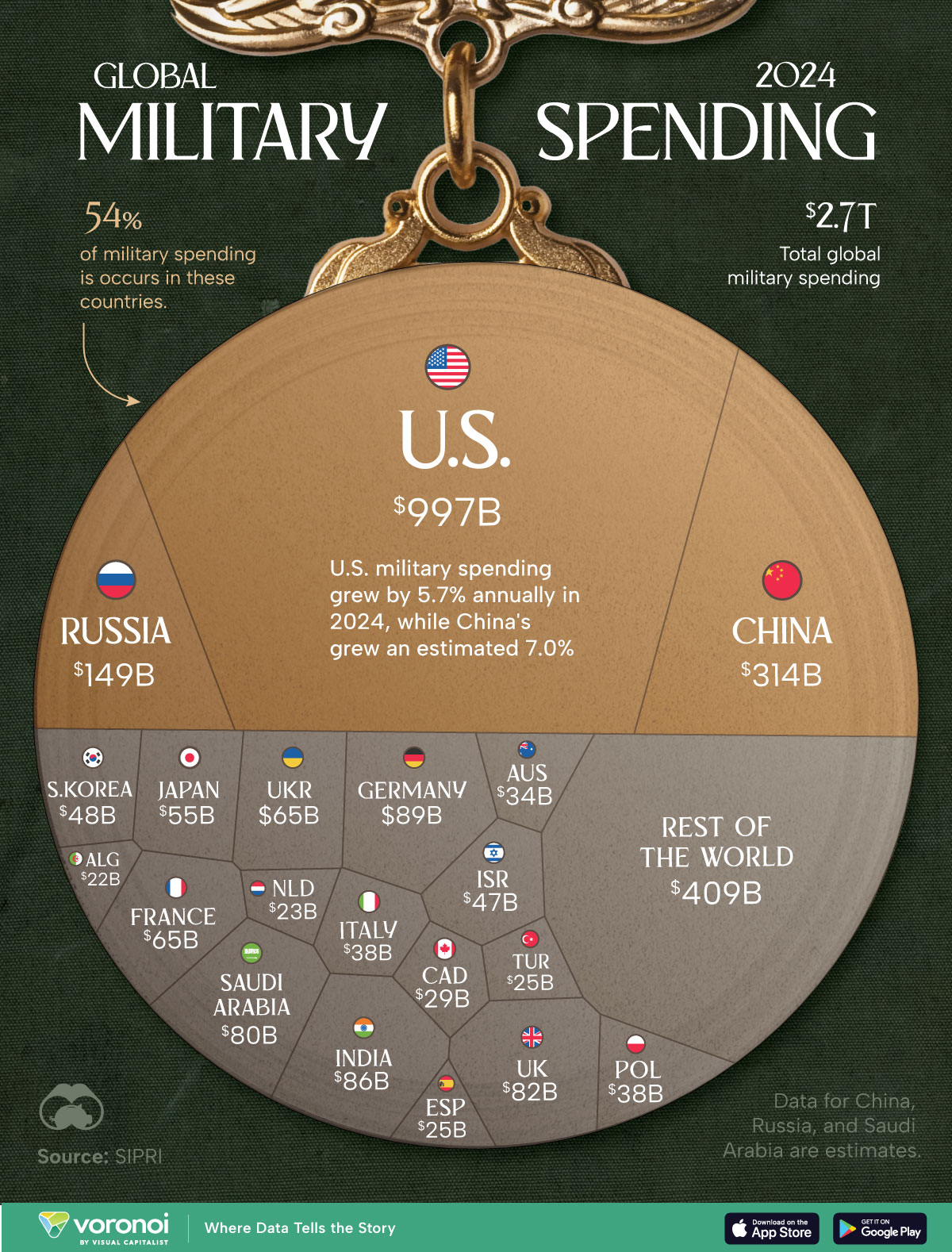
The United States led global military spending in 2025 with $912 billion, according to the Stockholm International Peace Research Institute’s latest report, while China’s defense budget rose 7.2% to $244 billion—its first increase since 2023. Russia’s spending fell 3.8% to $102 billion, reversing a decade of growth, as Western sanctions and domestic economic pressures reshaped priorities.
U.S. Maintains Dominance as Global Spending Shifts
The U.S. defense budget for fiscal year 2025—$912 billion—accounted for 38% of the world’s total military expenditure, according to the SIPRI Yearbook 2025, released last month. The figure reflects a 4.1% increase from 2024, driven by sustained funding for Ukraine, Taiwan deterrence, and modernization of nuclear triad capabilities. While Congress approved record levels for conventional forces, internal debates over hypersonic missile programs and AI-driven warfare systems delayed some procurement timelines.
China’s official defense budget—$244 billion—marked its first annual increase since 2023, rising 7.2% from $227 billion. Analysts note the figure likely understates actual spending, given historical opacity around military outlays. The rise coincides with accelerated production of domestically manufactured drones, aircraft carriers, and ballistic missile systems, as well as expanded naval patrols in the South China Sea. Beijing’s budget reflects a strategic pivot toward self-reliance in defense technology
, said Dr. Zhang Tuosheng, a senior fellow at the Chinese Academy of Social Sciences, in remarks to Caixin Global.
Russia’s defense spending dropped to $102 billion in 2025, a 3.8% decline from 2024, according to SIPRI. The reduction follows Western sanctions, currency controls, and a shift in military procurement toward cheaper, domestically produced systems. While Moscow has accelerated production of short-range missiles and artillery, the decline in overall spending reflects economic strain and logistical challenges in sustaining frontline operations in Ukraine. Russia’s military budget is now a hostage to its own economic mismanagement
, stated Mark Galeotti, a senior research fellow at the Royal United Services Institute, in a June 2 interview with BBC News.
Europe’s Spending Surge: NATO Allies Respond to Ukraine War
European defense budgets collectively rose 6.3% in 2025, with Germany and France leading the increase. Germany’s defense spending reached €75.5 billion ($82.1 billion), up 12% from 2024, as the government accelerated deliveries of Leopard tanks and IRIS-T air defense systems to Ukraine. France’s budget climbed to €55.3 billion ($60.2 billion), a 9.5% increase, driven by nuclear submarine programs and fifth-generation fighter upgrades.
The United Kingdom’s defense budget remained flat at £61.4 billion ($77.8 billion), despite political pressure to increase spending. Officials cited ongoing reviews of the Integrated Review 2023 strategy, which prioritizes cyber and space capabilities over traditional force structure. The UK’s approach is about quality over quantity—focusing on high-end deterrence rather than sheer numbers
, said Sir Simon Case, the UK’s National Security Advisor, in a speech to the Chatham House think tank last month.
Poland’s defense budget grew by 20% to $32.1 billion, making it the fastest-growing in Europe. The increase reflects Warsaw’s commitment to hosting NATO’s Future Multi-Role Aircraft and expanding its armored vehicle fleet. Meanwhile, Italy and Spain saw modest increases of 3.2% and 2.8%, respectively, as they balanced domestic defense needs with economic constraints.
Middle East and Asia: Regional Rivalries Drive Spending
Saudi Arabia’s defense budget expanded to $67.2 billion in 2025, a 15% increase, as Riyadh accelerated purchases of U.S. and European weapons amid tensions with Iran and Yemen’s Houthi rebels. The kingdom’s focus on air defense systems and precision strike capabilities reflects its shifting strategy from mass mobilizations to high-tech deterrence.
India’s defense budget rose to $81.4 billion, up 5.8% from 2024, with increased allocations for indigenous aircraft carriers, submarines, and missile defense systems. The spending aligns with New Delhi’s Atmanirbhar Bharat
(self-reliant India) defense policy, though delays in domestic production programs have led to continued reliance on Russian imports for certain platforms.
Japan’s defense budget reached $52.3 billion, a 7.4% increase, as Tokyo prioritized missile defense and amphibious warfare capabilities in response to North Korea’s expanding arsenal and China’s military activities in the East China Sea. The budget includes funding for the Type 31 frigate program and upgrades to the Aegis Ashore system.
South Korea’s defense spending grew to $48.7 billion, a 4.9% increase, with a focus on countering North Korea’s nuclear and missile threats. The budget includes funding for the K2 Black Panther tank and the K-ASP amphibious assault ship, as well as expanded cyber and space surveillance programs.
Africa and Latin America: Budget Cuts and Stability Priorities
Algeria’s defense budget remained the largest in Africa at $12.3 billion, though it saw a 2.1% decrease from 2024. The reduction follows lower oil revenues and a shift toward internal security spending amid protests and regional instability. Egypt’s budget increased slightly to $6.8 billion, with allocations for naval modernization and air defense upgrades.
Brazil’s defense spending rose to $18.9 billion, a 6.7% increase, driven by investments in the Tamandaré-class corvettes and upgrades to its F-5 fighter fleet. Argentina’s budget remained flat at $3.1 billion, reflecting economic constraints and a focus on maintaining existing platforms rather than expansion.
What Comes Next: Sanctions, Tech Shifts, and Uncertainty
The 2025 military spending data reveals three key trends shaping global defense priorities. First, Western sanctions are forcing Russia to prioritize domestic production, while China’s budget increases suggest a long-term push for technological self-sufficiency. Second, Europe’s spending surge is likely to continue, though political debates over burden-sharing within NATO may limit further growth. Finally, emerging powers like India and Saudi Arabia are investing in high-tech capabilities, reducing reliance on traditional arms suppliers.
Uncertainties remain, however. The U.S. Congress is expected to debate further increases in 2026, with some lawmakers advocating for cuts to offset domestic spending priorities. Meanwhile, China’s actual military outlays may exceed official figures, given historical underreporting. In Europe, economic pressures could slow spending growth, particularly in Southern nations facing fiscal constraints.
One constant is the accelerating pace of military-technological competition, from AI-driven command systems to hypersonic missiles. The 2025 budgets reflect not just traditional power projections but a race to dominate next-generation warfare. For now, the U.S. remains the undisputed leader—but the gap is narrowing, and the rules of engagement are changing faster than budgets can keep up.
