
U.S. stock markets endured a dramatic reversal Thursday, erasing a strong morning rally as concerns about interest rates and AI sector valuations resurfaced. The downturn followed a session where the Dow Jones Industrial Average briefly climbed over 700 points, ultimately closing down 386.51, and marked Nvidia’s largest intraday reversal in years after a significant earnings report (Reuters). Investors are now weighing the potential for a less dovish Federal Reserve and a cooling in the high-flying artificial intelligence trade.
U.S. stock markets experienced a sharp reversal on Thursday, November 20, as an earlier rally fueled by Nvidia’s earnings report lost steam. Concerns about valuations in the artificial intelligence sector and the possibility of fewer interest rate cuts from the Federal Reserve weighed on investor sentiment, leading to declines across major indexes. The downturn highlights the sensitivity of tech stocks to macroeconomic factors and investor expectations.
Shares of Taiwan Semiconductor Manufacturing (TSMC) ADRs fell by more than 1.7%, while the Philadelphia Semiconductor Index plummeted nearly 5%. The Dow Jones Industrial Average closed down 386 points, after being up more than 700 points during the trading session. The S&P 500 index fell 1.56%, and the Nasdaq Composite dropped 2.16%, widening the gap from its intraday high of a 2.6% gain and signaling a significant reversal.
Nvidia shares initially rose as much as 5% following the release of strong earnings and a positive outlook, but ultimately closed down over 3%, dragging down the broader AI sector.
Despite CEO Jensen Huang stating that demand for the Blackwell chip is “through the roof” and dismissing concerns about an AI bubble, the positive earnings report wasn’t enough to sustain the stock or the overall market rally. Lingering doubts about the valuations of AI stocks, particularly in light of the potential for the Federal Reserve to hold off on further rate cuts, contributed to the downturn.
Adding to the pressure on Thursday was the release of the delayed September jobs report, which showed an increase of 119,000 jobs, exceeding expectations and reducing market expectations for a December rate cut. Federal Funds futures now indicate less than a 40% probability of a rate cut in December.
Thursday’s reversal extended the weak November performance of AI-related stocks. Investors have begun taking profits after significant gains earlier in the year, putting downward pressure on market performance. Nvidia is down more than 8% in November, putting it on track for its worst monthly performance since March.
U.S. Stock Market Performance on Thursday, November 20:
- The Dow Jones fell 386.51 points, or 0.84%, to close at 45,752.26.
- The Nasdaq index fell 486.181 points, or 2.16%, to close at 22,078.048.
- The S&P 500 index fell 103.4 points, or 1.56%, to close at 6,538.76.
- The Philadelphia Semiconductor index fell 317.96 points, or 4.77%, to close at 6,352.07.
- The NYSE FANG+ index fell 349.87 points, or 2.17%, to close at 15,765.22.
Key Stocks
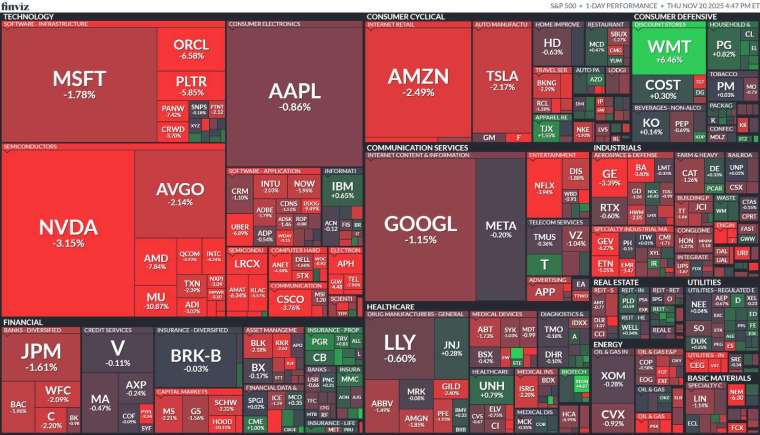
Among the tech giants in the NYSE FANG+ index, Meta (META-US) fell 0.19%; Apple (AAPL-US) fell 0.86%; Alphabet (GOOGL-US) fell 1.15%; Microsoft (MSFT-US) fell 1.60%; and Amazon (AMZN-US) fell 2.49%.
The Philadelphia Semiconductor index experienced a broad sell-off. Advanced Micro Devices (AMD) (AMD-US) plunged 7.84%; Broadcom (AVGO-US) fell 2.14%; Nvidia (NVDA-US) fell 3.15%; Applied Materials (AMAT-US) tumbled 6.15%; Qualcomm (QCOM-US) fell 3.93%; and Micron (MU-US) plummeted 10.87%.
Taiwanese ADRs were also largely lower. Taiwan Semiconductor Manufacturing (TSMC) ADR (TSM-US) fell 1.72%; United Microelectronics (UMC) ADR (ASX-US) fell 2.27%; and ASE Technology (UMC-US) fell 1.52%; while Chunghwa Telecom ADR (CHT-US) rose 0.84%.
Company News
Despite Nvidia (NVDA-US) reporting third-quarter earnings and a forecast that significantly exceeded expectations, investors remain wary of the high valuations in the AI sector. The stock surged as much as 5% earlier in the day before reversing course and falling more than 3%, closing at $180.64 per share, with an intraday market capitalization swing of a staggering $392 billion.
Analysts point to a significant increase in Nvidia’s accounts receivable as a potential sticking point for traders. Ray Dalio, founder of Bridgewater Associates, also noted signs of a bubble forming in AI, but advised against a complete exit from the sector.
Walmart (WMT-US) jumped 6.46% on Thursday, closing at $107.11 per share. The company’s third-quarter results beat expectations, and it stated that the impact of tariffs this year is smaller than previously assessed. Walmart also raised its full-year outlook for the second time and announced it will move its stock listing from the New York Stock Exchange to the Nasdaq in December.
Starbucks (SBUX-US) fell 1.27% to $82.62 per share as a week-long strike by Starbucks Workers United expanded. The union said baristas from 30 stores in 25 cities joined the strike on Thursday, bringing the total number of stores participating to 95 across 65 cities.
Wall Street Analysis
The intraday high-low difference for both the Dow and Nasdaq exceeded 1,000 points, with the Nasdaq rising as much as 2.6% before ultimately falling more than 2%. The VIX, a measure of market volatility, climbed.
“While it’s hard to pinpoint exactly what caused the reversal, we’ve been in a defensive trading environment for the past couple of weeks, so Thursday may have just been a continuation of that trend,” said Jed Ellerbroek, portfolio manager at Argent Capital Management.
“Nvidia’s momentum is being extinguished by the shifting narrative around December rate cuts,” said Jeff Kilburg of KKM Financial.
Thomas Martin, senior portfolio manager at Globalt Investments, assessed, “The market needs some time to digest how to position, particularly between growth versus value and risk assets versus defensive assets.”
Figures are updated as of the close of trading. Please refer to actual quotes for current data.
