

On Saturday, May 23, 2026, Catholic Church officials, including cardinals and a Vatican envoy, knelt before members of the Tallán indigenous community in Catacaos, Peru. The act served as a formal gesture of penance for decades of land expropriations, abuses, and labor rights violations linked to the Sodalitium Christianae Vitae, a religious organization dissolved by the Vatican in 2025.
A Symbolic Act of Reconciliation in Catacaos
The ceremony took place at the San Juan Bautista parish, located near the Plaza de Armas in Catacaos, a region in northern Peru that has long been the center of grievances against the now-defunct Sodalitium Christianae Vitae (SVC). For more than a decade, local farmers and indigenous families have campaigned for justice, documenting a history of persecution and the loss of nearly 10,000 hectares of communal land. The event brought together victims who have spent years seeking legal and moral redress for the systematic seizure of their ancestral territories.
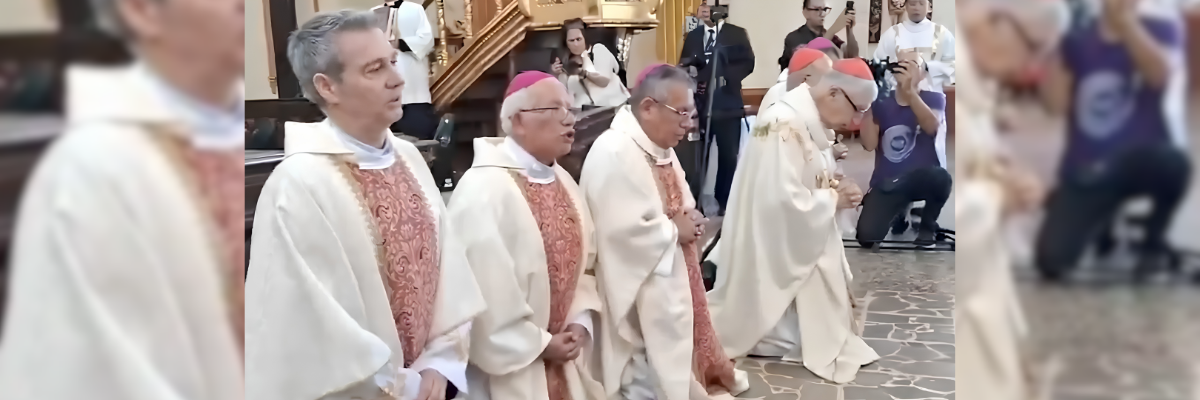
During the liturgy, which coincided with the Solemnity of Pentecost, high-ranking clergy descended from the altar to kneel before the attendees. The group included the Vatican’s apostolic commissioner, Jordi Bertomeu, alongside Cardinal Carlos Castillo Mattasoglio, Archbishop of Lima; Cardinal Pedro Barreto, Archbishop Emeritus of Huancayo; and the archbishops of Piura and Trujillo. This gesture was intended to signify a departure from the historical silence maintained by the ecclesiastical hierarchy regarding the activities of the SVC in the Piura region.
Today we are here to ask for your forgiveness in the name of the Church. We came here, we should have come 20 years ago, and we are truly sorry, please forgive us.
Jordi Bertomeu, Vatican official, via Vatican News
The Legacy of the Sodalitium Christianae Vitae
The Sodalitium Christianae Vitae was formally dissolved by Pope Francis in 2025 following widespread investigations into systemic abuse and corruption. According to reporting from Estadão, the organization’s leadership was found to have committed sexual abuses against 19 minors and 10 adults between 1975 and 2002. Beyond these crimes, the group engaged in aggressive business ventures, particularly in the real estate sector, which led to the displacement of the Tallán people. These business operations were frequently facilitated by complex corporate structures that obscured the involvement of religious figures in local land conflicts.
The Instituto Humanitas Unisinos highlighted that the land disputes were marked by violence and the criminalization of local leaders. Among those remembered during the ceremony were Cristino Melchor Flores and Guadalupe Zapata Sosa, indigenous leaders who died after opposing land-trafficking activities linked to SVC-affiliated companies. As noted by the Vatican News coverage, the investigative work of journalists Pedro Salinas and Paola Ugaz was instrumental in bringing these scandals to light, providing the evidence base that eventually necessitated the Vatican’s intervention.
Institutional Accountability and the Path Forward
The public apology marks a significant shift in the Church’s engagement with the victims, though critics argue that the institutional response has been delayed. During his homily, Cardinal Castillo Mattasoglio described the meeting as “a signal of hope,” while emphasizing the need for the Church to confront its past failures. The ceremony served not only as a request for forgiveness but as a public admission that the Church had neglected its pastoral duties to protect the vulnerable in the Piura region.

According to InfoVaticana, there is ongoing scrutiny regarding how the Church handles other allegations of abuse within Peru. The outlet pointed to pending cases in Huacho and Chiclayo, where victims have criticized the speed and transparency of canonical investigations. Despite the establishment of a “listening channel” by the Vatican in May 2026 to facilitate potential reparations, questions remain regarding how the Church will address the broader structural issues that allowed these abuses to persist for decades. The effectiveness of this channel is currently being monitored by advocacy groups who remain skeptical of internal Church processes.
We ask for forgiveness from God, from you, and from the Church, because we have not always been up to the task. We are very sorry, but please, help us to restore our Church, because we want to walk, especially now with the Peruvian Pope, we want to tread a path of reconciliation and truth here in Peru.
Jordi Bertomeu, Vatican official, via Instituto Humanitas Unisinos
The apostolic mission led by Jordi Bertomeu is tasked with overseeing the dissolution of the organization and ensuring that the assets acquired through the expropriation of communal lands are handled according to canonical and civil law. This process involves coordinating with local civil authorities to verify property titles and address the grievances of families whose livelihoods were destroyed. As the Vatican proceeds with the liquidation of SVC assets, the focus now shifts to the practical implementation of reparations. For the community in Catacaos, the kneeling of the bishops represents a symbolic acknowledgement of their suffering, yet the long-term work of restoring land rights and addressing the legal aftermath of the Sodalitium’s operations remains a complex, unresolved challenge for the Peruvian Church.
The diplomatic implications of the case have drawn attention to the role of international religious orders in local economies. The Vatican’s direct intervention in the affairs of the Sodalitium signals a heightened level of oversight from Rome, aimed at preventing the recurrence of similar abuses. However, local activists emphasize that the path to true reconciliation requires tangible restitution of land, a process that will likely involve prolonged litigation in Peruvian courts, independent of the Church’s internal disciplinary measures.
