
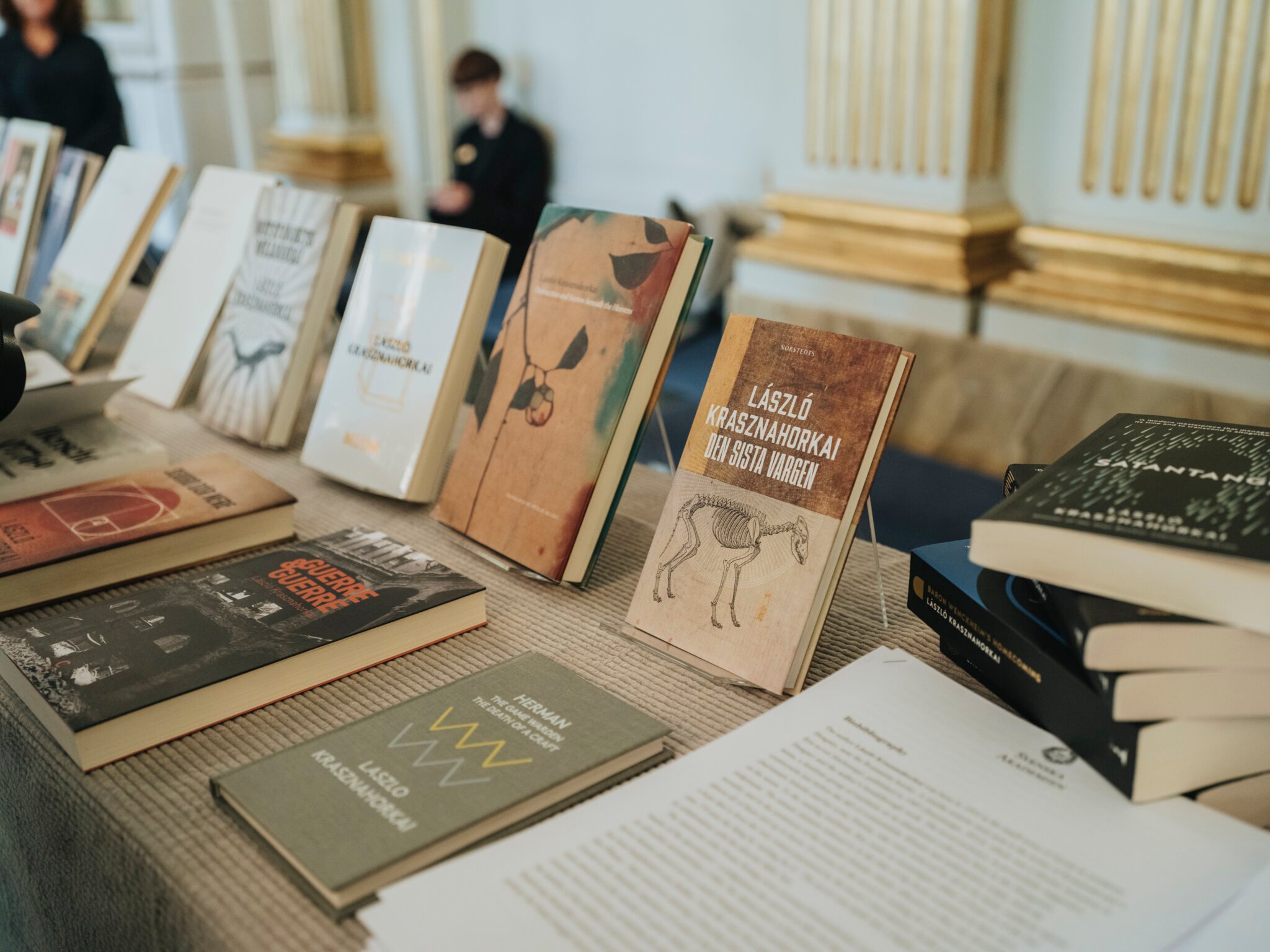
Swedish Academy Members Recommend Works by 2025 Literature Laureate László Krasznahorkai
Members of the Swedish Academy have offered their recommendations for readers seeking an introduction to the work of László Krasznahorkai, who was awarded the Nobel Prize in Literature yesterday.
Steve Sem-Sandberg highlighted Satantango (1985), Krasznahorkai’s debut novel, as “a virtuosic first achievement” that foreshadowed the fall of the communist regime in Hungary. The novel, set in the Hungarian countryside, follows the arrival of two mysterious figures in a struggling agricultural collective, prompting questions about their intentions and unleashing “an apocalyptic dance with infernal consequences.”
Ellen Mattson championed The Melancholy of Resistance (1989), describing it as a darkly humorous and timeless work where a small town is disrupted by strangers and a series of bizarre events. “It is wonderfully dark and darkly funny,” Mattson stated, adding that the novel illustrates how “you have to act even if there is no point to your actions.” Anders Olsson recommended Seiobo There Below (2008), a collection of seventeen episodes exploring the role of art amidst suffering, drawing comparisons to the traditions of Kafka and Thomas Bernhard. He pointed to the opening scene, featuring a heron in Kyoto, as an “elusive image of the situation of the artist.” For a more recent work, Anna-Karin Palm suggested Herscht 07769 (2021), set in eastern Germany, which explores themes of fear, suspicion, and the coexistence of mythology and reality. This award recognizes Krasznahorkai’s profound impact on contemporary literature and his unique stylistic approach.
The Nobel Prize in Literature is awarded annually to an author who has, in the words of Alfred Nobel, produced “the most outstanding work in an idealistic direction.” Further information about the Nobel Prizes can be found at the official Nobel Prize website, and readers interested in exploring Hungarian literature may find resources at Hungarian Literature Online.
Academy members indicated that further discussion regarding Krasznahorkai’s work and legacy will continue in the coming weeks.
