
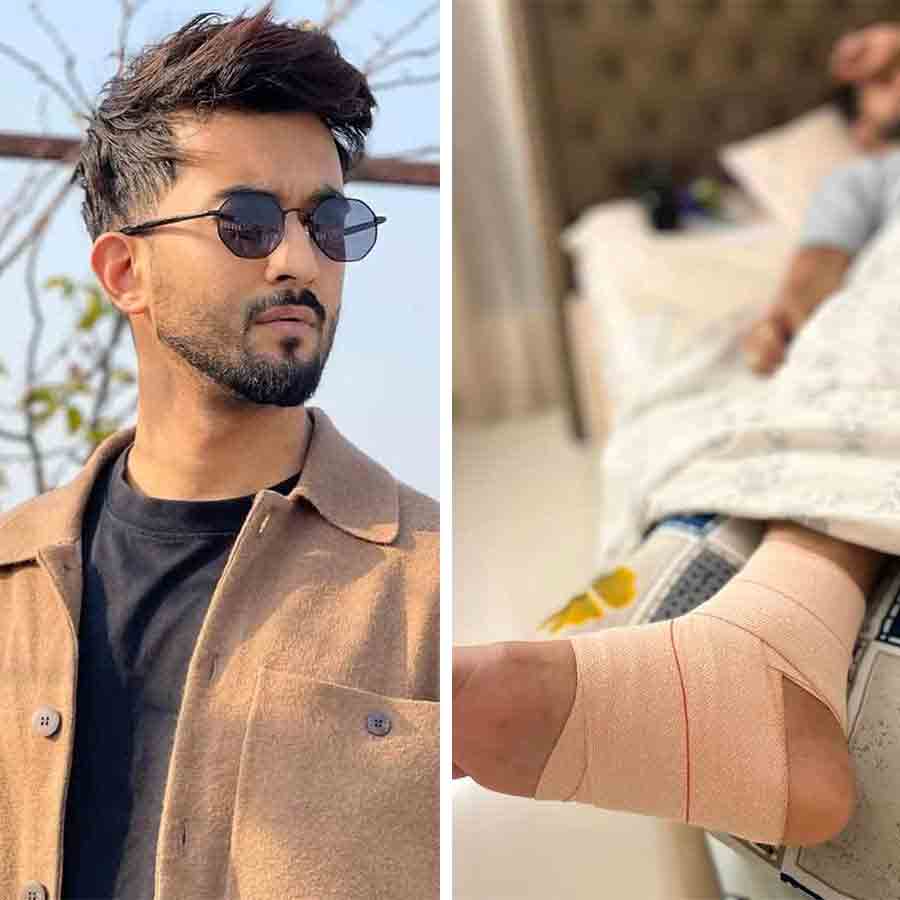
A Hollywood-style accident has collided with real-life drama for Bengali actor Subhrojit Saha, whose career—and the storyline of his popular TV series—now mirror each other in an unexpected twist.
On Friday, May 23, 2026, Saha suffered a severe ligament tear in his right leg while filming the set of the ongoing television series Shudhu Tomar Ei Nyon. The injury occurred when the actor fell during a scene, placing his full body weight on the affected leg—a moment that not only disrupted production but also became the basis for a plot development in the show itself. With his recovery timeline stretching at least four weeks and production forced to adapt, the incident raises questions about how Indian television handles on-set injuries, the blurred line between scripted drama and reality, and the physical toll of high-stakes storytelling.
How a Single Fall Unraveled a Script—and a Career
According to verified reports from Anandabazar Patrika, Saha’s injury began when he lost his balance during a scene and landed heavily on his right leg. The impact was immediate: his entire body weight shifted onto the joint, causing a 60% tear in the ligament. Medical professionals confirmed the diagnosis on Saturday, May 24, and prescribed bed rest for at least four weeks—a timeline that forces the production team to rethink their shooting schedule.
The irony? The same injury had already been scripted for his character, Rahul, in the series. As his wife and co-star Priyanka Mitra explained, “The show was already depicting Rahul recovering from a ligament tear. Life imitated art this time.” The coincidence has sparked conversations about how closely reality now mirrors fiction in Indian television, where on-set accidents are rarely discussed publicly. For Saha, the injury is not just a medical setback but a narrative pivot—one that requires him to film scenes with limited mobility, using a cane for support.
The Production Dilemma: Can a Show Survive Its Star’s Injury?
The immediate challenge for Shudhu Tomar Ei Nyon‘s production team is logistical: how to shoot a series centered on a character recovering from exactly the same injury its lead actor is enduring. Reports indicate the crew has devised a workaround—shooting scenes once every other day to accommodate Saha’s recovery while maintaining the show’s momentum. However, the long-term impact remains uncertain. If the actor’s rehabilitation extends beyond the initial four-week prognosis, the show’s schedule could face further delays, potentially affecting its broadcast timeline.
This isn’t the first time an actor’s real-life injury has influenced a script, but it is one of the most transparent cases in recent Bengali television. Typically, productions downplay on-set accidents to avoid negative publicity. Here, the accident has become a marketing angle, with the show’s promoters likely capitalizing on the “life imitates art” narrative to generate buzz. Yet, the human cost—both for Saha and the crew—remains undeniable. As Mitra noted, “He’s in pain, but he’s determined to finish what he started. The show must go on, even if it means adjusting the pace.”
What This Means for Indian Television’s On-Set Safety Culture
The incident shines a spotlight on the lack of public discussion around on-set safety in Indian television, where physical stunts and high-energy scenes are common but rarely scrutinized. Unlike Hollywood, where unions and safety protocols are strictly enforced, Indian productions often operate with minimal oversight. While no official statistics exist on the frequency of on-set injuries in the industry, anecdotal reports suggest they are not uncommon—yet they are rarely reported.
Saha’s case is unusual not just because of its visibility but because it forces the industry to confront a question: How much risk is acceptable for the sake of storytelling? In a medium where physicality is central—whether in action sequences, dance routines, or dramatic falls—actors often push their bodies to the limit. The absence of a standardized safety protocol means that injuries like Saha’s are treated as unfortunate but inevitable, rather than preventable.
Experts in Indian entertainment law and production have long argued for stricter safety measures, including mandatory medical checks, stunt coordinators, and insurance coverage for on-set injuries. While some big-budget films and web series have adopted these practices, smaller productions—where many TV shows fall—often cut corners. Saha’s injury, now tied to a high-profile series, could serve as a catalyst for change, pressuring producers to prioritize actor welfare over schedule demands.
The Human Story: Pain, Pride, and the Pressure to Perform
Behind the script adjustments and production logistics lies Saha’s personal struggle. The actor, known for his intense physical roles, has described the pain as “unbearable at first”, with his leg swelling almost immediately after the fall. Medical treatment includes intensive medication and physical therapy, but the road to recovery is slow. Despite the discomfort, Saha has committed to filming—though he now relies on a cane and must limit standing time to avoid further damage.

His determination reflects a broader cultural expectation in Indian entertainment: that actors, regardless of their physical condition, must deliver. There is little room for absences or delays, as schedules are tight and budgets are often fixed. For Saha, this means balancing his recovery with the demands of the show—a tightrope walk that could set a precedent for how future injuries are handled in the industry.
Yet, there’s also a sense of camaraderie. Mitra’s immediate response—rushing to the set to support her husband—highlights the personal stakes of on-set injuries. In an industry where actors often work long hours under pressure, such moments reveal the human cost of performance. The incident has also sparked conversations among fans and industry insiders about the need for better support systems, from medical assistance to flexible shooting schedules.
What Comes Next: Recovery, Rescheduling, and the Future of the Show
The next few weeks will be critical for both Saha’s recovery and the future of Shudhu Tomar Ei Nyon. If he adheres to the four-week bed-rest recommendation, the show’s production team will need to either:
- Extend the shooting schedule, delaying episodes and potentially affecting broadcast deadlines.
- Reduce the actor’s screen time, altering the narrative arc of his character’s recovery.
- Bring in a stunt double for physically demanding scenes, though this risks breaking the show’s continuity.
For now, Saha remains focused on healing, though he has expressed his commitment to returning to the set as soon as possible. The show’s producers have not yet commented on long-term adjustments, but industry insiders suggest they are exploring ways to integrate his recovery into the storyline, further blurring the line between fiction and reality. Whether this becomes a one-time anomaly or a turning point for on-set safety remains to be seen—but one thing is certain: the incident has already rewritten the script.
As for Saha, the actor’s experience serves as a reminder of the unseen sacrifices behind every screen performance. In an industry where physicality is celebrated, injuries like his are often treated as collateral damage. But in this case, the damage has become the story—and the story is far from over.
