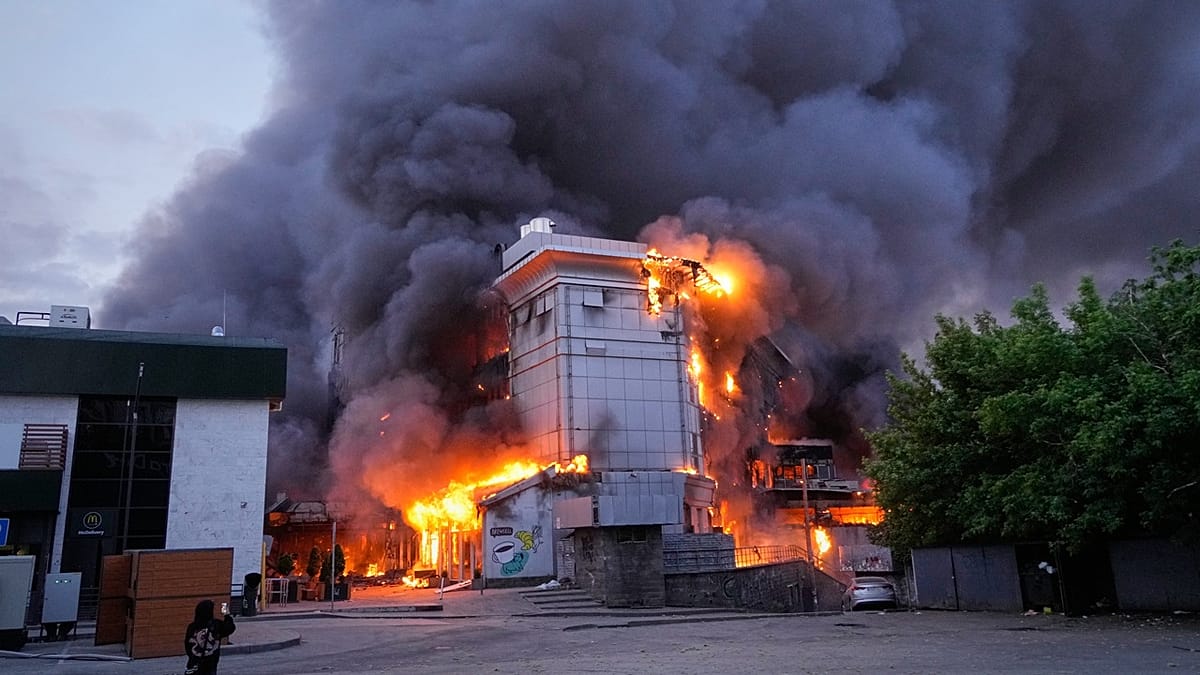
Russia launched a major air offensive against Kyiv on Sunday, May 24, 2026, utilizing a combination of drones and missiles, including the hypersonic Oreshnik. The attack, which struck residential areas and infrastructure, resulted in at least four deaths and dozens of injuries, marking a significant escalation in the ongoing conflict between Moscow and Ukraine.
A Retaliatory Strike Across the Capital
The military offensive, which unfolded during the early hours of Sunday, targeted multiple districts throughout the Ukrainian capital. Regional authorities reported that the barrage included cruise, ballistic, and aeroballistic missiles, alongside a swarm of attack drones. According to Euronews, the assault caused significant damage to residential buildings, schools, and essential city infrastructure, with the impact felt across at least nine districts in Kyiv. Emergency services were deployed across the city to clear debris and search for survivors trapped in the rubble of residential blocks hit during the early morning hours.
cluster (priority): Euronews.com
The Russian Ministry of Defense confirmed the operation, characterizing it as a response to what it described as crimes against Russian civilians. Specifically, Moscow cited a recent deadly strike on a student dormitory in Starobelsk, located in the Luhansk region. Russian officials claimed their forces successfully targeted military command centers, intelligence facilities, and components of Ukraine’s defense industrial complex, while explicitly denying that the strikes were aimed at civilian infrastructure, as reported by La Iguana. Ukrainian officials have consistently rejected these Russian claims, asserting that the targets were strictly civilian in nature and part of a broader campaign to degrade the morale and endurance of the Ukrainian population.
The Deployment of Oreshnik
Central to the intensity of the latest offensive was the use of the Oreshnik, a multi-warhead hypersonic ballistic missile. President Vladimir Putin has previously stated that the weapon is capable of reaching speeds up to ten times the speed of sound and is designed to penetrate deep into hardened, subterranean bunkers.
cluster (priority): Clarin.com
“The weapon travels like a meteorite and is immune to any missile defense system, added Putin, who maintained that several missiles of this type, even equipped with conventional warheads, could be as devastating as a nuclear attack.” — Vladimir Putin, President of Russia, via Euronews
Western nations accelerate air defense to Ukraine as Russia launches new offensive
While the Oreshnik has been deployed sparingly—with previous instances recorded in November 2024 and January 2026—its appearance in the Kyiv skies underscores a tactical shift toward high-velocity intimidation. As noted by Clarin, the missile’s versatility allows it to carry either conventional or nuclear-capable warheads, a duality that has heightened alarm among international observers regarding the risk of nuclear escalation. Military analysts monitoring the conflict noted that the use of such a high-tier asset against a capital city represents a departure from standard tactical operations, signaling a Russian intent to demonstrate capabilities that existing air defense systems in the region may struggle to intercept.
International Condemnation and Defensive Stance
The European Union has responded with sharp rhetoric, labeling the attack as a deliberate act of terror against urban centers. Kaja Kallas, the European Union’s High Representative for Foreign Affairs, condemned the use of the Oreshnik as a reckless political tactic.
“They are abominable terrorist acts.” — Kaja Kallas, High Representative for Foreign Affairs of the European Union, via Infobae
Kallas further warned that the use of such weaponry constitutes a political tactic of intimidation and a reckless policy of nuclear risk. European leaders are currently coordinating on how to increase international pressure on Moscow, with discussions planned for an upcoming informal meeting in Cyprus. The agenda for this meeting is expected to focus on strengthening the security architecture of the European continent and evaluating the effectiveness of current sanctions regimes in light of continued Russian military innovation. Meanwhile, the President of the European Commission, Ursula von der Leyen, pledged that the EU is working to expedite the delivery of additional air defense systems to bolster Ukraine’s ability to intercept future barrages, emphasizing that the protection of Ukrainian airspace remains a top priority for the European bloc.
Stakes on the Ground and Diplomatic Fallout
The human toll of the weekend’s violence remains a point of intense contention. While Russian sources maintain their strike was precision-targeted at military objectives, Ukrainian authorities, including President Volodímir Zelensky, documented widespread destruction of civilian life, including schools and historic landmarks like the Chernobyl Museum. The Ukrainian government has called for an independent verification of the strike sites, inviting international observers to document the damage and the proximity of the impacts to non-military structures.
cluster (priority): Infobae
The diplomatic friction was on full display at an emergency United Nations Security Council session requested by Russia. During the proceedings, the Ukrainian representative rejected allegations of war crimes, dismissing the Russian narrative as propaganda and maintaining that Ukraine’s military operations are directed strictly at dismantling the Russian war machine. The session highlighted the deepening divide within the international community, with several delegations expressing concern over the potential for the conflict to expand beyond its current borders. As the conflict enters this new phase, the deployment of hypersonic systems like the Oreshnik serves as a stark reminder of the escalating technological reach of the war, leaving both regional stability and diplomatic pathways to peace increasingly fragile. The UN Secretary-General’s office reiterated calls for an immediate cessation of hostilities, stressing that the use of advanced ballistic technology in proximity to dense civilian populations risks catastrophic outcomes.
Bio:
John Smith is the World Editor at Headlinez.News, leading the global news desk and overseeing international correspondents. With 15 years of field experience across Europe, the Middle East, and Asia, John has reported from conflict zones, summits, and humanitarian missions. His deep understanding of geopolitical trends and cross-cultural reporting ensures that readers receive accurate, balanced perspectives on world events that shape the global narrative.
Expertise: International reporting, geopolitics, diplomacy, conflict journalism, foreign policy analysis.
Location: London, United Kingdom