
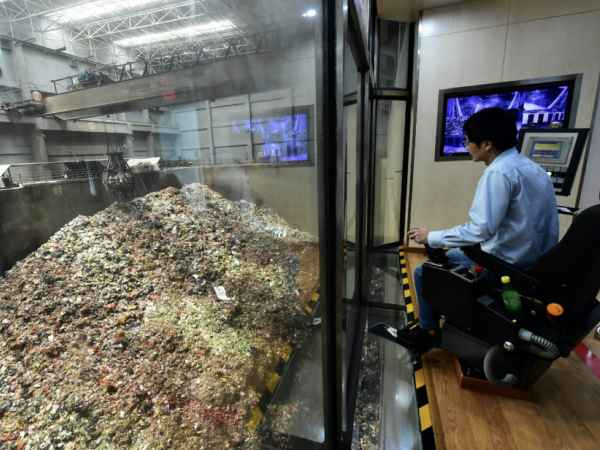
China’s nationwide garbage classification initiative, launched in 2019 to combat a mounting waste crisis, has led to an unexpected paradox: incineration plants now face a shortage of waste to burn, prompting desperate measures like excavating decades-old landfills. The policy, initially designed to reduce landfill use and boost recycling, has created a system where facilities must compete for garbage, sometimes resorting to controversial tactics. Meanwhile, localized campaigns in Anhui and Macau-Zhuhai highlight contrasting approaches to public engagement, raising questions about scalability and long-term sustainability.
The Paradox of Waste: From Classification to Scarcity
China’s garbage classification drive, mandated in 2019, aimed to transform waste management by separating trash into four categories: kitchen waste, recyclables, hazardous materials, and residual waste. At the time, landfills were nearing capacity, with 90% of urban waste buried—a practice that contaminated groundwater and rendered land unusable. Incineration was touted as a solution, but early technology struggled to process wet or hazardous waste, limiting its effectiveness. “Only dry waste was suitable for burning,” a 2025 report noted, highlighting the mismatch between policy goals and technical realities.
By 2026, however, the landscape had shifted dramatically. Incineration plants, now equipped with advanced technology, no longer require selective sorting. Instead, they face a critical shortage of waste. “The problem isn’t that people aren’t sorting—it’s that there’s not enough waste left to burn,” said a 2026 analysis. This scarcity has led to “garbage wars,” with facilities offering bribes to property managers, cross-border competition, and even the excavation of old landfills. In Shenzhen, a 1983 landfill containing 400,000 tons of waste was dug up in 2025, while Guangzhou’s plants began excavating a 160,000-ton site in April 2026.
According to news.google.com, these efforts are financially and environmentally costly. “Digging up landfills is a short-term fix,” one expert warned. “The real issue is that China’s incineration capacity now exceeds its waste production by a factor of 10.” With 400 million tons of waste burned annually in a country that generates 200 million tons, the imbalance underscores a deeper systemic flaw: the policy’s success in reducing landfill use has outpaced its ability to manage waste streams.
Local Successes: Anhui’s Community-Driven Approach
In contrast to the national scramble, Anhui’s Xiuning County has achieved notable progress through targeted outreach. The county’s “Xiangyin Chuanqing” (Village Voice) campaign used local dialects, school programs, and hands-on training to engage residents. “We made it simple: ‘Put the vegetable scraps in the green bin, the plastic in the blue, and the batteries in the red,’ ” said a 2026 report. The initiative, which included 500+ community interactions and 800+ educational materials distributed, reduced misclassification errors by 60% in its first year.
The program’s emphasis on “learning by doing” extended to schools, where children toured waste facilities and saw how their trash was processed. “They realized their garbage wasn’t just thrown away—it became energy,” a 2026 article noted. This intergenerational approach, combined with training for 132 community workers, helped shift behaviors beyond mere compliance. “It’s not just about rules,” one resident said. “It’s about understanding the impact of your actions.”
Hong Kong Commercial News highlighted the program’s scalability, suggesting that localized strategies could complement national policies. Yet critics argue that such efforts remain isolated. “Xiuning’s success is a model, but it’s not a solution for a country of 1.4 billion,” one analyst said.
Macau-Zhuhai’s Green Vision: Collaboration Over Competition
In the Macau-Zhuhai region, the fourth annual garbage classification week emphasized cross-border cooperation. The event, hosted by the Hengqin Guangdong-Macau Cooperation Zone, brought together officials, community leaders, and residents to promote “recycling as a new lifestyle.” A 2026 report described the initiative as a “bridge between two systems,” with Macau’s community organizations partnering with Zhuhui’s waste management agencies.

Key to the campaign was the “Green Market” event, where 300+ residents participated in interactive workshops and eco-friendly activities. Children earned rewards for learning classification rules, while volunteers demonstrated how to sort waste at home. “We’re not just teaching people to recycle—we’re building a culture,” said a 2026 statement from the Hengqin Development Committee. The event also included a “Recycling Classroom,” where experts explained how waste is converted into energy or raw materials.
Taichung Daily noted the region’s focus on “green innovation,” with plans to expand its recycling infrastructure. Yet the event’s emphasis on collaboration stood in stark contrast to the national trend of incineration plants competing for limited resources. “This is the future,” said a 2026 participant. “Instead of fighting over waste, we should be working together to reduce it.”
What’s Next? The Road to Zero Waste
The current crisis highlights a fundamental tension: China’s push for incineration has created a system where waste is both a resource and a liability. With 50% of global incineration capacity now in China, the country faces a critical decision: continue expanding facilities or pivot toward waste reduction. “The next phase must focus on prevention, not just processing,” said a 2026 policy brief.
Experts suggest a multi-pronged approach: stricter regulations on single-use plastics, incentives for circular economies, and investment in composting. “We can’t burn our way out of this,” one researcher said. “We need to rethink how we produce and consume.”
As the nation grapples with these choices, the contrast between localized successes and national challenges remains stark. While Xiuning’s model offers hope, and Macau-Zhuhai’s collaboration signals progress, the broader system still lacks a cohesive vision. “This isn’t just about waste,” said a 2026 analyst. “It’s about how we define progress in a world running out of space.”
