

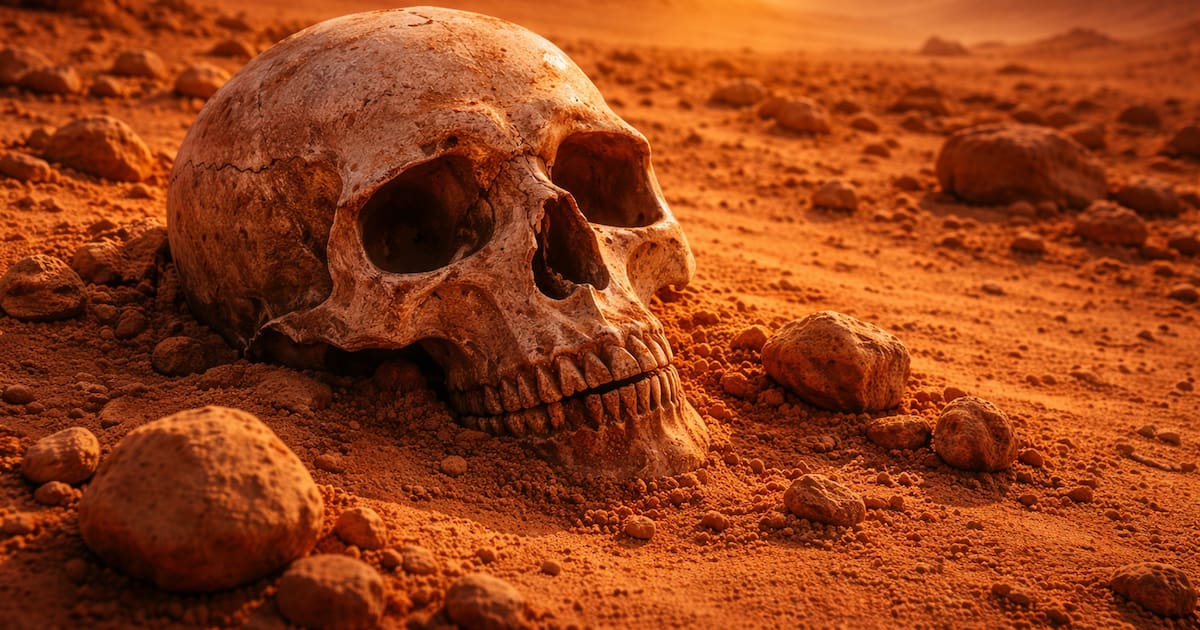
NASA’s Perseverance rover has uncovered a rock formation on Mars so eerily skull-like that scientists are scrambling to explain its origin—and what it might reveal about the planet’s ancient geology. Dubbed “Skull Hill” by researchers, the rock was discovered in February 2026 within the Jezero Crater’s “Port Anson” region, near the base of “Witch Hazel Hill.” Unlike typical Martian meteorites, this formation contains no iron or nickel, ruling out an extraterrestrial impact origin. Instead, preliminary analysis confirms it’s an igneous rock formed from volcanic activity, its dark minerals and granular texture offering clues to Mars’ long-extinct volcanic past.
A Martian Mystery: Why This Rock Looks Like a Skull—and What It Means
At first glance, the rock’s hollow cavities and spherical surface textures resemble a fossilized skull, sparking comparisons to Earth’s most famous “alien skull” hoaxes. But NASA’s Perseverance team quickly dismissed extraterrestrial theories. The rock’s composition—a mix of dark minerals like amphibole, biotite, and pyroxene—matches volcanic basalt found elsewhere on Mars, including the Gale Crater studied by the Curiosity rover. What sets “Skull Hill” apart is its isolation: unlike the surrounding lighter-toned sedimentary rocks, this formation appears to have traveled hundreds of meters before settling in its current location, possibly via ancient water flows or volcanic eruptions.


“This rock contrasts with its surroundings and could give us clues about distant geological processes.
The discovery forces scientists to reconsider how Martian rocks form and migrate. While igneous rocks are common on Mars—evidenced by Olympus Mons, the solar system’s largest volcano—”Skull Hill” stands out due to its unusual shape and compositional purity. Most Martian meteorites contain nickel and iron, but this rock’s lack of those metals suggests it formed from a unique volcanic event, possibly one tied to Jezero Crater’s ancient lake system. Researchers are now debating whether the rock’s “skull-like” features are purely coincidental or hint at erosion patterns from water or wind that shaped it over millions of years.
From Skull Hill to Scientific Goldmine: How This Rock Could Rewrite Martian History
Jezero Crater wasn’t chosen as Perseverance’s landing site randomly. NASA selected it for its high potential to preserve signs of past microbial life, thanks to its ancient river delta and lakebed. The discovery of “Skull Hill” adds another layer to this geological puzzle. Igneous rocks like this one can trap and preserve organic molecules, making them prime targets for the rover’s sampling campaigns. If the rock contains traces of past water interactions—or even microbial fossils—it could become one of the most significant finds in Mars exploration since the 2012 Curiosity landing.
- Volcanic origin: Formed from cooled magma, rich in dark minerals like pyroxene and olivine.
- No meteorite link: Lacks iron/nickel, ruling out an impact origin.
- Possible water exposure: Surface textures suggest erosion from liquid water or wind.
- Scientific value: Could preserve organic molecules from Mars’ wet past.
Yet the rock’s most intriguing aspect may be its geological age. Mars’ surface is ancient—some regions date back 4 billion years—but determining “Skull Hill’s” exact age will require lab analysis on Earth. If the rock is as old as Jezero Crater itself (estimated at 3.7–4 billion years), it could offer a window into Mars’ early climate, when liquid water flowed freely and the planet may have hosted life. NASA’s sample return mission, slated for the late 2020s, will be critical in unlocking these secrets.
The Bigger Picture: What This Discovery Means for Mars—and Earth
The “Skull Hill” discovery isn’t just a quirky Martian oddity—it’s a reminder of how little we still understand about our planetary neighbor. While the rock’s shape may evoke sci-fi tropes, its scientific implications are grounded in hard geology. For one, it challenges assumptions about how Martian rocks erode and transport. On Earth, similar-looking formations often result from water or glacial activity, but Mars’ thin atmosphere and lack of plate tectonics create entirely different processes.
More broadly, the find underscores the value of robotic exploration. Without Perseverance’s high-resolution cameras and spectrometers, this rock might have been dismissed as just another boulder. But its unusual composition and location have made it a focal point for the mission’s extended stay in Jezero Crater. As NASA prepares to send samples back to Earth, discoveries like this one will shape the next decade of Martian research—potentially leading to breakthroughs in planetary science, astrobiology, and even our understanding of how life might arise on rocky worlds beyond our solar system.
What’s Next? The Race to Solve the Skull Hill Enigma
NASA’s team is now prioritizing two key questions: How did this rock form? and What can it tell us about Mars’ past?
- Detailed spectral analysis: Using Perseverance’s SHERLOC and PIXL instruments to map mineral distribution and detect organic compounds.
- Sample collection: If deemed scientifically valuable, the rock may be cored and cached for the Mars Sample Return mission.
- Contextual mapping: Studying surrounding rocks to determine if “Skull Hill” is part of a larger volcanic deposit or an isolated anomaly.
- Erosion modeling: Simulating how wind and water might have shaped its “skull-like” features over millennia.
Beyond the science, the discovery has sparked public fascination—and no small amount of speculation. Social media has dubbed it the “Martian Skull,” reviving debates about ancient civilizations on Mars. But scientists remain focused on the data. As Margaret Deahn noted, “Its dark tone and visible grains in the regolith are valuable clues,” not evidence of anything beyond natural geological processes. Still, the find serves as a humbling reminder: even in our most advanced robotic explorations, Mars continues to surprise us.
For now, “Skull Hill” remains a tantalizing mystery—a rock that looks like a relic from another world, yet formed from the same cosmic ingredients that built Earth. As Perseverance continues its mission, one thing is clear: the story of Mars is far from over.
