
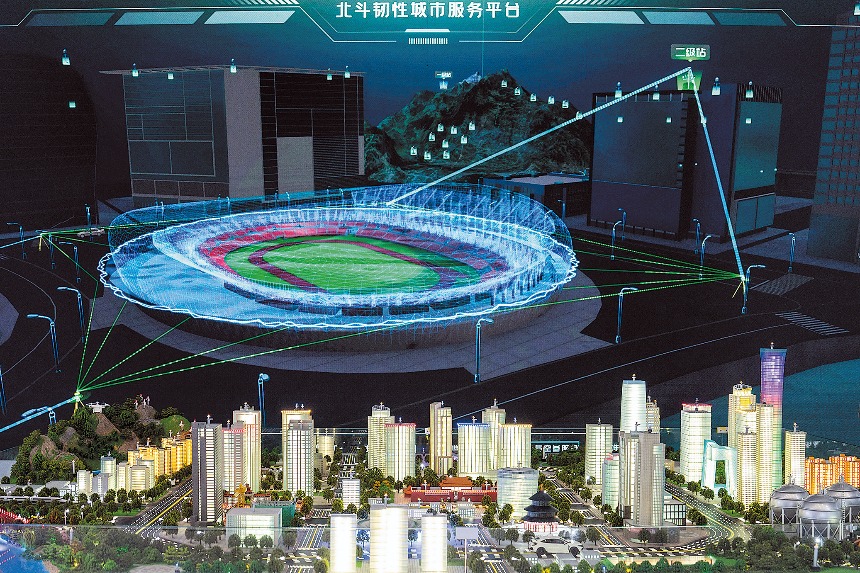
China Accelerates Development of Satellite Internet, Beidou Navigation System
China is rapidly advancing the integration of its satellite internet infrastructure with the Beidou Navigation Satellite System, aiming to bolster both technological innovation and economic growth.
China Satellite Network Group Co Ltd has achieved a global first by successfully completing a broadband video call using a 5G non-terrestrial network (5G NTN) standard via a new technology test satellite, validating a space-terrestrial integrated network system. “Looking ahead, the company plans to integrate technological innovation with industrial development, deepen the synergy between satellite internet and the Beidou system, and accelerate the emergence of new quality productive forces,” said Liang Baojun, general manager of China Satellite Network Group. This development is crucial as global demand for ubiquitous connectivity increases, particularly in remote areas.
Established in April 2024, China Time and Space Information Group, a collaboration between China Satellite Network Group, China North Industries Group Corp Ltd, and China Mobile, is focused on developing Beidou short messaging and high-precision infrastructure. The group has already launched commercial trials of Beidou short messaging services in provinces including Hebei, Chongqing, and Hunan, and has established a national spacetime information operation service platform. The value of China’s Beidou industry reached 575.8 billion yuan ($80.74 billion) in 2024, a 7.39 percent year-on-year increase, according to a recent report. For more information on the Beidou system, see the official Beidou website.
Applications of Beidou technology are expanding beyond traditional navigation, now integrated into shared bikes, robots, drones, and even mountaineering suits. In Zhuzhou, Hunan province, 5,000 shared electric bikes equipped with Beidou navigation have improved positioning accuracy to within 30 centimeters, enhancing urban management. Ground-based augmentation stations worldwide now offer precision up to millimeter and nanometer levels, opening new possibilities for industries relying on precise positioning, like those discussed in the U.S. GPS website.
Officials stated that the company will continue to expand Beidou’s international presence, focusing on countries within the Belt and Road Initiative to develop pilot projects and explore global markets.
China Satellite Network Group Co Ltd is accelerating efforts to drive the coordinated development of satellite internet and the Beidou Navigation Satellite System, highlighting it as both the responsibility and strength of the company.
Liang Baojun, general manager of China Satellite Network Group, said the company is actively advancing the development of satellite internet while focusing on long-term technological evolution.
In May, the company achieved a global first by successfully conducting a broadband video call using a 5G non-terrestrial network standard, or 5G NTN standard, via a new technology test satellite, effectively validating the space-terrestrial integrated network system, Liang said.
A 5G NTN standard enables the integration of satellites and other non-terrestrial platforms into the global 5G ecosystem, providing ubiquitous, high-speed wireless connectivity to underserved areas and expanding existing mobile services to the skies, seas and remote locations.
“Looking ahead, the company plans to integrate technological innovation with industrial development, deepen the synergy between satellite internet and the Beidou system, and accelerate the emergence of new quality productive forces,” Liang said.
In April, 2024, China Satellite Network Group, in collaboration with the China North Industries Group Corp Ltd and China Mobile, established China Time and Space Information Group.
Over the past year, the newly formed group has focused on its core mission, integrating business resources and systematically developing Beidou short messaging and high-precision infrastructure. A unified spacetime basic data network has been established, and the company has built a national spacetime information operation service platform, enhancing end-to-end operational capabilities, Liang said.
Additionally, China Time and Space Information Group has launched application demonstrations in collaboration with provinces and regions such as Hebei, Chongqing, and Hunan conducting commercial trials of Beidou short messaging services for the public, with significant progress in large-scale applications.
According to Liang, innovation is a defining feature of the Beidou system and should remain a central theme in its applications. China Time and Space Information Group will strengthen its strategic core technology capabilities, enhance self-reliant innovation, and intensify research in high-precision positioning, secure spacetime information services, multi-source data fusion, and smart technologies.
Meanwhile, the purpose and value of Beidou lie in its applications. Focusing on key industries, China Time and Space Information Group will explore emerging applications, develop innovative solutions and create landmark demonstrations. In key regions, it will leverage local advantages and co-create typical application scenarios, demonstrating Beidou”s comprehensive applications and empowering local economic and social development, Liang added.
The company said it will also expand Beidou’s international presence, focusing on countries and regions involved in the Belt and Road Initiative to develop overseas pilot projects and explore global markets.
From unmanned vessels to mountaineering suits, shared bikes, robots and drones, Beidou satellite navigation technology has been deeply integrated into cutting-edge fields as well as everyday life, empowering various industries and benefiting people worldwide.
At the 4th International Summit on Beidou Navigation Satellite System Applications, held in Zhuzhou, Hunan province, in September, thousands of application scenarios were on display, showcasing solutions in sectors such as energy, transportation, agriculture, communications and emergency response.
In Zhuzhou, the host city of the event, 5,000 shared electric bikes equipped with Beidou navigation devices were deployed this year. This initiative, the first in China to use BDS spatiotemporal intelligence on shared electric bikes, significantly enhanced the positioning accuracy of the vehicles from within 10 meters to 30 centimeters.
The technology makes it easier to locate or accurately park a bicycle, offering an effective approach to refined urban management, said Chen Jinpei, CEO of Qianxun Spatial Intelligence Inc, the service provider.
“We have established more than 6,000 ground-based BDS augmentation stations worldwide, offering services with precision up to millimeter and nanometer levels, uncovering new possibilities for various industries,” Chen said.
According to a report released at the summit, the value of China’s Beidou industry reached 575.8 billion yuan ($80.74 billion) in 2024, a growth of 7.39 percent year-on-year.
masi@chinadaily.com.cn
