
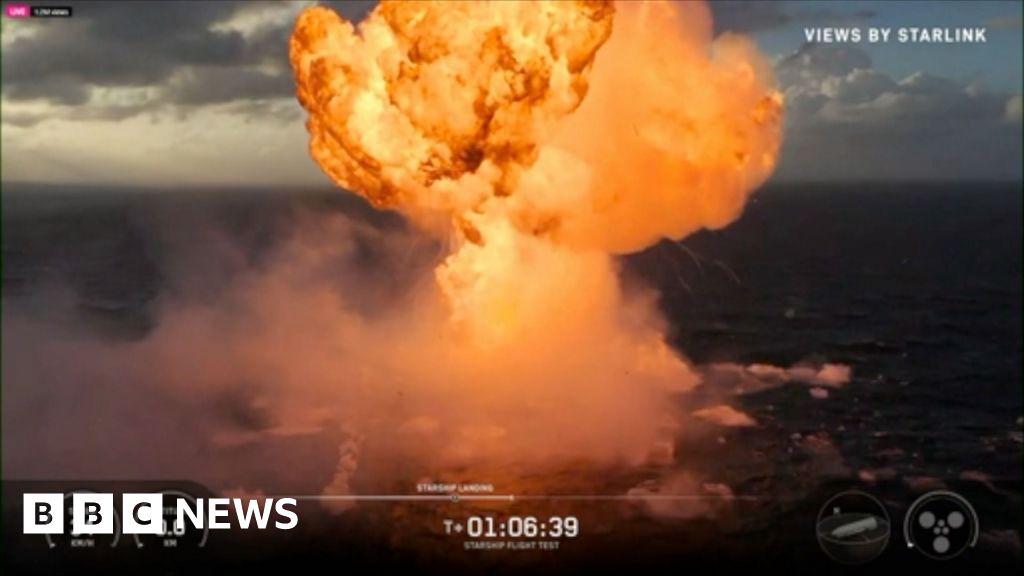
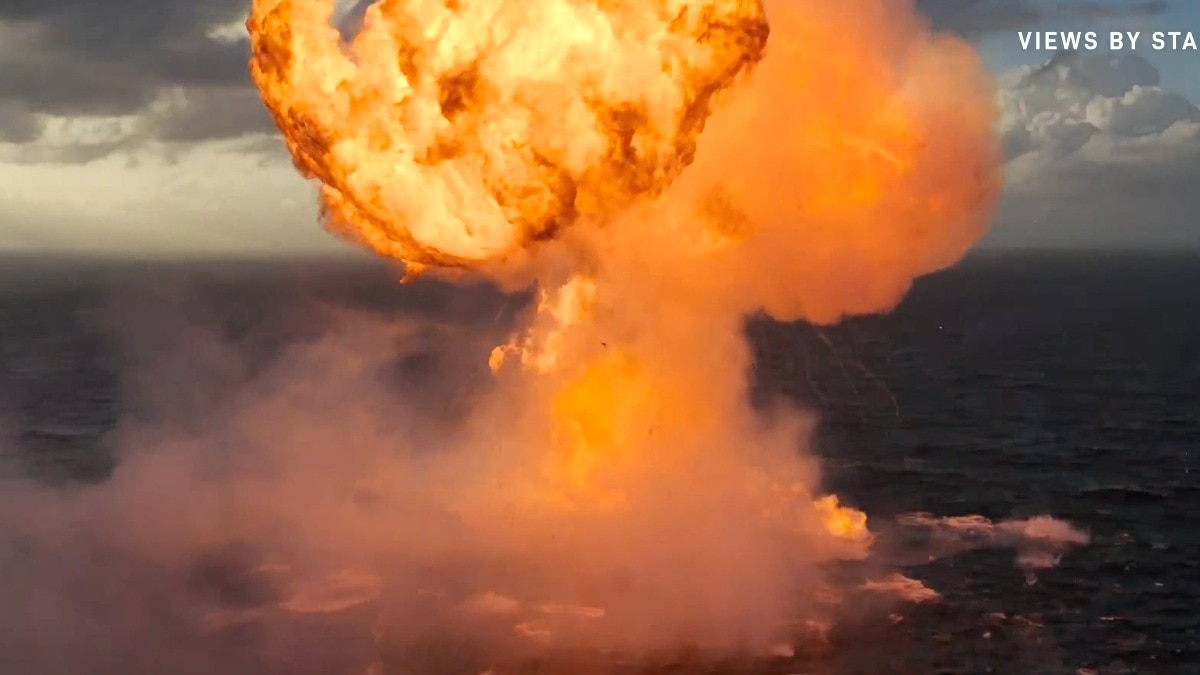
SpaceX’s Starship V3 rocket exploded in the Indian Ocean on May 23, 2026, after completing a high-stakes test flight that marked the largest controlled splashdown in aerospace history—but the fiery finale was by design.
Elon Musk’s company successfully guided the massive Starship spacecraft through an hour-long mission, achieving nearly all primary objectives before the planned “hard splashdown” in a remote Indian Ocean zone. The explosion, visible across the ocean surface, was the culmination of a test flight that pushed the boundaries of re-entry technology and recovery operations. While both the Super Heavy booster and Starship stages suffered engine failures, the mission demonstrated unprecedented control over the world’s most powerful rocket system—setting the stage for future Moon and Mars missions.
Why This Explosion Wasn’t a Failure
Contrary to initial reactions, the explosion was not an accident but a deliberate endpoint for SpaceX’s most ambitious test flight to date. According to the BBC, the rocket’s splashdown in the Indian Ocean was part of a “hard landing” protocol designed to gather critical data on atmospheric re-entry and structural integrity. The BBC reported that both stages of the rocket—Starship and its Super Heavy booster—suffered engine failures, but the controlled descent itself was a triumph of navigation precision.
The mission’s success hinged on two key maneuvers: first, guiding the 120-meter-tall Starship across the globe before initiating re-entry, and second, executing a dramatic flip into landing orientation just above the ocean surface. As India Today detailed, this final flip—critical for stabilizing the rocket during descent—was a moment SpaceX had refined through repeated test flights. The explosion that followed was the expected result of a “hard splashdown,” where the rocket’s velocity and angle were intentionally maintained to simulate worst-case landing scenarios.
Engineers have long treated splashdowns as “controlled destruction” events—opportunities to test how far they can push the limits of the vehicle before it breaks apart. This mission was no different. The ability to hit a precise splashdown target in the Indian Ocean, thousands of kilometers from the launch site in Texas, proved SpaceX’s growing mastery over long-duration flight dynamics. “Hard splashdowns” are a calculated risk: they destroy the hardware but provide irreplaceable data on heat shielding, aerodynamic stress, and recovery systems.
The Mission’s Hidden Achievements
While the dramatic explosion dominated headlines, the real story lies in what SpaceX accomplished before the splashdown. The rocket’s Super Heavy booster successfully separated from Starship in orbit, a milestone that had eluded previous test flights. Both stages then executed independent burns to de-orbit, a complex maneuver that required precise timing and fuel management. According to the BBC, this separation was “cleaner” than in past attempts, suggesting SpaceX is closing in on solving the persistent issue of stage separation reliability.
The Indian Ocean splashdown zone was chosen not just for its remoteness but for its role as a proving ground for future lunar and Martian missions. NASA’s Artemis program, which plans to use a modified Starship for crewed Moon landings, will rely on similar re-entry profiles. The ability to guide a vehicle through Earth’s atmosphere at extreme velocities—without relying on parachutes or traditional landing systems—is a prerequisite for missions to Mars, where atmospheric conditions are far thinner than Earth’s.

Key milestones from the flight:
- Ascent and separation: Super Heavy booster and Starship stage separated successfully in orbit, a critical step for future missions.
- Orbital flight: Starship completed a full lap around Earth, demonstrating sustained propulsion and trajectory control.
- Re-entry flip: The rocket executed a 90-degree flip mid-descent, a maneuver never before attempted at this scale.
- Splashdown precision: The vehicle hit its target zone in the Indian Ocean within meters of the planned coordinates.
- Engine failures: Both stages experienced engine outages during descent, but these were expected and did not compromise the primary objectives.
What This Means for SpaceX’s Moon and Mars Ambitions
This test flight wasn’t just about proving Starship could survive re-entry—it was about proving it could be controlled. For NASA’s Artemis program, where Starship will serve as the lunar lander, the ability to guide a vehicle through extreme atmospheric conditions is non-negotiable. A “hard splashdown” like this one simulates the kind of high-velocity re-entry astronauts will face when returning from the Moon, where Earth’s atmosphere is thicker than Mars’ but still demands precision.
SpaceX’s long-term goal is to use Starship as the backbone of its Mars colonization plans. The rocket’s sheer size—nearly three times the payload capacity of the Saturn V—is designed to carry hundreds of tons of cargo and eventually crew to the Red Planet. However, Mars presents a unique challenge: its thin atmosphere means traditional re-entry techniques won’t work. The data from this splashdown test will inform how Starship might deploy heat shields, aerodynamic surfaces, or even inflatable structures to slow descent on Mars.
Industry analysts have long noted that SpaceX’s rapid iteration cycle—launching, failing, and learning from each test—is unmatched in modern aerospace. This mission fits that pattern. While the explosion was expected, the fact that Starship achieved orbital flight and a controlled splashdown means SpaceX is now closer to solving the puzzle of how to land a massive vehicle on another planet. The next step? Refining the landing systems to survive the impact rather than explode on contact.
The Road Ahead: What Comes Next?
The immediate next steps for SpaceX will focus on two areas: analyzing the debris from the splashdown to understand structural failures, and preparing for the next orbital test flight. The BBC reported that engineers will prioritize the engine failures that occurred during descent, which may require redesigns to the Raptor engine’s turbomachinery. Meanwhile, NASA’s Artemis team will review the re-entry data to assess whether Starship meets the safety requirements for crewed lunar missions.
Looking further ahead, SpaceX is expected to shift its focus to developing a reusable first-stage booster—a critical component for reducing the cost of deep-space missions. The Super Heavy booster that launched this Starship was not recovered, but future flights will attempt to bring it back to the launch site for refurbishment. If successful, this could dramatically cut the cost of Mars missions, where every kilogram of payload counts.
One question looms over the program: When will Starship finally land intact? Previous attempts have ended in explosions or crashes, but this mission demonstrated that SpaceX is now capable of guiding the vehicle through the most dangerous phase of flight. The next test will likely focus on refining the landing systems to survive the impact—perhaps by deploying a heat-resistant base or using a softer splashdown technique. Until then, “hard splashdowns” will remain a necessary evil in the race to master interplanetary travel.
The Bigger Picture: Why This Matters for Space Exploration
Starship’s test flight is more than a technical milestone—it’s a statement about the future of space exploration. Traditional aerospace programs, like NASA’s Apollo or the Space Shuttle, relied on incremental improvements over decades. SpaceX, by contrast, is betting on rapid, iterative testing to solve the hardest problems first. The explosion in the Indian Ocean wasn’t a setback; it was proof that the company is willing to push the envelope, even if it means losing rockets along the way.
For NASA, this mission is a vote of confidence in SpaceX’s ability to deliver on its Artemis commitments. The lunar lander variant of Starship must be ready by 2028 to support crewed missions, and today’s test flight brings that timeline within reach. Meanwhile, private companies like SpaceX are reshaping the economics of space travel. By treating rockets as disposable—at least in the short term—they’re accelerating innovation in ways that government-led programs couldn’t.
The ultimate goal remains unchanged: to make humanity a multi-planetary species. But the path to Mars is littered with technical hurdles, and today’s splashdown explosion was a reminder that the journey will be messy. What matters now is whether SpaceX can translate this data into a working system—one that doesn’t just splash down, but lands safely, again and again.
