

Lithuania’s government is set to resign on June 23, 2026, after its ruling coalition collapsed over a populist party’s expulsion and the rise of a new social-democratic leader.
Lithuania’s government, led by Prime Minister Ingrida Šimonytė (known as Inga Ruginene), will formally tender its resignation next week, according to a June 18 announcement from her office. The move follows a dramatic split in the ruling coalition, where the Social Democratic Party of Lithuania (LSDP) cut ties with the populist Homeland Union–Lithuanian Christian Democrats (known as “Zaria Nemuno”) after its leader was convicted of antisemitism. LSDP chairman Mindaugas Sinkevičius, who has vowed to take over as prime minister, confirmed his intention to form a new government—one that will exclude the expelled party and include the centrist Homeland Union and the agrarian Lithuanian Peasants and Greens Union.
Why the government is collapsing: the antisemitism scandal that broke the coalition
The immediate trigger for the government’s collapse was the LSDP’s decision in early June to expel “Zaria Nemuno” from the coalition. The party’s leader, Viktor Uspaskich, had been convicted in court for antisemitic remarks, a ruling that prompted the social democrats to sever ties. As The Moscow Times reported, the LSDP’s central council voted unanimously to end the partnership, clearing the way for Sinkevičius to assume the premiership. The move reflects growing pressure on the coalition to distance itself from far-right allies, even as Sinkevičius—who previously served as foreign minister—positions himself as a more moderate leader.

Yet the crisis runs deeper than a single scandal. The outgoing government, which took office in September 2025, has faced mounting criticism over its handling of a major data breach at Lithuania’s National Registers Center and persistent accusations that Foreign Minister Kastytis Bublys has failed to align Lithuania’s diplomacy with the LSDP’s social-democratic agenda. According to Lidskaya Gazeta, lawmakers from the ruling bloc have openly questioned Bublys’ loyalty, suggesting his tenure may not survive the transition. If confirmed, his departure would mark another casualty of the coalition’s fragmentation.
Who’s next? The new coalition and Sinkevičius’ gambit
Sinkevičius’ path to power hinges on sealing a new coalition deal, which leaders from the LSDP, Homeland Union, and the Peasants and Greens Union finalized on June 17. The agreement carves up ministerial portfolios along predictable lines: the LSDP retains control over nine key ministries, including Finance, Defense, and Foreign Affairs, while the Homeland Union secures Agriculture, Energy, and Health. The Peasants and Greens Union will oversee two ministries, including the Environment. Crucially, the new government’s program reaffirms its commitment to the XXI Government’s agenda—though with a sharper focus on economic reform and EU integration, areas where Sinkevičius has staked his reputation.
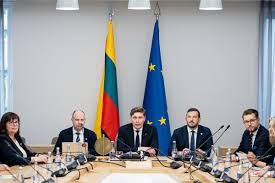
One open question remains: what role, if any, will Šimonytė play in the next cabinet? Sinkevičius has suggested she may return to her previous post as Minister of Social Security and Labor—a position she held before becoming prime minister in August 2025. However, as Delfi.lt notes, no formal decision has been made. Her potential return would signal continuity in social policy, even as the government undergoes a leadership overhaul.
For more on this story, see Latvia’s Drone Alerts Spark Debate Over Crisis Response vs. Lithuania’s Fallout.
The 15-day clock: how Lithuania’s presidency will shape the next government
The resignation triggers a constitutional process with a tight deadline. Under Lithuanian law, President Gitanas Nausėda has 15 days—until July 8—to nominate a new prime minister to the Seimas (parliament) for approval. The LSDP’s dominance in the coalition gives Sinkevičius a strong hand, but his success will depend on whether the Homeland Union and Peasants and Greens Union can reconcile their differences over economic policy. If negotiations stall, Nausėda could face a political crisis, possibly leading to early elections—a scenario that would disrupt Lithuania’s stability ahead of critical EU votes in 2027.
Historically, coalition-building in Lithuania has been a high-stakes game. The last government shuffle in 2024 took 21 days to finalize, and the 2020 crisis over COVID-19 lockdowns nearly triggered a no-confidence vote. This time, the stakes are higher: the new government must address public frustration over corruption probes, rising energy costs, and Lithuania’s role in NATO’s eastern flank amid Russia’s aggression in Ukraine. As EaDaily reported, Sinkevičius has framed his candidacy as a chance to “reset” Lithuania’s politics—but whether he can deliver remains an open question.
What’s at stake? Three risks for the new government
- Economic credibility: The LSDP’s economic record has been mixed, with slow wage growth and a widening budget deficit. The new government must convince markets it can stabilize public finances without alienating its coalition partners.
- Diplomatic realignment: Foreign Minister Bublys’ potential ouster could create uncertainty in Lithuania’s relations with Brussels and Washington. Sinkevičius, a career diplomat, will need to quickly assert his authority.
- Public trust: Polls suggest Lithuanians are weary of political infighting. If the new government fails to deliver on anti-corruption pledges, it could face early elections—derailing Lithuania’s recovery efforts.
The resignation also raises questions about Šimonytė’s future. While she has not ruled out a return to government, her leadership style—seen as more pragmatic than Sinkevičius’—may clash with the new coalition’s priorities. If she opts to leave politics entirely, it would mark the end of an era for Lithuanian social democracy.
What happens next? The timeline and key players
The next 15 days will be critical.
- June 23: Official resignation of the Šimonytė government.
- June 24–July 8: President Nausėda’s 15-day window to nominate a new PM.
- July 9: Seimas vote on Sinkevičius’ candidacy (expected to pass, given the LSDP’s majority).
- July 15: New government sworn in (target date).
Sinkevičius’ biggest challenge will be balancing his party’s left-leaning base with the Homeland Union’s more conservative wing. His foreign policy experience—including his tenure as EU commissioner—could help stabilize Lithuania’s relations with Brussels, but domestic reforms will determine whether his government lasts beyond 2027.
For now, the focus remains on June 23. When Šimonytė’s government steps down, it will hand the reins to a leader untested in domestic politics—but with a clear mandate: prove that Lithuania’s coalition system can still deliver stability.
Find more reporting in our World section.
