
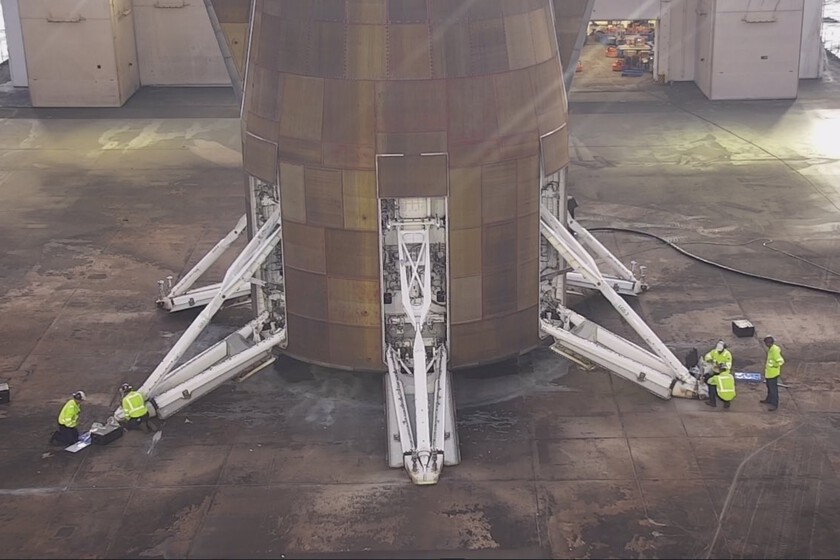
Blue Origin has achieved a historic milestone in reusable rocket technology,successfully landing its New Glenn rocket’s frist stage after its second orbital flight. The November 16th landing marks the first time a rocket utilizing a methane-fueled engine has successfully recovered from orbit, breaking SpaceX’s decade-long monopoly on routine rocket reusability. This achievement signals a meaningful shift in the space launch market, potentially lowering costs and accelerating the pace of innovation as competition increases.
Blue Origin successfully landed its New Glenn rocket’s first stage on a barge in the Atlantic Ocean, marking a significant milestone in reusable rocket technology. The 57-meter tall, 7-meter diameter first stage’s successful return to Earth demonstrates the company’s progress in challenging SpaceX’s long-held dominance in the space launch market.
SpaceX now has competition. For a decade, SpaceX has been the sole player capable of routinely landing and reusing its orbital-class rockets. The company, led by Elon Musk, has completed over 500 landings and reflights with the Falcon 9, establishing a benchmark for reliability in the industry. Only two rockets in history have achieved this feat – both belonging to SpaceX.
The successful landing of New Glenn, achieved on only its second flight, breaks SpaceX’s monopoly on orbital reusability. This advancement is crucial as reusable rockets are key to lowering the cost of space access and accelerating innovation in space exploration.
Founded in 2000 by Jeff Bezos, Blue Origin has been playing catch-up to SpaceX for years. However, this recent achievement represents a “giant leap” forward, as Bezos himself described it, stating Gradatim Ferociter (“step by step, fiercely”). Bezos shared this sentiment on X.
Size and Grace. The New Glenn stands at 98 meters tall and is designed to carry up to 45 tons to low Earth orbit, significantly exceeding the Falcon 9’s 70-meter height and 22-ton capacity. This larger size allows for heavier payloads and more ambitious missions.
The precision landing of such a large rocket on a moving barge in the Atlantic Ocean is a remarkable feat of engineering. It echoes SpaceX’s recent success in catching the Super Heavy booster (the first stage of Starship) with the launch tower’s arms, but demonstrates a different approach to recovery.
And remarkably clean. A notable detail in the landing imagery is the pristine condition of the New Glenn’s exterior. Unlike the Falcon 9 boosters, which return covered in soot from kerosene combustion, the New Glenn appears almost spotless. This difference highlights a key technological advantage.
The New Glenn’s seven BE-4 engines utilize liquid methane and liquid oxygen (a cryogenic propellant combination known as methalox). This fuel combination is not only more efficient and cost-effective but also burns much cleaner, simplifying inspection and refurbishment processes between flights.
With this landing, New Glenn becomes the first methalox rocket to successfully recover a first stage from an orbital flight, preceding China’s Landspace Zhuque 3 (and ahead of Starship, which also uses methalox but has yet to reach orbit).
More to come. Blue Origin is now entering a period of rapid development. In an interview with Ars Technica, CEO Dave Limp confirmed the company aims to complete between 12 and 24 missions in 2026.
The company has announced a launch price of approximately $70 million, comparable to SpaceX’s Falcon 9 pricing. However, the New Glenn aims to compete not only with the Falcon 9 but also with the Falcon Heavy, offering a fully reusable first stage as a key differentiator.
The recovered rocket is slated to carry the Blue Moon Mark 1 lunar lander on its next mission, planned for the first quarter of 2026. This launch is intended to demonstrate Blue Origin’s readiness to NASA for the lunar race.
Image | Jeff Bezos, Blue Origin
In Xataka | Blue Origin has a golden opportunity to overtake SpaceX in lunar travel, and it’s seizing it
