
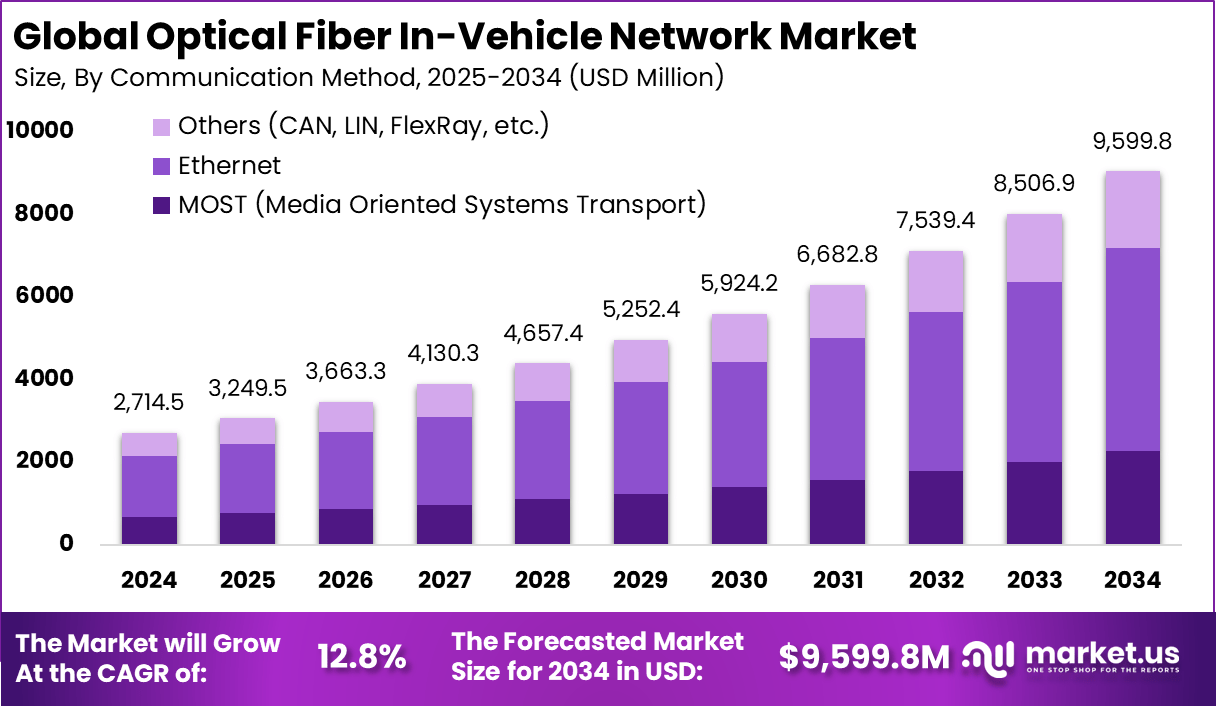
Global Optical Fiber In-Vehicle Network Market Projected to Reach $9.6 Billion by 2034
The global optical fiber in-vehicle network market is experiencing rapid growth, with projections indicating a rise from $2.71 billion in 2024 to approximately $9.59 billion by 2034, fueled by the increasing demand for high-speed data transmission in modern vehicles.
According to a recent report, the Asia-Pacific region currently dominates the market, holding a 45.5% share and generating $1.235 billion in revenue in 2024, largely driven by automotive manufacturing hubs in countries like China. Plastic optical fiber (POF) currently leads material types, accounting for 70.6% of the market share due to its flexibility and cost-efficiency, while multi-mode fiber (MMF) holds a strong 89.8% share for short-distance, high-capacity communication. This shift towards optical fiber is critical as vehicles become increasingly reliant on complex systems for safety, entertainment, and autonomous operation.
Key growth factors include the proliferation of advanced driver-assistance systems (ADAS), vehicle-to-vehicle (V2V) communication, and in-car entertainment systems, all requiring substantial bandwidth. The adoption of electric vehicles (EVs) is also accelerating demand, as optical fibers offer lightweight and energy-efficient communication solutions. Investment opportunities are growing as automotive manufacturers and technology providers focus on improving durability and reducing installation costs. For example, Fujikura Ltd. recently showcased advanced fiber optic technologies at Connected Britain 2025, aiming to accelerate network deployment. You can learn more about the benefits of fiber optics at The Fiber Optic Association.
China’s market is particularly strong, reaching $727.4 million in 2024 with a compound annual growth rate (CAGR) of 15.3%, reflecting its leadership in connected vehicle technologies. Analysts note that passenger vehicles currently dominate adoption due to consumer preference for connectivity and enhanced in-car experiences, but commercial vehicles are also increasing their use of optical fibers for fleet management. The integration of artificial intelligence and the Internet of Things (IoT) in vehicles is further driving demand for robust optical networks, as detailed in this Statista report on the automotive fiber optics market.
Industry experts anticipate continued investment in research and development to improve optical fiber technology and establish industry-wide standards, paving the way for future software-defined vehicles.
